[ 1 ]
INTRODUCTORY NOTE.
The origin of Mormonism seventy-two years ago was undoubtedly the greatest religious fraud ever perpetrated by man. Of three persons it is really difficult to determine on which one rests the greatest amount of guilt. The claims of Joseph Smith do not exceed those of Spalding any more than Spalding's exceeded the truth. And yet, without the manipulations of Sidney Rigdon neither of the former would likely have amounted to anything. Again, it is safe to say that if there had been no Spalding romance, there would have been no Mormonism. As it was, hundreds and thousands were deluded in a short time, and being recruited with converts in nearly every country of the world, two generations of over 500,000 children have been raised up to believe a lie, -- all because somebody did not take enough interest in the matter to dig it up at once.
Church histories and cyclopedias have usually related the crude story and left the reader about where they found him, with sometimes the weight of testimony in favor of Mormonism; avowing at the same time with an air of contentment, that as scarcely any one believes in it, its origin must be false but never taking time to give the proof.
The unexpected finding of the Spalding manuscript seventeen years ago afforded one of the best opportunities the world has ever had to strike the fatal blow to this delusion, but authors and writers outside of Mormon ranks have paid so little attention to it that even this great opportunity has been turned to advantage by the Mormons, who hastened to give to the world their triumphantly perverted story, with the result that many non-Mormon writers, accepting their version of the matter, have laid down pens and abandoned the thought of further effort.
This renewed zeal of the Mormons on the one hand, and this flagging interest on the part of their opponents on the other, has given fresh impetus to the Mormon movement to such an extent that within the last few years their success in this country and elsewhere has been amazing. During the past ten years they have made 96,982 converts in this country -- a net gain of
2 Introductory Note.
about 50 per cent. During the past year alone they gained 65,000 members in the East. They hold the balance of power in seven of the United States and are persistently colonizing in half a dozen others.
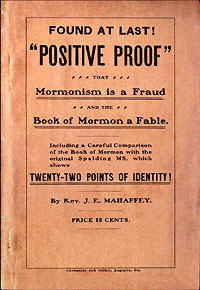
In the face of such figures it seems to be high time for some one to make a thorough investigation of the subject and give to the world the real facts in convenient, compact form. Of course, thousands of volumes have been written, each one containing some part of the evidence -- some of them many parts -- but in most of them several important links are missing, and in no one that I have seen is there a perfectly connected chain containing all the links. This brief work claims to furnish all the links, each one in its place and so perfectly connected as to constitute POSITIVE PROOF that the Book of Mormon is a fable and that Mormonism is a fake.
Most readers will especially appreciate the presentation of 22 points of perfect identity between the Book of Mormon and the Spalding manuscript. This new feature is the result of a careful comparison of the two works, and is especially important and convincing.
All the facts presented in this volume are the result of years of careful investigation and personal research. The list of literature on the subject is immense. It is not deemed worth while here to mention the names of authors consulted. Same will be given in the proper place. Through the courtesy of friends and libraries I have had access to a large range of this literature, some of which is not for sale at any price. Special indebtedness is acknowledged to the Librarian of Oberlin College in Ohio for the loan of a verbatim copy of the Spalding manuscript for examination and comparison with the Book of Mormon, and for other valuable information. Many personal letters of inquiry have been written, and in most cases courteous and helpful replies have been received.
The plain facts gathered from all these sources and by all these methods are so overwhelmingly convincing that I do not hesitate to pronounce it "Positive Proof." Each reader, however, is requested to be his own judge and give as impartial consideration to the testimony as has been exercised in gathering and presenting the facts, then make up his own verdict accordingly.
This volume, unlike my former work on the subject, deals mainly with the origin of the sect. That being determined, it is not thought necessary to pursue the subject further. I wish to
Introductory Note. 3
say, however, that I do not believe the Mormons of today are aware of their error. I believe that they are ignorantly sincere in their beliefs and labors, and nothing in this book is to be construed as a reflection on the honesty or sincerity of those who are living up to the light they have. It is our duty to give them the true story of their delusion and fortify others against being led astray until the entire fraud is wiped from the face of the earth.
With a sincere hope of helping in this great work, and an earnest appeal for the co-operation of those who are likewise responsible for whatever they can do in the same direction, I send forth this volume, prompted by the love of the truth, God and common humanity.
J. E. MAHAFFEY.
THE STORY THEY TELL US.
The Mormons tell us that Joseph. Smith, the founder of Mormonism in 1830, was a prophet. That he was visited by an angel from heaven who talked with him and directed him to a spot where he found the Book of Mormon engraved on gold plates written in what Smith called "Ancient Egyptian" language and bound together by three rings. Smith pretended that by means of two little transparent stones found with the record to be used as spectacles, he was enabled to translate this language into English. The manner of the translation is very suggestive.
Smith says he had been solemnly warned that no other eye should ever look upon these plates. Accordingly, "he sat behind a blanket hung across the room to keep the sacred records from profane eyes, and read off to Oliver Cowdery, who wrote down what the invisible prophet gave as a translation Smith himself
being, as he confessed 'but a poor writer.'"
A farmer by the name of Martin Harris was prevailed upon to furnish the money and the Book of Mormon thus produced was printed in 1830, with the names of Oliver Cowdery, Martin Harris and David Whitmer attached to a statement that an angel of God had come down out of heaven and showed them the
4 Mormonism a Fraud
original plates. This was soon followed by the testimony of eight other witnesses, including Smith's own father and two other brothers, all testifying that Smith had showed them the original plates.
Space will not admit of calling attention to the inconsistencies and contradictions evident at nearly every point in the progress of this new sect, but the one which occurs here may be taken as a sample of scores of others. Mind you, Smith claimed to have had solemn warning from the angel that no other eye but his
should ever behold these mysterious plates; therefore, he must sit behind a blanket "to keep the sacred records from profane eyes" and yet, eleven men, some of whom as will be seen later were addicted to the habit of sheep-stealing and other nefarious practices, testify that Smith had showed them the original plates.
WHITMER'S WONDERFUL "EYE OF FAITH."
As to the value of such testimony, the following extract from a letter written by E. S. Gilbert to Mrs. Ellen E. Dickinson speaks for itself. (New Light on Mormonism, p. 261)
Canaseraga, N. Y., Aug. 1, 1880.
Mrs. Ellen E. Dickinson.
Dear Madam: Your interesting paper in Scribner, entitled "The Book of Mormon," has recalled the following anecdote to my mind, related by my aunt, Mrs. Orill Fuller, who was converted to the Mormon faith in the first days, and emigrated from this State to join the Mormon congregation located, I think, at
Kirtland, Ohio.
It appears that a certificate or affidavit, signed by three witnesses -- David Whitmer, Oliver Cowdery and Martin Harris -- was appended to the "Book of Mormon" to this effect: "We, the undersigned, have seen and hefted the book of Plates," etc. Arrived at her destination, my aunt became acquainted with David Whitmer, who lived there; and wishing to be edified by the account of a reliable eye-witness concerning the appearance and peculiarities of the wonderful plates, she took early opportunity to converse with him on the subject, when, to her amazement, the veracious Whitmer assured her that he had never seen
them.
"Suppose," said he, "that you had a friend whose character was such that you knew it impossible that he should lie; then if he described a city to you which you had never seen, could you not by the eye of faith, see the city just as he described it?" She answered, that however that might be, the certificate attached to the Mormon Bible had given rise to the belief that the three witnesses half actually seen and handled the book of plates.
(Signed) E. S. GILBERT.
Book of Mormon a Fable 5
Mind you, this is the same Mr. Whitmer whose printed statement, in language the most solemn that English can make use of, is still being inserted in every copy of the Book of Mormon. He is the man who asserts in millions of copies of cold type that an angel of God laid the plates before his eyes, and now face to face with Mrs. Fuller he denies ever having seen them at all. This is one of the three original witnesses upon whose testimony the Mormon church is founded. Mrs. Fuller did not remain there long, but renounced Mormonism and went West.
It is said that all three of the original witnesses fell out with Smith, renounced Mormonism and avowed the falsity of their affidavits, but what mattered that to Smith or the superstitious public either? Their second testimony might be judged as liable to be false as the first. Smith soon found four other Whitmers, Hiram Page and three more of the Smith family, who consented to give out their testimony as witnesses, and thus his pretended system of religion was foisted upon the world supported by the slender testimony of these family connections.
Harris, being a farmer of considerable means, had been told by Smith that the Lord had commanded him to furnish the money to bring out the book, but he afterward confessed that he yielded to Smith's request in the hope of making money. Mrs. Harris was not at all in sympathy with the enterprise. She did.
not like the idea of mortgaging their land to raise the $3,000 to publish the book, and one day while on a visit to her sister she remarked that it was all a delusion; to which her husband replied: "What if it is a lie? Let me alone, and I'll make some money out of it." Mrs. Harris refused to join the Mormons, and she and Harris separated and divided their property. She remained at Palmyra until the day of her death; he followed Smith for some time, and after various misfortunes, died in want, as did several other of the prominent characters connected with the early history of Mormonism.
AS TO THE SMITH FAMILY.
Just here a little sketch of the history and character of Joseph Smith may be in order. He was born at Sharon, Vt. The date of his birth is not exactly known, but is supposed to be about the year 1798. His parents moved to Palmyra, central New York, when he was nine or ten years old. They had already settled on young Joseph as the "genius" of the family of nine children. It is said that he could read at an early age, but: could
6 Mormonism a Fraud
not write. His mother enjoyed quite a reputation for "telling fortunes" and was filled with other odd conceits and superstitions. His father dug wells, made baskets, peddled beer and ginger bread, and seems to have been everything by turns and nothing long. Mrs. Smith did washing by the day, hut her employers soon learned that it was not safe for the clothes to remain out after dark. Young Joseph assisted generally and soon had a reputation of being an adept at robbing hen-roosts and orchards. Indeed, the reputation of the Smith family is said to have been of the worst kind. "They avoided honest labor, were intemperate, untruthful and suspected of sheep-stealing and other nefarious practices." From all accounts they were the terror and torment of the neighborhood.
These accusations are generally denied by Mormons, but Smith himself partly admitted them, affirming that he had "never done anything so bad as was reported of King David, the man after God's own heart." Like his present followers now tramping through the country from house to house, scattering their pernicious books and sowing seeds of heresy that threaten the religious, social and political life of the nation, when assailed on the subject of polygamy, they point: to the Bible for examples, and try to make the impression that God approved of the wicked practices of ancient times.
From an old book in the Astor Library we learn that on November 3rd and 4th, 1833, sixty-two male residents of Manchester, Ontario Co., N. Y., made an affidavit that the family of Joseph Smith, Sr., with whom the Book of Mormon originated, are a lazy, indolent, intemperate set, whose word is not to be
depended upon. Joseph Smith, Sr., and his son Joseph, in particular, were considered entirely destitute of moral character, and addicted to vicious habits.
Very early Mrs. Smith instructed Joseph to set up claim for miraculous powers and provided him with a peculiar little stone afterward called the "peek stone," which had been in the family for generations. With this little transparent stone he pretended to see sights, buried treasures of gold, silver, stolen property, stray cattle, etc., and with the assistance of his witch-hazel rod, he told where wells should be dug to get water. In these ways, decked in his white stove-pipe hat, he fooled the credulous and superstitious and eked out a precarious subsistence.
For some time he had a band of diggers who slept by day and roamed at night to such places as he designated to dig for hidden
Book of Mormon a Fable 7
treasures, but his rules were of such a character as to easily break the "charm," and upon failing to find the treasure he affirmed that it had been spirited away to some other place, and that he must again consult the "peek stone" or the witch-hazel rod to see where it had located. When he wanted fresh meat for his family he told the diggers that in order to insure their success it was necessary for them to kill a black sheep as a sacrificial offering before going to work.
If the reader is inclined to wonder how such a man with such methods gulled the people and secured their attention as he did, just remember where his role was acted and when it was done, especially the latter. Eighty years have wrought wonders, but there is a good deal of such superstition and gullibility remaining
in people to this day. This same Smith is still gaining followers and making proselytes to a life more serious than that of plundering at night in other people's fields and sheep pastures.
This state of affairs continued for some time, and his reputation extended to the adjacent counties which he often visited. He often spent weeks and months away from his immediate community, and finally disappeared for four years, which have always been involved in mystery, and not until several years after were any traces of his whereabouts known to his acquaintances. It is now known that during that time he was in both Onondaga and Chenango counties, for his name appears in the criminal records of both of these counties as a vagabond. He is also known to have been in Broome county and at Harpersviile, Pa., but it was during his stay in Onondaga Valley, while working for William H. Sabine, about the year 1819 or 1820, that he fell upon his final gigantic scheme which resulted in the publication of the Book of Mormon and the projecting of the greatest and
slickest religious fraud that has ever disgraced any civilization.
Just about this time Smith became very much interested in the various theories that were afloat attempting to account for the peopling of the American continent. The discovery of ruined cities and temples in Central America, and the relics of pottery, bricks, and the stumps of axe-cut trees buried deep under the surface of the Mississippi Valley, together with traditions that had been collected from the Indians, made the subject a common topic of conversation throughout the country. Almost any one who had a theory to advance on this subject could get a hearing in almost any crowd at almost any time.
A man by the name of Solomon Spalding, highly educated and
8 Mormonism a Fraud
deeply interested in the subject, and being unable to engage in other employment, conceived the idea of writing a romance elucidating his theory, hoping to launch the book on this rising tide of public interest and make money out of it. He spent most of his time and nearly all of his thought for the space of seven years writing and re-writing the manuscript for his book, but finally died without ever being able to publish his long cherished story. As this matter is so important a factor in the subject under consideration the reader will doubtless appreciate a brief glance at the life and history of this man and his writings.
THE REAL HERO OF OUR STORY.
Solomon Spalding was born at Ashford, Conn., in 1761. He came of a highly respectable English family, was educated at the Plainfield, Conn., Academy, graduated at Dartmouth College in 1785 and graduating in theology in 1787, he became a preacher in some obscure New England town, and married Miss Matilda Sabine of Pomfret, Conn. In a few years he retired from the ministry on account of ill-health. The next we hear of him he is principal of an academy in Cherry Valley, N. Y., where he remained until persuaded by his brother, John Spalding, to remove to a little town in Ohio, now known as Conneaut, Ashtabula Co. Here in 1809 the two Spaldings and Henry Lake built an iron foundry and conducted a successful business until the war of 1812, which ruined them financially.
During these three years Spalding was almost an invalid, and spent much of his time in his own house, reading and writing. Possessed of a fine education and habits of study he naturally took to this as pastime, and continued it until his death in 1816. He was especially fond of historical studies, the writing of essays and romances, and given to talking with his neighbors about what he had read or written. He became very much interested in the earth-mounds near his residence and determined to have one of them investigated. A large tree on this mound was thought to be one thousand years old. It is said that he found buried in this mound various evidences and relics of a prehistoric race, mingled with human bones of gigantic skeletons. These discoveries excited him greatly and fired his imagination. He had long had a theory as to the peopling of this country by a race which inhabited the entire Continent, possessing the refinements of civilization, and that in some unaccountable manner they had all perished except the few Indians that remained.
Book of Mormon a Fable 9
These relies secured by his workmen seemed to confirm his theory, and he immediately decided to write a romance embodying his views. He was not the first, however, to indulge in this sort of speculation. Over forty authors, half of whom are Americans have been cited as writing on this subject, some of these as far back as the seventeenth century.
Mr. Spalding conceived an idea which he thought would secure for his romance the attention which he desired. Accordingly, he pretended that among the relics discovered by his workmen he had found a box containing a roll of parchment written in the Latin language, giving an account of a party of Roman sea voyagers, who left Rome in the time of Constantine, but by storms were drifted ashore on the American continent. He pretended that one of their number had made and buried this record of their travels, customs, wars, etc., etc., and that his romance was a translation of this record.
Finding that the plot of his story as to the time and place of their departure would not exactly harmonize with some other notions that he had, and that a question might he raised as to the preservation of the parchment for so long a time, he altered the plan after writing a portion of the story, and instead of starting them from Rome for their travels, he fitted them out and started them from Jerusalem with Lehi and his four sons under Divine direction, and with "brass plates" on which to make and preserve the records of their travels. Mr. Spalding pretended that his workmen had discovered these plates covered with hieroglyphical writings, and that he had merely translated the story of the wanderings and sufferings of this people as it had been inscribed on the plates.
This pretense, of course amused Spalding's friends and acquaintances very much, but it has resulted in deceiving thousands who will never known in this world that it was never intended for anything but a romance; though Spalding did once jokingly remark that in a hundred years it would be accepted as veritable history.
As proven by abundant testimony, a part of which will be noticed later, Spalding adopted the literary style of the Bible in re-writing his story according to the new plot, which dated back into Bible times and really pretended that it was a continuation of the Bible from the times of Zedekiah. His knowledge of the
classics and histories of olden times enabled him to coin and introduce the odd names which were noticed and remembered by
10 Mormonism a Fraud
his friends as he frequently entertained them by reading what he had written. Such names as Nephi, Mormon, Lamanite, Moroni, Lehi, etc., were remembered distinctly by members of his family and many of his friends and neighbors to whom he frequently read his story, all of whom were greatly impressed with
its peculiarities and apparently amazed at its plausibilities. He finally called it: "The Manuscript Found," -- that is, a written history of a lost people, found in an earth-mound, purporting to be an account of the peopling of America by the lost tribes of Israel.
At that time it was quite a distinction for a man to write a book and a still more difficult one to get it published after it was written. It appears that the entire community became very much interested, partly in the cleverness of the story, and partly out of sympathy for a man in ill-health who could do nothing
else and had nothing else to look to for support. He was encouraged to push its completion for publication. This pleased him very much. The war had blasted all his hopes of fortune in the iron business, his health was gone, and being embarrassed with debt (which doubtless embarrassed others also), his last
hope lay in the success of his book if it could only reach the
public in proper form.
At times he was very sanguine of success, and there are some things which indicate that he was not very particular as to the extent of seriousness with which his book should be received by the public. His joking remark to Nathan Howard, a neighbor, that probably in a century from that time his account of the
early inhabitants of America would be accepted as a veritable history, was a prophecy that was fulfilled in less than a fourth of that time. A nephew of Spalding named King told one Hale, a school teacher, that he could start a new religion out of his uncle's manuscript novel and make money. Some think that
Spalding himself was not a man who would be deterred by conscientious scruples from practicing such a fraud, if he believed it would be more profitable in that way; but from all I can learn of the man I am not inclined to this opinion. If this had been his purpose he would have acted differently in the beginning, and would not have read and talked about his romance so freely to the public.
He was confident of making money out of it as a novel, and with this in view he borrowed money and removed to Pittsburg, Pa., where he had a preacher friend named Patterson, who was
Book of Mormon a Fable 11
a publisher, to whom he submitted a copy of his manuscript for inspection immediately upon his arrival, with the hope that Patterson would publish the book. After some discussion of the matter this copy was turned over to Silas Engles, the foreman and superintendent, whose business it was to decide upon the propriety, or otherwise, of publishing manuscripts offered to the book department, which was in a separate building. Mr. Spalding called again in a few days, but the manuscript could not be found. He was given to understand that the matter was still under consideration, but that Mr. Patterson wanted him to guarantee the expense of printing, which of course, Spalding was not then able to do. One day Mr. Patterson finally said to him: "Polish it up, finish it, and you will make money out of it." A young man by the name of Rigdon was in some way connected with this department at the time, and Mr. Spalding always believed that he had it out of the office when it could not be found.
Encouraged by Patterson's remark, Spalding left this duplicate copy of the manuscript there for further consideration, and in order to lessen the expense of living and secure some additional employment while he was engaged in "polishing up" and re-writing his romance, he removed in 1814 to Amity, Pa. Here at one time he kept a store, then a public-house, and again became the center of attraction among the neighborhood listeners to his talk and the reading of his peculiar writings. Here the story was polished and re-written, and from Amity in 1816, Spalding again journey [sic] to Pittsburg for the purpose of securing its publication.
Spalding's wife and daughter both assert that about this time Patterson requested him to "make out a title page and preface." This seems to indicate that they had about arrived at some agreement for its publication, and the following letter shows that he complied with this request. The letter was written to Mrs. Ellen E. Dickinson (New Light on Mormonism, p. 240), by Joseph Miller, who lived at Amity during Spalding's stay there. He gives some interesting facts as to his knowledge of Spalding and his doings while at Amity. He says:
"I knew the man very well, was intimately acquainted, often heard him read from what he called his MS., he came to our house and wanted me to go with him and bail him for fifty dollars as he needed the money, and while on the road he told some of his history. He said while living in Ohio he lost his health and in looking over the country where he lived he discovered
12 Mormonism a Fraud
some mounds, they appeared to be the work of an ancient race of people and he concluded he would write their history or a fictitious novel of the people that built the mounds. After living there, he told me he moved to Pittsburg and while there he applied to Mr. Patterson to have his novel printed for the purpose as he stated to help him take care of his family. Patter[son] said he, Patterson, would publish it, if he, Spalding, would write a title page. He told me he kept a little store in Pittsburg. He then moved to Amity, leaving a copy of the manuscript in Patterson's hands. After being at Amity some time he went back to Pittsburg, took his title page. He called it the The Lost Manuscript Found. When he went to Pittsburg the manuscript could not be found. He said there was or had been a man by the name of Sidney Rigdon who had stole it. Spalding did not die at my house as you have it, but died at a house he had rented in Amity and kept as a public-house or tavern. He was a man fully six feet high, rather stooped forward a little, of sober visage, very reserved in conversation and very candid apparently in all his dealings, and I think a very good man. It used to he very common at that day to gather in at the public house in the evenings and often Mr. Spalding would read from his MS. to entertain us. I had the Book of Mormon in my house for about six months for the purpose of comparing it with my recollections of the Lost Manuscript Found, and I unhesitatingly say that a great part of the historical part of the Book of Mormon is identical with the MS. and I fully believe that the MS. is the foundation of the whole concern.
Yours truly,
JOSEPH MILLER."
This same Mr. Miller tells how he nursed Mr. Spalding in his last illness, made his coffin, helped to bury him and settled up his slender little estate, which probably did not replace the $50 he loaned him about the time of his second journey to Pittsburgh with the "polished" copy, title page, etc., of his manuscript. Spalding was buried in the village graveyard at Amity, Pa., and the humble head-stone which marks his grave has been almost entirely chipped away by relic hunters of this and foreign lands.
Thus far we have traced the history of the Spalding romance through the different stages of its preparation by the author, to the hands of Patterson, the publisher in Pittsburg, and after considerable delay its publication was promised upon certain conditions, which Mr. Spalding was evidently making an effort to comply with when he moved to Amity to "polish up" the story, and after which he again journeyed to Pittsburg, carrying with him the polished story, and according to Mr. Miller, the title page and preface. Upon his arrival in Pittsburg the
Book of Mormon a Fable 13
old copy which he had left with Patterson could not be found and Mr. Spalding expressed his belief that young Rigdon, who was connected with the office at the time, had stolen it. This state of things aroused Spalding's suspicions to such an extent that further negotiations with Patterson were suspended. He immediately returned to his home at Amity, carrying with him the polished story, and being tired and disappointed at these repeated failures, he sank into an illness which soon culminated in his death, October, 1816.
The following extract from a letter written by Mrs. McKinstry, Spalding's daughter, and sworn to by her before a Notary Public, furnishes the next period in the history and travels of Spalding's writings. She says:
"In 1816 my father died at Amity, Pa., and directly after his death my mother and myself went to visit my mother's brother, William H. Sabine, at Onondago Valley, Onondago county, N. Y. * * * We carried our personal effects with us, and one of these was an old trunk in which my mother had placed all my father's writings, which had been preserved. I perfectly remember the appearance of this old trunk, and of looking at its contents. There were sermons and other papers, and I saw a manuscript about an inch thick, closely written, tied with some of the stories my father had written for me, one of which he called the 'Frogs of Wyndham.' On the outside of this manuscript were written the words: 'Manuscript Found.' I did not read it, but looked through it and had it in my hands many times and saw the names I had heard at Conneaut when my father read it to his friends. I was about eleven years old at this time."
That this old hair-covered trunk, containing the various productions of Mr. Spalding, -- novels, sermons, essays, etc., was carried to Mr. Sabine's house, has never been denied, and that it also contained the "polished up," that is, the last and final writing of Spalding's story, cannot be denied in the face of the
testimony furnished by Spalding's wife, his daughter, Mr. Sabine's family and others who saw it and talked about it together off and on during all this time. That this old trunk containing all these writings was put in the garret at Mr. Sabine's house in 1816, and remained there until some time after 1820, a period of four years or more, and that it was accessible to the Sabine family, their friends and visitors, or any one else who might chance to be in the house, there is not the shadow of a doubt.
Mrs. Anna T. Redfield testifies that in 1818 she was principal of the Onondago Valley Academy, and resided in the house of
14 Mormonism a Fraud
William H. Sabine, that she heard Mrs. Spalding and the family talk of a manuscript in her possession, which her husband, the Rev. Mr. Spalding had written. That it was so often mentioned that she remembered well the substance and peculiarities of the story. Mrs. McKinstry is quite sure that Mr. Sabine read the manuscript while it was in his house. It is just at this point that the tracks of Joseph Smith first cross the path of the Spalding manuscript, and while his part in the story-has been laid aside for some time, the facts demand that he now be recognized and looked after, at least for a little space.
JOSEPH SMITH AGAIN.
As has already been noted, Smith was in Onondago county about the time of Mrs. Spalding's stay at Mr. Sabine's, as his name appears in the criminal records of 1817. An old man testifies that Smith was about this time employed to locate wells and look for gold with his "divining rods" of witch-hazel and his "seer-stone" in that community. He was put in the Onondago county jail for "vagrancy and debt" when he was 20 or 22 years old. The jail was then at Onondago Hill, two miles from Mr. Sabine's house. Mr. Sabine was a lawyer, and it was probably a few months after this that Smith was employed by Mr. Sabine as
teamster and man for out-door work, taking his meals in the kitchen, hearing the talk of the family, and probably sleeping in the garret with the old trunk. It is quite likely that Smith got in possession of a portion of Spalding's writings at this time, but the manner in which he followed up the trunk suggests that he took charge of its contents on the installment plan.
Mrs. Spalding had by this time set up courtship with a Mr. Davison of Hartwick, and her interest in her dead husband's writings (what little she had) was fast being eclipsed by the attentions of this gentlemen. They married in 1820, and all of Mrs. Spalding's personal effects, including the old trunk and its contents, had to be moved to the residence of her new husband at Hartwick, N. Y., back into the section of Smith's old haunts and almost his immediate vicinity. Neither the mother nor the daughter in their new relations gave the same attention to Mr. Spalding's literary productions that they had formerly given. The old trunk was carried, but it was now beginning to be looked upon as rubbish, and it was a very easy matter for Smith, either while living the team in moving, or sometime after its arrival in the new quarters (which happened to be an old closet somewhere
Book of Mormon a Fable 15
in Mr. Davison's house), to relieve the old rickety trunk of whatever suited his taste.
He would probably not have been suspected of such a thing if he had not immediately after this talked and acted in such a way as cannot be accounted for upon any other supposition. For, as we shall see, there was ample opportunity afforded him through Rigdon to take the part he did in the perpetration of the Mormon fraud without ever stealing the manuscript himself. A number of witnesses testify that soon after this, and previous to his ostensible discovery of the "plates," he advocated the Spalding views and called many of the names contained in that story. At one time he professed to have found a book buried in white sand, but was not permitted to show it, as he said an angel had warned him that it would be death to any one else to look upon it. This all happened previous to his acquaintance with Rigdon and previous to his pretended opening of the "plates" which he says was on the night of September 22, 1827.
Add to this date the several years claimed by Smith to have been occupied in his pretended translation and preparation of the work, which he says was delayed at one time for the space of ten months on account of the abstraction of several sheets by Mrs. Harris, who it is said could not be induced, by threat or cajolement, to give them up, and the following testimony from Mr. Thurlow Weed looks very suspicious. Mr. Weed says:
"In 1825, when I was publishing the Rochester Telegraph, a man introduced himself to me as Joseph Smith, of Palmyra, N. Y., whose object, he said, was to get a book published. He then stated he had been guided by a vision to a spot he described, where, in a cavern, he found what he called a golden Bible. It consisted of a tablet, which he placed in his hat, and from which he proceeded to read the first chapter of the 'Book of Mormon.'
I listened until I became weary of what seemed to me an incomprehensible jargon. I then told him I was only publishing a newspaper, and that he would have to go to a book publisher, suggesting a friend who was in that business."
Smith afterwards made a second call, but was again refused. (New Light on Mormonism, 260.) Mind you now, Mr. Weed says this was in 1825, and yet, when Smith's plans were finally perfected and means secured for the publication of the book in 1829, he affirmed that it was on the night of September 22, 1827.
16 Mormonism a Fraud
that these records were first committed to him. Thus it appears that he was seeking a publisher and reading it out of his hat two years before it was dug out of the ground, and four years before the "translation" was completed. These facts and others that might be given begin to furnish positive proof that if Smith did dig his treasure out of the ground in 1827, it had not been buried there more than two years.
As to the exact time and manner in which Smith first got in possession of the Spalding manuscript, of course no one but him may ever exactly know. About the nearest we call come to it, according to the most reliable evidence, sifted from direct testimony and circumstances, is that:
First, during the stay of the trunk at Sabine's house, from 1816 to 1820, the manuscript was there, and it appears that Joseph Smith while working as teamster for Mr. Sabine, had become interested in it.
Second, during this time Mrs. Spalding visited her father at Pomfret, Conn., leaving her daughter and all her personal effects, including the old trunk, at Mr. Sabine's house about the year, 1819.
Third, Mrs. Spalding married Mr. Davison in 1820, and sent for her things, including the old trunk, to be moved to her new home at Hartwick, Joseph Smith probably being the driver of the team that carried the things to her.
Fourth, Joseph Smith is next visible, according to his own statement, in the employ of Mr. Stowell, near Hartwick, where the trunk said to contain Spalding's writings was carelessly deposited.
Fifth, shortly after this time Joseph Smith returns to Palmyra and begins preparations, with great caution, to bring before the public his fraudulent scheme.
One day at dinner time he told his family that in passing through a grove, he found a book in some white sand. They asked to see the book, but he said that the angel which told him of its locality had forbidden him to show it, and that any other person who looked on it would surely die. It was a little after
this time that he first applied to Mr. Thurlow Weed to get it published.
Sixth, soon after this the most valuable contents of the old trunk appear to be missing, and the manuscript which Mrs. Clark saw when the old trunk was moved to her father's house, "looked soiled and worn on the outside," and according to her
Book of Mormon a Fable 17
statement, was dry reading and did not contain the words Mormon, Maroni, etc. This of course, was the manuscript which was turned over to Mr. Hurlburt a few weeks later, but the finished manuscript could not be found.
It is safe to say that Smith did not get all of Spalding's writings at the same time, but that he did get first and last, about all that was of any particular value to him. It was doubtless his interest in this old treasure that accounts for his digging
around after it from place to place, ostensibly in the employment of some neighbor near by.
Those who claim that this old trunk and its contents were too carefully guarded to admit of Smith or any one else stealing anything from it, will find it difficult to explain how it was that in so short a time after Mrs. Spalding's marriage to Mr. Davison the old trunk was again put aside and contained absolutely nothing. What went with all that mass of writings? And how did it go?
Mrs. (Spalding) Davison soon found it necessary to break up from, her new home and take up her abode in Munson, Mass., with her daughter, who had married a Dr. McKinstry, and the old trunk, a feather bed and an old bureau were stuck away somewhere at her cousin's, Mr. Jerome Clark, in Hartwick, and
in a short while everything in the old trunk had disappeared.
The following extract of a letter from George Clark, a son of Jerome Clark, at whose house the trunk was left, gives some idea of how the trunk and its contents were guarded. About a year after Mrs. (Spalding) Davison left the things at Clark's, she wrote him to sell her personal effects and remit to her the proceeds, which he did, and as to the trunk, he says: "The old trunk still remained in the garret when I sold the farm, and was given away, to whom I do not remember. It was an old rickety, moth-eaten hair trunk, and entirely worthless. There was nothing whatever in it." There is not to be found any where single fragment of all that mass of Spalding's writing except that first fragment of the "block-out" of the original story written at Conneaut, which is now in the Library of Oberlin College, and as some may be anxious to know just how it happened to be preserved, its history will be given here.
Soon after the arrival of Mrs. (Spalding) Davison at Munson to live with her daughter, the whole country became agitated over a new religious faith which had suddenly sprung up, called Mormonism, and the report that it was founded on Solomon
18 Mormonism a Fraud
Spalding's romance quickly followed, to the great surprise of all who knew him. Then a report was carried directly to these ladies at Munson, how that on one occasion when the Book of Mormon was being read to a vast assemblage at Coneaut, Ohio, by an "elder" who had accidentally straggled into that town, John Spalding and Mr. Lake, the farmer partners of Solomon Spalding, and many others present, recognized its similarity to the Spalding romance, which they had heard him read time and again in that very locality years ago. These reports excited them considerably, and Mrs. McKinstry says she remembers how her mother talked on the subject, recalling the firm conviction of Mr. Spalding that Sidney Rigdon had appropriated his manuscript while it was in Patterson's office at Pittsburg. (See letter in Scribner's Magazine, Aug., 1880.)
During this controversy between Spalding's friends and the Mormons as to the real authorship of Smith's new book, inquiry was made as to the whereabouts of Spalding's writings at that time, with a view of securing the Spalding manuscript for comparison with the Book of Mormon. The Mormons themselves, evidently knowing the situation better than any of their opponents, readily consented to make the comparison, and a committee was appointed to get the manuscript. This committee employed Mr. D. P. Hurlburt to do its work. It is difficult to say whether Hurlburt's interest in the matter at this time was in behalf of the new faith or against it, The fact that he was a Mormon about that time is well established, but whether he :had renounced the faith previous to this undertaking will probably never be known. However, he was willing and anxious to go, and it seems that all parties were willing that he should.
The ease and directness with which he went about the matter indicate that he was provided with considerable private information. He went directly to the residence of William H. Sabine, Onondago Valley, N. Y., and secured a letter of introduction to Spalding's widow at Munson, Mass., and also a request from Mr.
Sabine, that she give Mr. Hurlburt an order to Mr. Jerome Clark for the manuscript which was thought to be in the old trunk at Mr. Clark's house in Hartwick. Mrs. McKinstry says that her mother was greatly agitated over the arrival of Mr. Hurlburt with this request, and hesitated for some time before complying. But upon being assured by Mr. Hurlburt that her brother, Mr. Sabine, was anxious to have the fraud exploded, and that he (Hurlburt) had made the trip with that in view, she reluctantly consented and gave him the order.
Book of Mormon a Fable 19
With this order he hurried back to Mr. Clark, and upon examining the old trunk which only a short time ago contained all the numerous writings of Mr. Spalding, the only thing that could be found which in any way resembled a manuscript for a book, was the fragment of the original block-out of the story as it was first written while he was connected with the iron foundry in Coneaut. Not one of the subsequent re-written copies, nor even the 'polished-up" copy which had finally been prepared for Mr. Patterson, but was not left with him for reasons already given, -- not one of these copies could be found. The charge that Hurlburt obtained an additional copy of the manuscript and sold it the Mormons or made some other disposition of it is utterly without any foundation.
This fragment block-out of Spalding's story was carried by Mr. Hurlburt back to Coneaut and, it is said, compared with the Book of Mormon publicly, but the superficial manner in which it was done, and the crudeness and incompleteness of this fragment copy, resulted in a victory for the Mormons, and it seems added new force to their enterprise. Mr. Hurlburt had solemnly promised to return the manuscript to Mrs. Davison in a short time, but was so disappointed on finding that it was not the copy he wanted, he loaned it to Mr. Howe and took no more interest in it. Unfortunately this old fragment of Spalding's first writing disappeared from view without being critically compared with the Book of Mormon and was lost for over fifty years, but finally turned up in Honolulu, S. I., in 1884, and now has its final resting place in the Library of Oberlin College, Oberlin, Ohio. The following letter furnishes additional light on its seclusion for fifty years:
1325 Panchau St., Honolulu, Hawaii, Nov. 8, 1901.
Rev. J. E. Mahaffey.
Dear Sir: My father had the Spalding manuscript for more than 50 years without knowing that it was among his papers. He discovered it while looking through some old documents being in his possession, to see what they might be. He was never quite certain how it came to be in his hands but believed that it was among a lot of manuscripts transferred to him with the other property when he bought out the Painesville Telegraph. I think there is no doubt it came to him with other documents, such as accumulate in a printing office, when he bought the paper from Mr. Howe. I have no further information
20 Mormonism a Fraud
of any importance. The manuscript is now deposited in the Library of Oberlin College.
Yours truly,
WILLIAM H. RICE.
Dr. D. P. Hurlburt has been severely censured by many who have charged him with dishonesty and many other unkind things utterly without any foundation, but the story of the manuscript as told in the above letter confirms the sincerity
and truthfulness of the following statement, which Mr. Hurlburt first gave to the world years ago, and which he has repeated from time to time when requested. The following is probably the last statement that he ever gave out:
Gibsonburg, Ohio, January 10, 1881.
To all Whom it May Concern:
In the year eighteen hundred and thirty-four (1834) I went from Geauga Co., Ohio, to Munson, Hambden Co., Mass., where I found Mrs. Davison, late widow of the Rev. Solomon Spalding, late of Coneaut, Astabula Co., Ohio. Of her I obtained a manuscript, supposing it to be the manuscript of the romance written by the said Solomon Spalding, called "The Manuscript Found," which was supposed to be the foundation of the "Book of Mormon." I did not examine the manuscript until I got home, when, upon examination, I found it to contain nothing of the kind, but being a manuscript upon an entirely different subject. This manuscript I left with E. D. Howe, of Painsville, Geauga Co., Ohio, now Lake Co., Ohio, with the understanding that when he had examined it he should
return it to the widow. Said Howe says the manuscript was destroyed by fire, and further the deponent saith not.
(Signed) D. P. HURLBURT.
Modern developments have demonstrated the truthfulnes of Mr. Hurlburt's statement, and the following letter written to him by Mr. Howe, August 7, 1880, is worth preserving in the same connection. Mr. Howe says:
"Dear Sir: Just received your line, calling my attention to an article in Scribner, on the origin of that old Mormon Bible. Hardly a year passes that I do not receive more or less inquiries, some of which seem to reflect on your honesty in regard
to the manuscript obtained from, that old trunk, that: was all explained truthfully in the book I published, as I then believed, and have ever since, that Spalding's 'Manuscript Found' was never found or received by you. I have no manner of doubt, but altogether a different manuscript on a very different subject. It was in my possession till after the publication of 'Mormonism
Book of Mormon a Fable 21
Unveiled,' and then disappeared and lost, I suppose, by fire."
These letters also give us some idea of the opinion which prevailed as to the likeness or unlikeness of the Book of Mormon to the manuscript which Hurlburt had obtained, and while of course, there is always considerable difference between an author's first block-out of a story and the finished story, and especially one that has undergone so many revisions and change in the plot as this one had, yet we shall see later whether this manuscript did really contain "nothing of the kind," and whether it was "a manuscript on an entirely different subject" as stated by these men and others, evidently upon very careless and superficial examination and comparison.
Let us see now. We have traced the fate of the finished manuscript from the death of Spalding to the second marriage of his widow, and found that Smith was closely associated with the old trunk in which it was deposited. His stay at
Sabine's house while it was there, and the probability of his having charge of the wagon which moved her things to Hartwick, together with the evident carelessness with which the old trunk and its contents were now beginning to be regarded by Mrs. Davison as a new bride, -- all these things seem to afford Smith abundant opportunity to put himself in possession of some of this old rubbish. Add to this his ostensible employment at Mr. Stowell's near Hartwick, which afforded him additional opportunity to secure whatever might still be to his liking from the old neglected trunk, and note the fact that he next turns up as having "found a book in some white sand" and soon applies to Mr. Weed to get it published. All these things occurring previous to his pretended finding of the "plates" and previous to his acquaintance with Rigdon, begin to indicate what became of Spalding's writings and the use that Smith intended to make of them.
It must be remembered, however, that while Smith possessed a wonderful amount of tact and shrewdness which had already won for him prophetic notoriety among the ignorant and superstitious, yet he was lacking in that intelligence which was necessary to make his scheme a success. This must be supplied from some other source, and to this source we must now turn our attention.
22 Mormonism a Fraud
SIDNEY RIGDON AND PARLEY PARKER PRATT.
We now propose to show beyond the shadow of a doubt that Sidney Rigdon was the master mind in the preparations for Smith, the "Peeker" and money digger, to pretend the discovery of the golden plates in Cummora Hill, and the final planning of the scheme of Mormonism.
Mormon objectors assert that even if Rigdon did have one of the Spalding manuscripts in his possession, it could have been of no service to Joseph Smith in preparing the Book of Mormon, since as they claim, no possible connection between Rigdon and Smith has ever been shown to exist prior to 1830. We propose to show that Smith and Rigdon were intimately associated for four years prior to 1830, and that their association was through such a medium and of such a nature as leaves no doubt as to the object they had in view.
The first knowledge that Smith and Rigdon had of each other was doubtless through Parley Parker Pratt, who was born at Burlington, Ostego Co., N. Y., April 12, 1807. In his sixth year he went to reside with his father's sister named Van Cott, which name afterward became prominent in the early history of Utah. In 1825 Pratt spent a few months in Wayne (formerly Ontario) county, New York. This was the same county in which Smith was at that time enjoying much newspaper notoriety by the use of his "peek-stone' and other implements of necromancy, by which he worked the gullible and superstitious of the entire neighborhood, Pratt at this time was a peddler, traversing the country at intervals, and it is said, knew almost everybody in western New York. His recorded connection with the Wells family, who were Smith's neighbors and friends makes it certain that he knew Smith in 1825.
Pratt frequently extended his trips into northern Ohio and Pennsylvania, and as will be seen, was acquainted with Rigdon, who for some time had been itinerating from one denomination to another as a preacher. About this same time Smith pays a visit to relatives in Harpersville, Pa., and Rigdon is said to have
made "mysterious journeys" to that section at the same time. Just where and when they first met may be impossible to say, but that they did meet about that time there is no doubt, if any confidence can be placed in recorded facts.
It was on this same visit at Harpersville, Pa., that Joseph Smith was married to Emma, the daughter of Isaac Hale, January
Book of Mormon a Fable 23
18, 1826," and Sidney Rigdon performed the ceremony. This fact seems to indicate that they not only did meet four years prior to 1830, and that they were not only acquainted with each other; but that for some reason Rigdon's services on this occasion were preferred above others, and that he put himself to considerable trouble in order to be on hand. The protracted absence of Smith and Rigdon from their accustomed haunts at this time has been substantiated by several persons familiar with the matter at the time, and there is no doubt that here, as Rigdon once admitted, they laid their plans and made preparations for the coming great discovery which Smith was soon to make at Cummora Hill.
Just here may be as good a place as any to settle the question as to Rigdon's possession of the manuscript which Spalding left at Patterson's printing office. A few glimpses into Rigdon's previous history will help us to understand his part in the story. He was born February 19, 1793, in Piney Fork of Peter's Creek, St. Clair township, Allegheny county, Pa., about eight miles from Pittsburg, and remained on the farm with his parents until eighteen years old. He joined the Baptist church under the pastorate of Rev. David Phillips, May 31, 1817, and "began to talk in public on religion soon after his admission to the church, probably at his own instance, as there is no record of his license." The next year he left the farm to take up his residence and the study of Divinity with Rev. Andrew Clark at Sharon, Pa., where in March, 1819, he was licensed as a Baptist preacher.
Rigdon's preaching from place to place, apparently having no settled charge, except about two years in Pittsburg, is too tedious and tasteless to spread out on these pages. His preaching was so tainted with what turned out to be Mormonism that in 1824 he was expelled from the Baptist church. Thereupon Rigdon, Alexander Campbell and Walter Scott proceeded to organize the "Christian Church," otherwise known as "Disciples" or finally "Campbellites." It was during this period of roaming around through the country making "disciples" to his new faith that he was called upon to marry Joseph Smith and Emma Hale in 1826. *
As to the genuineness of Rigdon's conversion and pious intentions
___________
* Some say 1827, but the very well established fact that he returned with his bride in 1826, deserves consideration.
24 Mormonism a Fraud
when he joined the Baptist church, the following item taken from Dr. Winter's historical sketch of the first Baptist. church of Pittsburg is sufficient He says: "When Holland Sumner dealt with. Rigdon for his bad teachings, and said to him: 'Brother Rigdon, you never got into a Baptist church without relating your Christian experiences.' Rigdon replied: 'When I joined the church at Peter's Creek, I knew I could not be admitted without an experience, so I made up one to suit the purpose; but it was all made up and was of no use, nor true.' This I have just copied from an old memorandum as taken from Sumner himself." This item was published thirty-four years before Rigdon's death and yet he never did deny it.
According to his own testimony, therefore, Rigdon had some other object in view when he suddenly "made up" the tale of his miraculous conversion," as he says, "to suit the purpose," and applied for membership in the Baptist church, early in 1817. We venture to assert and propose to prove that this "purpose"
was to seek an opportunity to ventilate his newly acquired religious views, deducted from the Spalding ,manuscript which had fallen into his hands the year before, and this sort of religious dishonesty establishes his willingness to become party to the religious fraud which we shall see is charged against him.
Let us inquire, first: Did Rigdon have any opportunity to steal Spalding's manuscript from Patterson's office? No one will likely ever know upon what ground Spalding's expressed suspicion that Rigdon had stolen it rested. Probably it was Rigdon's great interest in it when first submitted, and his close intimacy with Lambdin, in whose name the book department was run; but be that as it may, it is not difficult to show the ground upon which the suspicion rests now. The first ground is, as will be seen, he did get it from some where. The second
ground is, that during the years 1815 and 1816, Rigdon was in some way connected with the office, most likely as a printer.
Unfortunately in the early years of the Mormon controversy, Rigdon was frequently charged with being connected with Patterson's office "during his residence in Pittsburg," which was in 1822-1824. This charge was vehemently denied and denounced as "the most base of lies, without even the shadow of truth" by Rigdon in a studied-lawyer-like statement published in 1839. He also adds: "There was no man by the name of Patterson during my residence in Pittsburg who had a printing office." This denial by Rigdon may all be true and yet not effect in any
Book of Mormon a Fable 25
way the real grounds of the suspicion. Very likely Rigdon was not in any way connected with Patterson's office "during his residence" in the city in 1822-1824; for as preacher, pastor and lawyer, his hands were full. It was previous to this time, in 1815 and 1816, just after leaving the farm and becoming a printer, that he was known to have been connected with the office.
The facts in the case are as follows: In 1812 the firm was known as Patterson & Hopkins. They had in their employ J. Harrison Lambdin, who was soon taken into partnership, and the firm known as Patterson & Lambdin. This new partnership also had under its control a book store on Fourth street, a book bindery and a job printing office. The book business was run under the name of Buttler & Lambdin, and of course this was the place where all business pertaining to books was transacted. This was the department to which Spalding's book manuscript was submitted, and this was the department with which Rigdon was connected at the time. It is doubtful whether Rigdon really knew of Patterson's interest in that department. Patterson was a Presbyterian minister and seldom paid any attention to the job office and bindery, as it was mainly an enterprise of Buttler and Lambdin. Rigdon has never denied being on very intimate terms with Lambdin and Engles, the latter being foreman of the office at that time. It appears that Rigdon or either of the others handled the office mail, and frequently on Sundays visited the postoffice together.
The following statement by Mrs. R. J. Eichbaum, under date of Pittsburg, September 18, 1879, leaves no doubt on this subject and is worth preserving:
"My father, John Johnston, was postmaster at Pittsburg for about eighteen years, from 1804 to 1822. My husband, William Eichbaum, succeeded him, and was postmaster for about eleven years, from 1822 to 1833. I was born August 25, 1792, and when I became old enough, I assisted my father in attending to the postoffice, and became familiar with its duties. From 1811 to 1816 I was the regular clerk in the office, assorting, making up, dispatching, opening and distributing the mails. Pittsburg was then a small town, and I was well acquainted with all the stated visitors at the office who called regularly for their mails. So meager at that time were the mails that I could generally tell without looking whether or not there was anything for such persons, though I would usually look in order to satisfy them. I was married in 1815, and the next year my connection with the office ceased except during the absence of my husband. I
26 Mormonism a Fraud
knew and distinctly remember Robert and Joseph Patterson, J. Harrison Lambdin, Silas Engles and Sidney Rigdon. I remember Rev. Mr. Spalding, but simply as one who occasionally called to inquire for letters. I remember there was an evident intimacy between Lambdin and Rigdon. They very often came
to the office together. I particularly remember that they would thus come during the hour on Sabbath afternoon when the office was required to be open, and I remember feeling sure that Rev. Mr. Patterson knew nothing of this, or he would have put a stop to it. I do not know what position, if any, Rigdon filled in Patterson's store or printing office, but am well assured he was frequently, if not constantly; there for a large part of the time when I was clerk in the postoffice. I recall Mr. Engles saying that 'Rigdon was always hanging around the printing office.' He was connected with the tannery before he became a preacher, though he may have continued the business whilst preaching." (Pamphlet by A. T., Schroeder, 21.)
This evidence establishes the fact of Rigdon's intimacy with Engles and Lambdin in the book publishing department, and the fact that they frequently called for business mail on Sundays indicates that Rigdon must have had some sort of connection with the office. Of course, Patterson could not have "put a stop" to these men calling for their own private mail on Sundays. At any rate, the fact that Rigdon was known to be almost constantly around this office known as Buttler & Lambdin, and that his conduct was such as led to a general impression that he had some connection with it, and the further fact that Rigdon so vehemently denounced as the basest of lies, the charge that Spalding's manuscript was ever in Patterson's office, quite naturally leads one to conclude that Rigdon's denial was based on the still further fact of his knowledge that Spalding's manuscript was submitted to this office of Buttler & Lambdin. If Rigdon really knew as little as he pretends about Patterson's office, how did he know that the Spalding manuscript was not there, except upon the fact that he knew it was at the Buttler and Lambdin office, and did not know of Patterson's connection with it.
Presuming that we have clearly established the fact that Rigdon did have opportunity to get in possession of the manuscript just before applying for membership in the Baptist church, and that this was one of his motives, if not the only one, in uniting with the church, we will now examine the still more convincing proof of the still more convincing ground upon which rests the
suspicion that Rigdon did get the Spalding manuscript from
Book of Mormon a Fable 27
some where, -- that is to say, that he did have it in his possession during his residence in Pittsburg from 1822 to 1824, and of this there is not the shadow of a doubt.
The Rev. John Winter, M.D., one of western Pennsylvania's early preachers, was teaching school in Pittsburg during Rigdon's pastorate of the Baptist church. It appears that at first they were very intimate friends, and on one occasion when Dr. Winter was in Rigdon's study, Rigdon took from his desk a large manuscript, and told Dr. Winter that a Presbyterian minister named Spalding, whose health had failed, brought it to a printer to see if it would not pay to publish it. "It is a romance of the Bible," said Rigdon. Dr. Winter did not read the manuscript nor think any more of it until the Book of Mormon appeared. Dr. Winter's family think that he then committed his recollections of this interview with Rigdon to writing, but it has not been found.
The authorities for Dr. Winter's statement, however, are of such character as gives it as much weight as though reduced to writing by himself. The first is the Rev. A. G. Kirk, to whom Dr. Winter related the incident at New Brighton, Pa. The second authority is the Rev. J. A. Bonsall, a son-in-law of Dr. Winter, and at one time pastor of the Baptist church at Rochester, Pa. The third authority is Mrs. Mary W. Irvin, a daughter of Dr. Winter. Her statement of the matter brings out
additional details and is worth preserving. She says: "I have frequently heard my father speak of Rigdon having Spalding's manuscript, and that he had gotten it from the printer to read it as a curiosity; as such he showed it to father and that at the time Rigdon had no intention of making the use of it that he afterwards did." (Schroeder's Pamphlet, 22.)
This testimony brings out the fact that while Rigdon was going forward and upward in the Baptist church he was tolerably well contented, and had not yet conceived of the necessity which finally arose for his establishing a new religion. Hence, in this unguarded moment with his friend, he exhibited and commented upon the Spalding manuscript. In a short time after this, however, upon being expelled from the Baptist church, he was confronted with an emergency which set him to thinking seriously; but inasmuch as he had betrayed his opportunity by so free an exhibition of the manuscript, he contented himself with helping to establish that new religion now known as "Disciples" or "Campbellites." This he did doubtless, for
28 Mormonism a Fraud
the sake of having further preparatory employment until some of his old associates should die out, and a more favorable opportunity for the launching of his new faith should arise. Spalding had died in 1816. His family had about disappeared from notice. Lambdin, who doubtless knew that Rigdon had
the manuscript, died in 1825, but Dr. Winter and probably others, who knew that Rigdon had it, were still alive. Hence, Rigdon easily saw the propriety of forming a partnership with Joseph Smith, the "peeker-prophet and treasure-digger," and
allow him to make the great find of "Golden Plates" and become, as Rigdon once thought, second fiddler to the new hero of a mighty religious and political empire. These dreams of future glory fired his elastic imagination more and more, until as though by some magician's wand he and Smith came face to
face, and then in some manner and method so delicate as almost approaches unconsciousness, each began to reveal to the other in tones that crumbled like the falling of dew, the infinite possibilities of the founding of a new religion.
Rigdon's pleasure at Smith's willingness and fitness for such a task was only exceeded by his surprise to find that Smith already had in his possession a copy of the Spalding manuscript, "polished and finished," and in many ways superior to the one Rigdon had treasured so long. But we must stop here and return to the balance of the evidence.
Let us not forget. The last we saw of Joseph Smith was at the time of his marriage to Emma Hale by Sidney Rigdon, at Harpersville, Pa., in 1826. We had traced his tracks in the "white sand" through the grove, listening to his strange talk, his tale of finding a book in the sand, which only his eyes were permitted to behold. We followed him on to the printing office of Mr. Weed in 1825, to whom he read a part of the first chapter out of his hat, and failing to get it published after two efforts, he quiets down and decides to take unto himself a wife.
His Christmas trip to Harpersville proved a good time to court, and he was married on January the 18th.
This wedding occasion also proved to be a good time for Smith and Rigdon to decide which one had the most honorable title to the Spalding manuscript. This part of the conference, of course, occupied but a few moments. The only conclusion which they could reach is evident at once: Smith must furnish the reputation and Rigdon the brains. Smith was already the "peek-stone prophet and gold treasure digger," and Rigdon
Book of Mormon a Fable 29
had the brains and a good deal of literary shrewdness for a man of his day. More still, Smith probably had by far the finer finished manuscript, and Rigdon had made too much of a display of the one he had to risk the venture of digging it out of the ground.
About the time that Joseph Smith was married to Emma Hale, Sidney Rigdon was also married to Joseph Smith. Of course it was not a holy matrimony, but we cannot deal with them any more as separated long at a time. The story is coming to a focus and we shall have to keep an eye on both in order to see the part each one takes in the play. Upon coming to an agreement and forming this sort of partnership, Smith returned with his bride in 1826, and secured a primitive log house, only partly furnished, having a stove-pipe running through the roof as a chimney. This was on a hill about four miles from Palmyra, N. Y. Rigdon at once removed his family to Bainbridge, Ohio, and by this time is all aflame with his strange doctrines, amazing the people as he preaches and talks from: place to place throughout the country, preparing the way for the forthcoming new faith; but unfortunately as in the past he sometimes says too much and makes too bold with what he knows.
The Rev. Adamson Bently, whose wife was a sister of Mrs. Sidney Rigdon wrote the following to Walter Scott under date of January 22, 1841:
"I know that Sidney Rigdon told me that there was a book coming out, the manuscript of which had been found engraved on gold plates, as much as two; years before the Mormon book made its appearance or had been heard of by me."
The Rev. Alexander Campbell testifies that he was present and heard the conversation between Bentley and Rigdon, but says it was in the summer of 1826, -- nearly four years before the Book of Mormon was published, and over one year before the pretended date of its discovery.
In the meanwhile Smith was pushing preparations as rapidly as possible and frequently talked of wonders soon to be performed "at the hill." It is said that the neighbors became suspicious and thought a band of counterfeiters was at work under Smith's direction, (which of course, was really the truth). Some of the boys believed that a giant was going to come out of the hill and crush Palmyra and all those who ridiculed Joe Smith and his revelations.
30 Mormonism a Fraud
During this time of incubation Smith was frequently visited by Rigdon, who it is claimed on very good authority, spent three or four months there. A number of other men, came and went with an air of mystery. For a long time even Smith's
nearest neighbors could not learn the name of Rigdon, "the mysterious stranger," who was spending so much of his time at Smith's cabin. It was known at this time that Rigdon was absent from his home in Ohio, on several long visits, but he reported himself as going to Pittsburg. Abel Chase, one of Smith's near neighbors, testifies that he saw Rigdon at Smith's house at different times with considerable intervals between. Lorenzo Saunders, another neighbor, says: "I saw Rigdon at Smith's several times, and the first visit was more than two
years before the Book appeared."
RIGDON BLUNDERS AGAIN.
Rigdon seems to have acted very imprudently, even up to the very last of the incubation period. It was probably just after returning from one of these visits to Smith that he made a final exhibition of;his own copy of the Spalding romance in his own house, and in the presence of a child who never did forget it. Mrs. Amos Dunlap, a niece of Mrs. Rigdon, under date of Warren, Ohio, December 7, 1879, writes as follows:
"When I was quite a child I visited Mr. Rigdon's family. He married my aunt. They at that time (1826) lived at Bainbridge, Ohio. During my visit Mr. Rigdon went to his bed-room and took from a trunk which he kept locked, a certain manuscript. He came out into the other room and seated himself by the fireplace and commenced reading it. His wife at that moment came into the room and exclaimed: 'What, you are studying that thing again?' or something to that effect. She then added: 'I mean to burn that paper.' He said: 'No indeed you will not; this will be a great thing some day.' Whenever he was reading this he was so completely occupied that he seemed entirely unconscious of anything passing around him." (Schroeder's Pamphlet, 24; Who Wrote the Book of Mormon,
12; Braden-Kelly Debate, 45.)
Here it is plain to see that Rigdon's interest had suddenly been revived to the great surprise of his wife, who it seems had previously been vexed with the amount of attention Rigdon had been giving to it. The vast amount of study that Rigdon had devoted to the manuscript was necessary, not only to familiarize
Book of Mormon a Fable 31
himself with its contents, but also with a view of revamping the whole thing to suit the purposes for which it was finally to be dug out of the ground. This work of revision was being carried on at Smith's cabin at the hill, under the direct supervision of Rigdon, who passed in and out at regular intervals, and was at the same time roaming through the country in the garb of a "Disciple preacher," preparing the way for Mormonism and securing what funds he could for the support of those engaged in its preparation.
The Rev. D. Atwater, then a young man in a Disciple family which Rigdon frequently visited, testifies as to his recollections of Rigdon's conduct at that time. He says:
"Sidney Rigdon preached for us, and notwithstanding his extravagantly wild freaks, he was held in high repute by many. * * * That he knew before of the coming of the Book of Mormon is to me certain from what he said (during) the first of his visits at my father's some years before. He gave a wonderful description of the mounds and other antiquities found in some parts of America, and said that they must have been made by the aborigines. He said that there was a book to be published containing an account of those things. He spoke of these in his eloquent, enthusiastic style, as being a thing most extraordinary. Though a youth then, I took him to task for expending so much enthusiasm on such a subject, instead of things of the gospel." (Schroeder's Pamphlet, 24; Early History of the Disciples, 239-240, etc.)
A great deal of such testimony is at hand, but it is not thought necessary to consume the time and space that would be required to give it all. And yet, tedious as it may seem to some, it is necessary to establish all the facts as we go; for fragmentary presentations of the subject have allowed the fraud to reach present day proportions. But we will close this feature of Rigdon's preparatory gyrations by giving an extract from a statement by Dr. S. Rosa, dated Painsville, Ohio, June 3, 1841. The conversation alluded to here also occurred months before the publication of the Book of Mormon. Dr. Rosa and Rigdon rode together a few miles one day on horseback, and of it Dr. Rosa says:
"Our conversation was principally on the subject of religion, as he was at that time a very popular preacher of the denomination calling themselves 'Disciples,' or Christians. He remarked to me that it was time for a new religion to spring up; that mankind were all rife and ready for it. I thought he alluded to
32 Mormonism a Fraud
the Campbellite doctrine. He said it would not be long before something would make its appearance; he also said that he thought of leaving Pennsylvania, and should be absent for some months. I asked him how long. He said it would depend on circumstances. I began to think a little strange of his remarks as he was a minister of the gospel. I left Ohio that fall and went to the state of New York to visit my friends who lived at Waterloo, not far from the mine of golden Bibles. In November I was informed that my old neighbor, E. Partridge, and the Rev. Sidney Rigdon were in Waterloo, and that they both had become the dupes of Joe Smith's necromancies. It then occurred to me that Rigdon's new religion had made its appearance, and when I became informed of the Spalding manuscript, I was confirmed in the opinion that Rigdon was at least accessory, if not the principal, in getting up this farce." (Gleanings by the Way, 317; Schroeder's Pamphlet, 25, etc.)
The fact is, according to all available testimony, (and there is no little), that Rigdon's entire ministry and conversation was characterized by those peculiar tenets of faith and doctrine which afterwards were incorporated in the Book of Mormon, and his evident purpose, which seemed to develop more and more, was to prepare his followers for the acceptance of Mormonism when it was ready to come forth. Upon being accused of this, and finding it necessary to make some apology or defense in reply, even Rigdon had a convenient "revelation," dated December 7, 1830, in part as follows: "Behold thou was sent forth, even as John, to prepare the way before me, and before Elijah which should come, and thou knewest it not." The best comment I have ever seen on this "revelation" is by Mr. Schroeder in his valuable work, page 26. He says:
"That Rigdon did prepare the way we knew before the revelation informed us of it. That it was done unconsciously we cannot even now believe. Especially in the light of the foregoing evidence, this revelation must be construed as much more convincing proof of Rigdon's advance knowledge of the forthcoming Book of Mormon and its contents than even a tacit admission. It is practically an admission of guilty knowledge, coupled with a transparent effort at warding off the inference of complicity in fraud by veiling the acts constituting the evidence in an assumed mysticism, which really deceives few aside from the mystic degenerate and the willing victim who enters the fold for opportunities to 'fleece the flock of Christ.'"
Alas, alas, however, many are the mystic degenerate who have been deceived already.
PARLEY PARKER PRATT HAS A VISION.
A discussion of this subject that did not pay some attention to
Book of Mormon a Fable 33
P. P. Pratt could hardly be considered just. His place is that of middle man between Smith and Rigdon, hence, he must not be dispensed with entirely in our study. Remember, Smith is at the hill in 1816. In October of that year Pratt leaves Smith's community to locate in Ohio, to get to a country, as he expressed it, where there "is no law to sweep all the hard earnings of years to pay a small debt." He happens (?) to land right in Rigdon's vicinity. He says that one night he stopped at an humble cottage, but carefully fails to give the name, and here while asleep a messenger of a mild and intelligent countenance suddenly stood before him, arrayed in robes of dazzling splendor, who introduced himself as the "Angel of the Prairies," exhibiting to Pratt the mysteries of this wonderful country, and portraying to his mind the whole future of Mormonism, -- its cities, with inhabitants from all parts of the globe, its temples, with yet unattained splendor its present church organization was with considerable definiteness outlined; its political ambition to establish a temporal kingdom of God on the ruins of this government was set forth with accurate precision, as related by Pratt afterwards in a sermon.
Now, according to Mormon theology, an angel is but an exalted man. They say, "God may use any beings he has made or that he pleases, and call them his angels or messengers." "God's angels and men are all one species, one race, one great family." "God is a man like unto yourselves; that is the great secret." YES, INDEED, THAT IS THE GREAT SECRET! Sidney Rigdon is an exalted man; therefore, Mormons may call him "God's angel or messenger," as doubtless in the light of all the evidence, Pratt did on this occasion, which accounts for Pratt's failure to give the name of his host that night. After this event P. P. Pratt may also be "an angel of God' or "heavenly messenger," and Sidney Rigdon, the exalted man, may even be "the God" to Joseph Smith, in the same sense that Joseph Smith is now claimed by the Mormons to be "the God of his people."
Smith's father's dream (?), in which there appeared to him a "man with a peddler's budget on his back," such as peddler Pratt usually carried, might have happened when the old man was awake as easily as if he were asleep, and Sidney Rigdon, "the exalted man," can send this same "heavenly messenger," Parley Parker Pratt, to deliver up the precious box. Watch out for what is about to transpire at the hill and all will soon be clear.
34 Mormonism a Fraud
ALL THINGS ARE READY.
By September, 1827, preparations are all completed, and Smith has announced to his neighbors that he has been shown the box in which the golden plates are concealed, and had often tried to open it, but was struck back by an invisible blow from Satan, who had been at his elbow, and accused him of avarice and ambition, and that he must repent and humble himself for that great event.
I suppose there is no doubt about Satan being at his elbow; but that he struck him back, accused him of avarice and ambition, and urged him to humble himself and repent, is extremely doubtful, as that is quite out or his line of business. Who ever heard of the devil urging any one to repent and prepare or
anything?
Smith said that angels (Rigdon and Pratt, of course) visited him frequently, and while he boldly confessed himself a great sinner, and owned that he had led an unworthy life, "the Lord had chosen him and forgiven all his sins; and for his own inscrutable purpose made him, weak and erring as he might have been,
the instrument of His glory."
Smith's neighbors have testified that he made contradictory statements as to where the box was going to be found. Of course, this treasure, like others he had dug for many a time, might-be "spirited away" from place to place, though he finally stated that he had know[n] exactly where it was for four years, and had annually visited the spot. This statement was probably true, as that is about the time that had transpired since he first got in possession of the manuscript.
However, the time came at last, on the night of September 22, 1827, as he claims, amid storms of thunder and lightning, that an angel came out of a chasm in Cummora Hill, and delivered the box with its valuable contents into his hands. Here, of course, Rigdon, the exalted man or "God" to Joseph Smith, can
command Pratt, the "heavenly messenger" chosen of God (Rigdon), to perform this act, and not in any way marr the dignity of the occasion.
Smith carried the box to his cabin and opened it in secret, but just what it contained and in what shape it was has probably never been known to any one except Smith, Rigdon and; Pratt, who prepared it for the occasion. Smith is reported as claiming that it contained six golden tablets eighteen inches square, held
Book of Mormon a Fable 35
together by three rings at the back; the sword of Laban and a breastplate, which had been brought from Jerusalem. Others say he claimed that the plates were about eight inches long by seven inches wide. In either case, the space afforded by such a set of plates is utterly inadequate to contain engravings for one-tenth of the Book of Mormon, and when we add to this the still more outrageous pretention that the Book of Mormon is not the "one-hundredth part" of the matter contained on the plates in the box, it does seem that at least some fragment of all this precious metal might have been seen for some time afterwards.
The fact is, it would be utterly impossible for Smith or any other man, to carry the amount of metal plates, which, according to the Book of Mormon, were deposited in that box, no matter in what style of visible hyeroglyphics it might have been inscribed. But when we remember that all three of the original witnesses who testified that they had seen the plates, afterwards acknowledged that their statement was false, we can safely dismiss this part of the fabrication; though it would have been an easy matter for Rigdon to have gotten up a few in very ingenious style for exhibition. But as no one has ever been able to produce them, however loudly demanded, we conclude that not even that much precaution was taken. The magazine pictures were taken from paper copy.
A large portion of the following two years (1827-1829), was spent in what Smith calls translating the records. The community was now informed as to what was going on at Smith's house, and as the work progressed people sometimes called to see how it was getting on. Some of them were allowed to feel the manuscript as it reposed in a pillow-case, but no one was allowed to see it. Curiosity ran so high at one time that certain persons of Palmyra contrived a plan to capture the plates, and as a pretense, went to serve on Smith a writ for debt. Hearing about it he placed everything in a bag of beans and tried to escape, but was overtaken and searched by the sheriff, who was not bright enough to look in the bean bag, else he might have found at least the Spalding- manuscript. Smith and Cowdrey soon returned to their work and with the exception of one other calamity, were unmolested while it was slowly finished.
RIGDON'S COPY WAS USEFUL.
This last calamity brought Rigdon again upon the scene. During the "translation" a man by the name of Harris had gotten
36 Mormonism a Fraud
to he very intimate with Smith and was being persuaded to furnish the money for the publication of the book. Mrs. Harris was not at all pleased with this proposed lay out of their means, and watched for an opportunity to prevent it. She managed in some way to get possession of one hundred and sixteen pages of the work and could not be induced in any way to give them up. The problem was : How to replace them. Smith claimed that he was denied the gift of translation, and ten months labor was thus lost. (A very sad and remarkable loss this was at such a time, the very time it was most needed, and the very time it would certainly not have been withdrawn if it had of God.)
Luckily Joseph had a "revelation," and the solution to his dilemma is unconsciously furnished by Mother Lucy in "Joseph Smith, the prophet," pages 119, 120, 121, where she gives an account of a mysterious and unnamed "stranger" who came to their home with Joe at the time Mrs. Harris had abstracted the lost pages. She relates that as a mere matter of kindness this "stranger" forced upon Joe, "the prophet," his company for all
twenty mile walk through the woods at night, left a stage coach and went out of his way to do it, and attended the interview with Harris next day. This was a very opportune time for Rigdon's presence, and a time when doubtless his second-grade copy of the Spalding manuscript was greatly in demand. Everything soon started up again though Mrs. Harris never did pony up the lost pages.
Mr. Z. Rudolph, the father of President Garfield's wife, knew Sidney Rigdon well and has stated that during the winter previous to the appearance of the Book of Mormon, Rigdon was in the habit of spending weeks away from his home, going no one knew where; and that he afterward appeared very preoccupied, and would indulge in dreamy, imaginative talks which puzzled those who listened. When the book appeared and Rigdon joined so readily in advocating the new religion, the suspicion was at once aroused that he was one of the framers of the new doctrines and not ignorant of the authorship of the Book
of Mormon.
HELPERS IN THE FRAUD.
The suspicious manner in which the so-called translation was conducted has already been referred to and only adds to the already abundant weight of testimony that the whole thing was
Book of Mormon a Fable 37
a fraud from the beginning and will be to the end. The idea of Smith hiding "behind a blanket hung across the room to keep the sacred records from profane eyes" and then to publish the book with an affidavit from eleven other men that they had "seen and hefted" the original plates, is nauseating even to a
healthy stomach. And notwithstanding the fact that these witnesses have since affirmed the falsity of their statement, yet every copy of the Book of Mormon that has been printed since that time contains the same affidavit of these same men, and it is repeated in millions of pamphlets and tracts being circulated all
over the face of the earth today. Thus it is that tons of fraudulent lies, are being transported by the mails of the United States, and much of it at one cent a pound.
The sheets of paper which circulated around through the country as pretended transcripts of the plates, were no doubt prepared by Rigdon for the purpose. These pictures finally got into some of the magazines and thousands of leaders all over the land today think they were really taken from original plates. The crooked characters were arranged in perpendicular columns precisely as indicated in the literary style of a people described in Spalding's first attempt at the romance, now found in the Oberlin College Library, -- another positive proof of plagiarism. The characters were a combination of Greek, Hebrew and Roman letters, placed sideways, inverted, and every other way, so as to signify nothing whatever to any one, except that it was the "great mystery" with which these magazines helped Smith to fool the people.
THE CHURCH ORGANIZED.
The work is finally ready for the press and Martin Harris mortgaged his farm, contrary to the wishes of his wife, for $3,000 to get it published, as he afterwards stated, in the hope of making money. A few weeks after the publication of the book, Smith and his friends met at the house of Peter Whitmer and organized the church, with six members: Joseph Smith, Hiram Smith, Samuel H. Smith, Peter Whitmer, David Whitmer and Oliver Cowdrey, April 30, 1830. They professed to believe that it was the "Church of Christ" once more restored to the earth, holding the keys of authority, and power to bind and to loose, and to seal, on earth and in heaven. The following Sunday Cowdrey preached his first sermon on "the principles of the
38 Mormonism a Fraud
gospel as revealed to Joseph," and Mrs. Joe Smith was baptized and given the new name, "Electra Cyria," or "Daughter of God."
The church is now organized and ready for work. Pratt and Rigdon are yet unknown to the public as having anything to do with it. Let us see if there is any difficulty in bringing them into the fold. Pratt, through his association with Rigdon in Ohio, has already been converted and entered the ministry as a "Disciple."
PRATT'S MYSTERIOUS VISIT
In the summer of 1834 only a few weeks after the organization of Smith's new church in New York, Pratt left Ohio for a visit to that state, and the following facts are taken from his autobiography:
"Landing in Buffalo, we (Pratt and wife) engaged our passage for Albany in a canal boat, distance 30 miles. This, including board, cost all our money and some articles of clothing." This shows that he was bent on going. When a man gives up
part of his clothing to pay his fare "on a visit," you may rest assured something is up. But read on: "Arriving at Rochester, I informed my wife that, notwithstanding our passage being paid through the whole distance, yet I must leave the boat and leave her to pursue her passage to our friends, while I would
stop a while IN THIS REGION. * * * I said to her: We part for a season; go and visit our friends in our native place; I will come soon, but how soon I know not, FOR I HAVE A WORK TO DO IN THIS REGION OF COUNTRY, AND WHAT IT IS OR HOW LONG IT WILL TAKE ME TO PERFORM IT, I KNOW NOT; BUT I WILL COME WHEN IT IS PERFORMED." He went with her as far as Newark, about a hundred miles from Buffalo, then left her on the boat, and his autobiography continues:
"It was early in the morning, just at the dawn of day, I walked ten miles into the country" (mind you now, he does not know where he is going) "and stopped with a Mr. Wells." (The same Wells family, mind you, with which Smith had long been intimate.) He then continues: "I proposed to preach in the evening. Mr. Wells readily accompanied me through the neighborhood to visit the people and circulate the appointment."
"We visited an old Baptist deacon by the name of Hamblin. After hearing of our appointment for the evening, he began to tell of a BOOK, A STRANGE BOOK, A VERY STRANGE BOOK in his possession, which had just been published. I inquired of him how and whence the book was to be obtained. He promised me the perusal of it at his house the next day, if I
Book of Mormon a Fable 39
would call. I felt a strange interest in the book. Next morning I called at his house, where, for the first time, my eyes beheld the Book of Mormon, that book of books."
That he was interested in it and had been for two or three years, there is no doubt, and that this was this first sight of the printed book, may likewise be conceded; but that he was ignorant of its contents, no one can believe in the light of what preceded and what followed.
Pratt at once determined to see Smith but he was away. He spent the night with Hirum Smith, preached two more nights in the neighborhood and Joseph still not having arrived, Pratt went to the Whitmers, rested that night and took his Mormon baptism the next day. The following Sunday he attended a Mormon meeting, preached a Mormon sermon, and his autobiography concludes: "My work was now completed, for which took leave of my wife and the canal boat some two or three weeks before."
Knowing that such a sudden conversion raises a suspicion of Pratt's complicity in the fraud, the Mormons tried to make it appear that Pratt was much prejudiced against the book and took much time for serious deliberation, etc., but in a sermon delivered in 1856, Pratt affirmed that he was converted during that first reading of the book. Here are his own words: "I knew it was true, because it was light, and had come in fulfillment of Scripture; and I BORE TESTIMONY OF ITS TRUTH TO THE NEIGHBORS THAT CAME IN DURING THE FIRST DAY THAT I SAT READING IT AT THE HOUSE OF AN OLD BAPTIST DEACON NAMED HAMBLIN."
The many discrepancies in the various accounts given by Mormons of Pratt's conversion are caused by an attempt to conceal Pratt's complicity in the fraud. I should think his own account, recorded by him at the time and publicly preached later, would be just about as reliable as anything that might he hatched up years after to keep down suspicion.
RIGDON CAPTURED NEXT.
Let us now behold with what difficulty and dispatch Rigdon is brought into the fold. Pratt is already in, of course Rigdon must report next, and as far as possible, the people whom he had so carefully prepared for the reception of Mormonism.
Joseph has a "revelation," ordering Pratt and others to "go
40 Mormonism a Fraud
unto the wilderness among the Lamanites (Indians)." Pratt is out of clothing, having sold it in getting to the Book of Mormon. The women set to work to supply him, which they say, "was no easy task, as most of it had to be manufactured out of the raw material." Pratt's wife is left at Whitmers, "that she may not want while he is away converting Indians" (and Rigdon.) "Late in October" Pratt took leave of his friends and started on foot, of course, "preaching by the way," to Indians at that, and through the inclement weather of that season and the rough roads of the then wild west, we find him at Kirtland, Ohio, a distance of three hundred and seventy miles, by November the 13th, and according to very exact authority, Pratt preaches Mormonism in Rigdon's own church (Disciples) on Sunday, and Rigdon is baptized and brought into the fold that same day, November 14, 1830, -- just thirty-six hours after Pratt's arrival.
Seeing that these sudden conversions would serve to identify the guilty conspirators, the Mormons have claimed that Pratt and Rigdon both antagonized Mormonism for weeks, but in doing this they make Pratt walk three hundred and seventy miles in less than no time at all and give the lie to his own words in his autobiography and in his published sermon. If these conversions had really been honest, there would have been no thought of trying to conceal their suddenness.
By the last of November Rigdon is a Mormon visitor at Smith's home in New York, and preached the first Mormon. sermon in what is at present the Hall of the Y. M. C. A., at Palmyra, taking his text from the Book of Mormon, and on December 7th, was made "scribe to the prophet Joseph, by special revelation from God."
In another revelation following immediately after this, Rigdon's community in Ohio, where for some time he has been preparing the people for the reception of the new faith, is designated as "the promised land," even at Kirtland, which was to be the "seat of the New Jerusalem" for the Mormons. This "revelation" grew out of the fact that fierce opposition and persecution of an unfortunate type now confronted the "Saints" in their native state. It was "revealed" to Smith that that was not a suitable place for them to prosper in, or be recognized. He announced that it was time for them to move to Kirtland, Ohio. There the soil had been better prepared by the effectual work of Rigdon while posing as "Disciple" preacher.
Preparations were made and the Mormons, under the leadership
Book of Mormon a Fable 41
of "Joseph, the prophet," journeyed in wagons to Ohio, carrying their household goods with them. On the way a sister of Joseph was delivered of a lifeless female child, which the "prophet Joseph" had said before its birth, would astonish the Gentile world as a second advent of a "triune humanity." Its mother was unmarried, and the birth of the babe was to be miraculous; but it became pretty well known that Rigdon was its father. But as we are dealing only with the origin of Mormonism, we will not soil these pages with its further abominable history.
STILL MORE CONVINCING.
Thus far we have traced the history and revisions of Spalding's romance along two lines:
1. We have shown that one copy of it disappeared from Patterson's printing office under such circumstances as made Spalding assert just before his death that Rigdon was the thief.
2. We have shown that there was between Rigdon and that office an intimacy which afforded him ample opportunity at the time it disappeared
3. We have shown that Rigdon was afterward in possession of a manuscript, which he exhibited to different persons on several occasions, stating that it was written by Solomon Spalding.
4. We have shown also that the last "polished" copy of the romance disappeared from the old hair-covered trunk under such circumstances as fix suspicion on Joe Smith as the thief.
5. We have shown that there was between Smith and the trunk an intimacy which afforded him ample opportunity.
6. We have Shown that previous to his first meeting with Rigdon, and previous to his pretended find at the hill, Smith professed to be in possession of a similar work, which he never did say was written by Solomon Spalding.
7. We have shown a subsequent plain connection between Smith and Rigdon, through Parley P. Pratt, dating at least from the time of Smith's marriage to Emma Hale, at Harpersville, Pa.
8. We have shown that Smith and Rigdon were closely associated from that time on during the whole term of the preparations, Rigdon's visits being characterized as those of a "mysterious stranger."
9. We have shown also that the attempts to conceal the
42 Mormonism a Fraud
sudden conversions of Rigdon and were really attempts to conceal their complicity in the fraud, and that the prompt removal of Mormon headquarters to Kirtland, Ohio, was to get into the more favorable territory where Rigdon had previously prepared, and thus avoid the exposure that was about to overtake them in their native state.
The facts thus far established are doubtless sufficient for the: ordinary mind, but as this little work is to furnish "Positive Proof," even to the most prejudiced reader, no link in the chain must be left unhooked. The best way to show that we have the proof for what we say, is to plank it down. When that is done the matter should be settled, but experience teaches that it is not likely to be settled until that is done.
It now remains to establish beyond the shadow of a doubt the points of identity between the Spalding romance and the Book of Mormon. The showing of this will not only clinch the fraud, but will establish also the very low-down human. origin of the book and the system of religion which it inculcates.
The first part of the evidence establishing this identity consists of spontaneous, voluntary testimony of eye and ear witnesses, and is therefore of very great evidentiary value. The second part consists of a careful examination and comparison of the internal contents of the Spalding manuscript and the Book: of Mormon. The manuscript used for this purpose is the original block-out of the story, now deposited in the Library of Oberlin College, Oberlin, Ohio. It is rather a poor specimen of Spalding's work, but as we shall see, it abundantly answers our purpose for comparison.
Spalding was very fond of his writings and took great pleasure in reading them to his friends when they visited him at his home. Many of his old friends were still living at Conneaut when Mormonism was organized in New York. The "elders" were soon going up and down in the earth, and began to "compass sea and land to make one proselyte." It happened that one of them accidentally straggled over into Conneaut, the very place where Spalding had done most of his writing, and where he had read it from time to time to his friends. A public meeting was appointed for the stranger preacher, and he discussed and read copiously from his new Bible, the Book of Mormon. It was immediately recognized as the writings of Solomon Spalding by many who were present, among them John Spalding, a brother of Solomon, who was amazed and afflicted that
Book of Mormon a Fable 43
his brother's writings had been perverted to so wicked a purpose. With tear-filled eyes he arose in the meeting and expressed his sorrow that his sainted brother's writings were being used for so vile a purpose. Others united with him in protesting against it, and a citizen's meeting appointed Dr. D. P. Hurlburt to collect evidence which was afterwards published in Howe's Mormonism Unveiled, and which has been republished many times since then. We will now take up some of this direct testimony, together with some of the abundant corroborative evidence which has been gathered since then.
FIRST WITNESS, OLIVER SMITH.
Conneaut, Ohio, August, 1833.
When Solomon Spalding first came unto this place, he purchased a tract of land, surveyed it out, and commenced selling it. While in this business he boarded with me six months. All his leisure hours mere occupied in writing an historical novel founded upon the first settlers of this country. He said he intended to trace their journey by land and sea till their arrival in America, give an account of their art, sciences, civilizations, wars, and contentions. In this way he would give a satisfactory account of the old mounds, so common in this country.
During the time he was at my house I read and heard read one hundred pages or more. Nephi and Lehi were by him represented as leading characters when they first started for America. Their main object was to escape the judgments which they supposed were coming upon the old world. * * * When the Book of Mormon came in the neighborhood, and I heard the historical part of it related, I at once said it was the writings of Solomon Spalding.
OLIVER SMITH."
SECOND WITNESS, JOHN SPALDING.
Conneaut, Ohio.
Speaking of the writing which his brother had done, John Spalding says: "The book he was writing was entitled 'Manuscript Found,' of which he read to me many passages. It was an historical romance of the first settlers of America, endeavoring to show that the American Indians are the descendants of the Jew, or the lost tribes. It gave a detailed account of their journey from Jerusalem by land and sea till they arrived in America under the command of 'NEPHI and LEI-LEHI.' They afterwards had quarrels and contentions and separated into two distinct nations, one of which he denominated NEPHITES and the other LAMANITES. Cruel and bloody wars ensued, in which great multitudes were slain, They buried their dead in
44 Mormonism a Fraud
large heaps, which caused the mounds so common in this country. The arts, sciences and civilization were brought into view in order to account for all the curious antiquities found in various parts of North and South America. I have recently read the Book of Mormon, and, to my great surprise, I find NEARLY ALL THE SAME HISTORICAL MATTER, NAMES, ETC., as they were in my brother's writings. I well remember that he wrote in the old style and commenced about every sentence with 'AND IT CAME TO PASS,' or 'NOW IT CAME TO PASS,' THE SAME AS IN THE BOOK OF MORMON, and, according to my best recollection and belief, it is the same as my brother Solomon wrote, with the exception of the religious matter. By what means it has fallen into the hands of Joseph Smith, I am unable to determine.
JOHN SPALDING."
THIRD WITNESS, MARTHA SPALDING.
Conneaut, Ohio.
The testimony of this witness being substantially the same as that of her husband above, as to the general contents of the romance, and the leading names and phrases, all of which are identical with the same in the Book of Mormon, it is not deemed worth while to spread it out here, as our space is already getting scarce.
FOURTH WITNESS, HENRY LAKE.
Conneaut, Ohio.
Our fourth witness was business partner during the time the romance was being written. Mr. Lake says:
"He (Spalding) frequently read to me from a manuscript he was writing, which he entitled, the 'Manuscript Found,' and which he represented as being found in this town. I spent many hours in hearing him read said writings, and became well acquainted with its contents. He wished me to assist him in getting his production printed, alleging that a book of that kind would meet with a rapid sale. I designed doing so, but the forge not meeting our anticipations, we failed in business, when I declined having anything to do with the publication of the book. This book represented the American Indians as the descendants of the lost tribes, gave an account of their leaving Jerusalem, their contentions and wars, which were many and great. One time when he was reading to me the tragic account of Laban, I pointed out to him what I considered an inconsistency, which he promised to correct, but by referring to the Book of Mormon, I find to my surprise, that it stands there just as he read it to me then. Some months ago I borrowed the Golden Bible, put into my pocket, carried it home and thought no more about it. About a week after my wife found the book in my coat pocket as it hung up, and commenced reading it aloud as I lay upon the bed. She had not read twenty minutes when I
Book of Mormon a Fable 45
was astonished to find the same passage in it that Spalding had read to me more than twenty years before from his 'Manuscript Found.' Since that I have more carefully examined the said Golden Bible, and have no hesitation in saying that the historical pare of it is principally, if not wholly, taken from the 'Manuscript Found.' I well recollect telling Mr. Spalding that the so frequent use of the words, 'And it came to pass,' 'Now it came to pass,' rendered it ridiculous.
Spalding left here in 1812, and furnished him with the means to carry him to Pittsburg, where he said he would get the book printed and pay me. But I never heard any more from him or his writings, till I saw them in the Book of Mormon.
HENRY LAKE."
FIFTH WITNESS, JOHN N. MILLER.
Conneaut, Ohio.
Our fifth witness, John N. Miller, was in the employ of Spalding and Lake at the time, and boarded at Spalding's home when Spalding settled and went into business. Miller says:
He (Spalding) had written two or three books or pamphlets on different subjects, but that which more particularly drew my attention was the one which he called 'Manuscript Found.' From this he would frequently read some humorous passages to the company present. It purported to be the history of the first settlement of America before discovered by Columbus. He brought them off front Jerusalem under their leaders, detailing the travels by land and water their manners, customs, laws, wars, etc. He said that he designed it as a historical novel, and that in after years it would be believed by many people as much
as the history of England. He soon after failed in business, and told me he should retire from the din of his creditors, finish the book and have it published, which would enable him to pay his debts and support his family. He soon after removed to Pittsburg, as I understand. I have I recently examined the Book of Mormon, and find in it the writings of Solomon Spalding from beginning to end but mixed up with Scripture and other religious matters which I did nor meet with in the 'Manuscript Found.' Many of the passages in the Mormon book are verbatim from Spalding, and others in part. The names of NEPHI, LEHI, MORONI, and in fact, all the principal names are brought fresh to my recollection by the Golden Bible. When Spalding divested his history of its fabulous names by a verbal explanation, he landed his people near the Straits of Darien, which I am very confident he called Zarahemla; they were marched about the country for a length of time in which wars and great bloodshed ensued. He brought them across North America in a northeast direction."
46 Mormonism a Fraud
SIXTH WITNESS, JOSEPH MILLER.
Amity, Pa.
The testimony of our sixth witness, Joseph Miller, has already been recorded, and need not be repeated here. Reference to it will show that this testimony serves a two-fold purpose. First, it shows the identity of Spalding's writings and the Book of Mormon. Second, it shows that Spalding had in his possession another manuscript which he read to the people of Amity, after the former copy had been lost from Patterson's office. The evidence of this Mr. Miller is of very great value, as he was with Spalding in his last days, helping and nursing him in time of need.
In another letter he says that the account of the battle between the Amlicites and the Nephites, in which the soldiers of one army placed a red mark on their foreheads to distinguish them from their enemies, is not only the same in narration, but that it is in the very words which had been impressed on his mind in reading Spalding's manuscript.
SEVENTH WITNESS, AARON WRIGHT.
Conneaut, Ohio.
"I first became acquainted with Solomon Spalding in 1808 or 1809, when he commenced building a forge on Conneaut Creek. When at his house one day, he showed and read to me a history he was writing of the lost tribes of Israel, purporting that they were the first settlers of America, and that the Indians were
their descendants. Upon this subject we had frequent conversations. He traced their journey from Jerusalem to America as is given in the Book of Mormon, excepting the religious matter. The historical part of the Book of Mormon I know to be the same as I read and heard read from the writings of Spalding more than twenty years ago; the names are especially the same, without any alteration. He told me his object was to account for all the fortifications, etc., to be found in this
country, and said that in time it would be fully believed by all except learned men and historians. I once anticipated reading his writings in print, but little expected to see them in a new Bible. Spalding had many other manuscripts which I expect to see when Smith translates his other plates. In conclusion I
will observe that the names of, and most of the historical parts of the Book of Mormon, were as familiar to me before I read it as most modern history. If it is not Spalding's writing, it is the same as he wrote; and if Smith was inspired, I think it was by the same spirit that Spalding was which he confessed to be the love of money."
Book of Mormon a Fable 47
EIGHTH WITNESS, ARTEMUS CUNNINGHAM.
Madison Township, O.
"In the month of October, 1811, I went from the township of Madison to Conneaut, for the purpose of securing a debt due me from Solomon Spalding. I tarried with him nearly two days for the purpose of accomplishing my object, which I was finally unable to do. I found him destitute of the means to pay his debts. His only hope of ever paying his debts appeared to be upon the sale of a book which he had been writing. He endeavored to convince me from the nature and character of the work that it would meet with a ready sale. Before showing me his manuscripts, he went into a verbal relation of its outlines, saying that it was a fabulous or romantic history of the first settlement of this country, and as it purported to have been a record found buried in the earth, or in a cave, he had adopted the ancient or Scripture style of writing. He then presented his manuscripts, when we sat down and spent a good share of the night, in reading them, and conversing upon them. I well remember the name of Nephi, which appeared to be the principal hero of the story. The frequent repetition of the phrase, "I Nephi," I recollect as distinctly as though it was but yesterday," all confirming more and more the identity of the Spalding romance and the Book of Mormon.
NINTH WITNESS, REDICK MCKEE.
Amity, Pa.
The letter of our ninth witness, being similar to others in many respects, need not be copied in full. McKee says he kept a store eighteen or twenty months, a few doors west of Spalding's Tavern; that he boarded with Spalding during that time; that Spalding spent much of his time writing what purported to be a veritable history of the nations or tribes who inhabited Canaan; that he called it "Lost History Found," "Lost Manuscript," or some such name. He also has a recollection of the passage about the foreheads of one army being painted red to
distinguish them from their enemies, etc.
TENTH WITNESS, REV. ABNER JACKSON.
The testimony of our tenth witness, given to the Washington county (Pa.) Reporter of January 7, 1881, contains so many interesting details that it is worth preserving in full. Mr. Jackson was then a boy and, being confined to the house with a lame knee, he heard Spalding read his romance to his father, and remembers hearing them talk about it. He says:
"Spalding frequently read his manuscript to the neighbors and amused them as he progressed with the work. He wrote it in Bible style. 'And it came to pass' occurred so often that
48 Mormonism a Fraud
some called him 'Old Come-to-Pass.' The Book of Mormon follows the romance too closely to be a stranger. In both, many persons appear having the same name, as Moroni, Mormon, Nephites, Laman, Lamanites, Nephi, and others. Here we are presented with romance second called the Book of Mormon, telling the same story of the same people, traveling from the same plain, in the same way, having the same difficulties and destination, with the same wars, same battles and same results, with thousands upon thousands slain. Then see the Mormon account of the last battle at Cumora, where all the righteous were slain. How much this resembles the closing scenes in the 'Manuscript Found.' The most singular part of the whole matter is that it follows the romance so closely, with this difference: The first claims to be a romance; the second claims to be a revelation from God, a new Bible. When it was brought to Conneaut and read there in public, old Squire Wright heard it and exclaimed: 'Old Come-to-Pass has come to life again.' Here was the place where Spalding wrote and read his manuscript to the neighbors for their amusement, and Squire Wright had often heard him read from his romance. This was in 1832, sixteen years after Spalding's death. This Squire Wright lived on a little farm just outside of the village. I was acquainted with him for twenty-five years. I lived on his farm: when I was a boy and attended school in his village. I am particular to notice these things to show that I had an opportunity of knowing what I am writing about."
ELEVENTH WITNESS, MRS. M. S. MCKINSTRY.
(Spalding's Daughter.)
The testimony of our eleventh witness, Mrs. Matilda Spalding McKinstry, is an extract from a very elaborate sworn statement published in Scribner's Magazine, August 1880, page 615.
After stating where they lived in 1812; that her father was connected with the iron foundry, but spent most of his time in the house reading and writing, she says:
"There were some round mounds of earth near our house which greatly interested him, and he said a tree on the top of one was a thousand years old. He set some of his men to work digging into one of these mounds, and I vividly remember how excited he became when he heard that they had exhumed some human bones, portions of gigantic skeletons, and various relies. He talked with my mother of these discoveries in the mound, and was writing every day as the work progressed. Afterward he read the manuscript which I had seen him writing, to the neighbors, and to a clergyman, a friend of his who came to see him. Some of the names that he mentioned while reading to these people I have never forgotten. They
Book of Mormon a Fable 49
are as fresh to me today as though I heard them yesterday. They were 'Mormon,' 'Maroni,' 'Lamenite,' 'Nephi.' " She then continues the story of their removal to Pittsburg where her father submitted the manuscript to Patterson; then of their removal to Amity, her father's death, moving to Sabine's, her
mothers second marriage, and how the trunk containing her father's writings was moved from place to place and finally left at Hartwick etc. etc.
It will be observed that the witnesses all uniformly testify as to: 1. The general plot of the story. 2. The literary style of the writing. 3. The frequent use of conspicuous phrases, and 4. The names of the prominent characters. The double weight of this feature of the evidence will be seen later, if not seen already.
Several other letters are at hand and could be inserted if it were thought necessary. The extraordinary opportunity of one other witness for knowing something about Mormonism makes it proper to insert his testimony at the close of this valuable array. We introduce John C. Bennett, who says he joined the Mormons to expose their iniquity. He occupied several prominent positions for some time, was the recipient of special complimentary "revelations" and numerous encomiums from Mormon leaders and their church organ. But when he renounced Mormonism: they called him more kinds of a liar than possibly any other mall that ever lived.
TWELFTH WITNESS, JOHN C. BENNETT.
(Ex-Mormon.)
Commenting on some of the testimony relating to the fraudulent origin of the Book of Mormon, he says: "I will remark here in confirmation of the above, that the Book of Mormon was originally written by the Rev. Solomon Spalding, A. M., as a romance and entitled the 'Manuscript Found,' and placed by him in the printing office of Patterson and Lambdin, in the city of Pittsburg, from whence it was taken by a CONSPICUOUS MORMON DIVINE, and remodeled by adding the religious portion, placed by him in Smith's possession, and then published
to the world as the testimony exemplifies. This I have from the confederation, and of its perfect correctness there is not the shadow of a doubt. There never were any plates of the Book of Mormon excepting what were seen by the spiritual and not the natural eyes of the witnesses. The story of the plates is all
chimerical."
It appears that Bennett was at that time expecting Rigdon
50 Mormonism a Fraud
also to renounce Mormonism and join him against them, hence he did not wish to embarrass him by calling his name. He did finally leave them, and probably made some true confessions, but it was not until every one had lost all confidence in him and had no idea when he was telling the truth. It is said that "he returned to Pittsburg, led a life of utter obscurity and vagrancy, and died at Friendship in Allegheny Co., New York, July 14, 1876.
The array of personal testimony of eye and ear witnesses is now closed. This I: think is sufficient to establish the charge of fraud before any intelligent court, but our work is not yet done. We will now turn our attention to a comparison of the internal contents of Spalding's writings with the Book of Mormon, by which we will show a sufficient number of points of identity to establish the fraud independent of all, or any, of this outside evidence.
SPALDING'S MANUSCRIPT EXAMINED AND
COMPARED WITH THE BOOK OF MORMON.
The manuscript we are to examine is not the one from which the Book of Mormon was taken, nor the one of which the witnesses have testified, but is the first crude outline of the story written by Spalding, and was probably never exhibited to any one by him. The wonder is that this first crude block-out of
the romance contains so many points of detailed identity with the final copy; and the fact that so many points of identity have been retained through all the revisions by the same author, then through a final revision by different authors (Smith and Rigdon), doubtless laboring to conceal as much as possible, -- all this is additional evidence that a later copy did furnish the basis for the Book of Mormon.
The witnesses who testified to Hurlburt in 1834 that this manuscript was Spalding's writing, also testified that it was not the copy which they had heard him read. They further stated that Spalding had told them, of his original plot of the story, but that he had changed it by going further back with his dates and
writing in the old Scripture style which they heard him read. This he did that his story might appear more ancient, he said. After reading the manuscript, Hurlburt himself affirmed that it was not the one he wanted, and was greatly disappointed in not being able to get the other.
According to Patterson's own statement, this is not the manuscript which was submitted to him for publication. It is incomplete, full of alterations, interliniations, etc., which a man with
Book of Mormon a Fable 51
Spalding's learning would not submit to a publisher, and never was submitted to any publisher until a few years ago by the Mormons in the hope of refuting the Spalding origin of the Book of Mormon. Nobody that I know of has ever claimed that the Book of Mormon was founded on this copy of Spalding's romance; but the claim that it refutes the Spalding origin of the Book of Mormon displays either a criminal amount of ignorance on the part of those who make it, or what is worse, an attempt to play on the ignorance of others.
However others may view it, I am free to say that the accidental finding of this old skeleton manuscript in 1884, afforded the best opportunity that the truth has ever had to leap from its prison. But owing to the characteristic indifference of this materialistic age among those who ought to lend a hand, seventeen years have passed and very little use has been made of this opportunity. On the other hand, the Mormons hastened to the scene and have endeavored to bar the loosening doors, pull down the curtains, and raise the cry that there is nothing in it of conceivable value except "that it utterly dispels and demolishes a long existing error, and compels those who will not acknowledge the divinity of the Book of Mormon to seek in other directions plausible excuses for rejecting its truths."
Both branches of Mormonism, in publishing the manuscript, have had the audacity to label it "The Manuscript Found," though with what authority, no one can tell. No such title is discoverable anywhere on it or in it. It is marked: "Manuscript Story -- Conneaut Creek," in accordance with Spalding's first idea of the romance, and yet these heralds of truth (?) have concealed that title and substituted the one that scores of witnesses had seen on the later complete story. They published it under oath that it should be an exact copy, and yet the very first line is a lie. Verily, it still seems that "the children of this world are wiser in their generations than the children of light," and that the devil can run a mile barefooted with a lie while some of us are hunting slippers for truth to creep out in.
A Mormon paper, The Deseret News, in an editorial July 19, 1900, puts it this way: "The discovery of the manuscript written by Mr. Spalding and its deposit in the Library of Oberlin College, Ohio * * * has so completely demolished the theory once relied upon by superficial minds that the Book of Mormon was concocted from that manuscript, that it has been
52 Mormonism a Fraud
entirely abandoned by all opponents of Mormonism except the densely ignorant or unscrupulously dishonest." Then again on May 14, 1901: "It is only the densely ignorant, the totally depraved and clergymen of different denominations afflicted with anti-Mormon rabies who still use t;he Spalding story to account for the origin ;of t!he Book of Mormon."
The Momons boldly assert that "there is not one sentence, one incident, or one proper name common to both, and that the oft boasted similarity in matter and nomenclature is utterly false. No two books could be more unlike; in fact Mr. Spalding's 'Manuscriptt Story' no more resembles the Book of Mormon than 'Guliver's Travels' is like the Gospel of St. Matthew." (See Preface to "Manuscript Found.")
Additional deceptive force was given to these assertions by statements from President Fairchild in the New York Observer of February 5, 1885, immediately after his discovery of the manuscript in Honolulu. Mr. Fairchild was visiting there at the time and requested the search among Mr. Rice's papers that resulted in its discovery, and without giving the matter as careful consideration as its importance demanded, he hastens to say:
"The theory of the origin of the Book of Mormon in the traditional manuscript of Solomon Spalding will probably have to be relinquished. * * * Mr. Rice, myself and others compared it with the Book of Mormon, and could detect no resemblance between tlhe two in general detail. * * * Some other explanation of the Book of Mormon must be found, if an explanation is required."
Of course, a statement like this coming from James H. Fairchild furnishes great "stock in trade" for the Mormons. They have made every possible use of it from that day to this, and it can scarcely be hoped that his latest and more mature statement will catch up with or counteract the reckless one that was first
hurried to the press. His latest statement is as follows:
"With regard to the manuscript of Mr. Spalding now in the Library of Oberlin College, I have never stated, and know of no one who can state, that it is the only manuscript which Spalding wrote, or that it is certainly the one which has been supposed to be the original of the Book of Mormon. The discovery of this MS. does not prove that there may not have been another, which became the basis of the Book of Mormon. The use which has been made of statements emanating irom me as implying the contrary of the above is entirely unwarranted.
JAMES H. FAIRCHILD."
Book of Mormon a Fable 53
POINTS OF IDENTITY.
With reference to these sweeping statements made by Mr. Fairchild and the Mormons, I desire to say that through the kindness of the Librarian of Oberlin College I have been favored with the loan of a copy of the Spalding manuscript for comparison with the Book of Mormon. I have given as careful attention, and as much time as I could spare for several months, in reading and comparing the two works and the following are some of the items of similarity and identity which I have discovered:
1. THE GENERAL PLOT OF THE STORIES IS THE SAME.
2. Both pretend to be translator's of records found buried in the earth.
3. Both records pretend to be abridgments of older and more elaborate records.
4. Both records trace the ancestry of the American Indians from the old world, and give tragic accounts of their providential passage over the sea to the American Continent.
5. Both stories pretend to give a history of the settlements; the rise and fall of nations; the terrible wars, bloodshed, death and carnage that followed.
6. Both stories are interspersed with occasional outbreakings of appeal and exhortations on questions of morality and religion.
7. Both stories cater to the use of the little transparent stone through which sights could be seen, hidden treasures discovered, and ancient writings translated.
8. Both stories contain the same account of one army contending in battle, which painted their foreheads red in order to: distinguish themselves from their enemies in time of confusing excitement.
9. Both stories contain an account of a most disastrous war caused by the people of one nation stealing the daughters of another nation.
10. Both stories contain accounts of the discovery of other nation who had preceded them to America; that some of them were in a savage state; but were soon educated and restored to civilization.
11. Both stories contain a marvelous account of wonders wrought by one army while the other was lying asleep in camp after a night of revelry.
54 Mormonism a Fraud
12. Both stories portray similar characters of prominent leaders and teachers who were believed to :have held converse with celestial beings and whose teachings were said to be divinely revealed, or inspired.
13. Both stories contain an account of a battle in which, by stratagem, one army was divided up into four parts: East, west, north and south, and gained a glorious victory.
14. Both stories are characterized by the same tale of a "Sacred Roll," believed to have been of divine origin, and which formed the basis of religious belief and teaching.
15. Both stories contain individual plots of stratagem, which are identical in motive, methods and results.
16. Both stories give an outline for plans of government, also the invention and coinage of money in its various denominations, uses, etc.
17. Both stories attribute times of peace and prosperity to fidelity in religious matters, and the retrograde in these respects to a neglect of religion.
18. Both stories, in portraying the extermination of the two great factions, describe the gathering of armies and slaughter which were a physical impossibility to a people without modern methods for the transportation of troops and army supplies.
19. The literary style of the "plates" described by the Smith-Rigdon Co., is identical with the literary style of a people discovered and described in the Spalding romance. The identity here is perfect in every respect.
20. The religious code in the Spalding romance teaches polygamy outright, while the Book of Mormon evasively leaves the matter open for some future time by saying: "I will command my people" (Book of Jacob 3:30) and the reference points us to the "Revelation on marriage given in 1843. Doc. & Cov. 132," which provides that a man shall have as many wives as he wants.
21. Many of the places, and positions of nations and armies described are geographically identical in both stories.
22. Spalding's life was contemporaneous with anti-Masonic riots, and he harbored a sentiment against all secret societies. The Book of Mormon abounds with this same sentiment.
Now, when we remember that the Oberlin manuscript is probably Spalding's first attempt of his romance, the wonder is that so many points of identity have been retained throughout its numerous revisions. Any one addicted to the habit of writing
Book of Mormon a Fable 55
can easily see, by the many erasures and changes which occur at different turns in the story, and also by the frequent insertion of words and phrases, that they are only suggestive of what the author will supply in making his next copy.
The very abrupt stop off in the manuscript, right in the fiercest of a terrible war, when it seems that Spalding decided to change his dates and the place of the original departure from the old world, confirms the testimony of the witnesses that this is not the manuscript which Spalding had been in the habit of reading to them. And the fact that this manuscript does contain these and many other points of identity with the Book of Mormon -- some of which are three-fold in detail -- and the still further fact that the Mormons have hastened to assert that there is not one particle of similarity between the two, all these facts together establish the still further irresistible fact that a later copy of the Spalding romance was the basis, and to a great extent, the literal body of the Book of Mormon.
In the light of all these undeniable facts it is easy to see that the sweeping assertion of the Mormons, or any one else, as to the absolute unlikeness of the two works in any particular, displays either a vast amount of ignorance, or what is worse, an attempt to play upon the ignorance of other people. There is positively no other view to take of it.
As already stated, I do not believe that the Mormon people in general are aware of their delusion, and possibly many of their leaders are in a similar state of ignorance at this late day. Having been raised up in that faith and practice, with little, if any opportunity to know better, the present generation might be as honest and sincere in their belief as any other denomination. On this account I would not be understood as censuring those who have had no opportunity of knowing better, but I cannot withhold censure from those whose long neglected duty it has been to give them the opportunity. Some of the Mormons may stand guiltless before God in their darkness while their Gentile neighbors are condemned for not giving them the light.
These thoughts give me no rest day nor night until I have done what I can with my meager time and money to lift the veil from their eyes. It is out of a heart-felt interest in my fellow MAN, that I write these pages. How it is that some otherwise intelligent and good people can dispose of a question like this with such utter indifference is to me inexplicable.
Some of the Spalding family have denied that his writings contained
56 Mormonism a Fraud
any allusion to a plurality of wives. In this, however, they are evidently mistaken. The following appears in the religious code of this manuscript: "Let thy citizens be numbered once in two years -- and if the young women who are fit for marriage are more numerous than the young men -- then wealthy men who are young and who have but one wife, shall have the privilege, (with the permission of the King) to marry another until the numbers of the single young men and the single young women are made equal. But he who hath two wives shall have a house provided for each and he shall spend his time equally with each one." There is evidence that the above lines have been erased and altered, but they set
forth very clearly the poligamous notions of the author.
MORE LIGHT ON THE BOOK OF MORMON.
Turning now to the Book of Mormon in particular, there are a few additional things which may be noted for the benefit of those who have not examined it carefully, and I may add that time is too precious to waste in that way unless you are sure that it is spent in an effort to save others from such unpirofitable
employment.
The Book of Mormon is an elaboration of the Spalding romance possessing all the essentials of the general plot, as mentioned before, but going into an imaginary account of thousands of details and incidents attending the rises and falls, prosperities and adversities, wars and destructions of the aborigines of America. The language and style of the book is similar to that of the Bible, differing from it mainly in its ostentatious pretentions to divine authenticity. Its author is extremely anxious all along to try to show that it is of divine origin.
Probably the most remarkable feature is the pretended translation of thirteen consecutive chapters of Isaiah from Smith's "plates" pretended to have been brought by Lehi from Jerusalem, reproduced chapter for chapter, verse for verse, punctuation marks and all, just as it appears in our English Bible. Also
chapters 48, 49, 50, 51, 53, and 54 are copied in the same literal way. Now, is it not remarkable that Joe Smith should turn out such a translation from what they call "reformed Egyptian," which was said to have heen made from Hebrew, and yet these chapters and many other portions of the book are identical with our English Bible which has come down through so many translations to the present time. Any one can see that such a thing would have been utterly impossible. The only way to
Book of Mormon a Fable 57
produce such word for word readings, verse for verse, and chapter for chapter, was to copy it from our Bible; and everybody knows that the original records of the Bible were not divided into chapters and verses. Therefore, Spalding, Smith, Rigdon, or whoever it was, just simply copied these portions
out of the Bible.
The same thing may be said about the reproductions from Malachi, Matthew, and other direct quotations from the Bible, all of which are copied with such exact precision as to preclude the idea of translation. They are just simply transcribed. Notwithstanding all this array of verbatim identity, the Mormons are the people who claim that our Bible is not properly translated. I should think that if our Bible is good enough for them to copy in this way, word for word, it ought to be good enough for them to let it alone as it is.
LOVE OF MONEY AND NOTORIETY.
Our task of proving the fraudulent origin of Mormonism is now finished. A few lines more in reply to some questions that are being asked will close this work.
What was the motive of the Smith-Rigdon Co. for devising such a scheme? Answer: Money and notoriety, -- both of which were speedily realized. But you are not asked to believe this without direct evidence, though only a small past of it will be reproduced here. The death of Smith is enshrined in the memory of Mormons as a "martyrdom," and they seem to think this a sufficient answer to the charge of selfishness on his part; but a man who dies as Smith did, with a six-shooter in his own hand, firing at his assailants, is in a novel pose for a martyr. No other such death has ever been characterized as martyrdom. If Smith could have foreseen his ignominious end from the beginning, he would never have chosen such a career of imposture.
Immediately after the establishment of Mormonism Smith had "revelations" thick and fast, and of such a nature as demonstrate the motive that prompted them. Only a few samples need be quoted from Doctrine and Covenants:
"It is wisdom in me that my servant Martin Harris should be an example unto the church IN LAYING OUT HIS MONEY BEFORE THE BISHOP OF THE CHURCH. And also this is a law unto every man that cometh into this land to receive an inheritance, and he shall do with this money according as the law directs." (Harris, you know, had just laid out $3,000.)
58 Mormonism a Fraud
Another: "And let all the moneys which can be spared, it mattereth not to me whether it be little or much, be sent up unto the land of Zion unto those I have appointed to receive it."
Another: "And let all those who have not families, who receive moneys, send it up unto the Bishop of Zion."
Another: "Behold, this is my will obtaining moneys even as I have directed."
Another: "Impart a portion of thy property; yea, even part of thy lands, and ALL SAVE THE: SUPPORT OF THY FAMILY."
One more: "Verily thus saith the Lord, I REQUIRE ALL THEIR SURPLUS PROPERTY TO BE PUT INTO THE HANDS OF THE BISHOP OF MY CHURCH OF ZION." Etc., etc. (Remember, Smith is Bishop.)
These successive "revelations" leave no doubt as doubt as to the real motive which prompted the scheme, and when we couple with this the love which Smith and Rigdon both had for notoriety, especially when there was a little money along with it, all is clear.
Smith's father, who had made a scanty living dispensing ginger-cake and beer, now engaged in the more lucrative business of dispensing "patriarchal blessings" at forty dollars a month and expenses, and later at three dollars per bless. Joseph, whose average income including "peek-stone" performances, had been about fourteen dollars a month, now became president of a bank, which after the brief term of eight months business, failed to the amount of $150,000, with practically no assets when he had the lucky "revelation" to instantly depart for Missouri. He died the richest man in Nauvoo.
Smith's rapid increase of wealth led Brigham Young to actually express suspicion that Smith was appropriating other people's funds, but his suspicions were soon allayed by finding a lot of money in his own trunk. Of course, if the Lord could put money in Brigham's trunk in that way, he could do the same for Smith, bank or no bank.
The whole story of Mormonism manifests a greed for earthly gain that is a disgrace to any institution that would attempt to gratify it at the expense of its hard-worked, poverty-stricken, ignorant unfortunates. Even as late as Dec. 5, 1853 President Young said: "If an Elder has borrowed from you, and you find that he is going to apostatize, then you may tighten the screws
Book of Mormon a Fable 59
on him: but if he is willing to preach the gospel without purse or scrip it is none of your business what he does with the money he has borrowed from you." (Jour. Dis., Vol. I, p. 340.)
These "elders" try to prejudice our people against their own preachers; making much ado about a "free gospel;" citing themselves as going without purse or scrip, while other preachers receive "exorbitant salaries," etc. This is nothing less than a willful intention to deceive. Every member of the Mormon church at home is required to pay one-tenth of his entire income to the church, and out of this fund the "elders" are paid, and all other enterprises of the church supported.
One of the elders in Wisconsin urgently requests me to make, the distinction between his branch of the Mormon church and the "Utah people," but in the same letter he informs me that his church has no ministers in South Carolina (though he thinks "they are badly needed"), so I think it unnecessary for me to try to make the distinction. There is probably some difference, but it all had the same beginning. There was a split in the church soon after the death of Joseph Smith, and the courts have decided that the Utah Mormons are not the original
church. I may, therefore, give my Wisconsin correspondent the credit (if there be any) for being a member of the original Mormon church, founded by Joseph Smith upon the Spalding fable. The foundation is rotten; the superstructure cannot be sound.
The whole thing is an awful fulfillment of Paul's prophecy: "For the time will come when they will not endure sound doctrine; but after their own lusts shall they heap to themselves teachers having itching ears; and they shall turn away their ears from the truth, and shall be turned unto fables." 2 Tim. 4: 3-4.
APPENDIX.
PERNICIOUS DOCTRINES.
The following pages were not at first thought necessary in this work, but as it is likely to reach many who desire to know something of the real doctrines of this people, the following epitome is submitted for their convenience.
Mormonism is a monstrous compound of the crudest and vilest forms of Paganism and Mohammedanism, combined with a little of Judaism and Christianity. In their proselyting work away from home they pretend to accept the Bible "so far as
60 Mormonism a Fraud
properly translated," but the Book of Mormon and the book of Doctrines and Covenants, a subsequent list of "revelations" to Smith, is the real basis of their belief. In introducing the subject to strangers the form of statement used is so similar to orthodox views that one might converse with them for hours and scarcely detect the difference.
DOCTRINE OF GOD.
They deny that God is a Spirit, affirming that spirit is only finer matter, and that God is therefore a physical being just like man, with all the passions and appetites of a man. That originally God came down from his first estate into the garden of Eden, where he was known as Adam, living in poligamy with Eve and the angels. On the 9th of April, 1852, Brigham Young, speaking as the inspired prophet of the church, used this language:
"When our father Adam came into the garden of Eden, he came into it with a celestial body, and brought Eve, one of his wives, with him. He helped to make and organize this world. He is Michael the Archangel, the ancient of Days, about whom holy men have written and spoken. He is our Father and our God; and the only God with whom we have to do." (Tell It All, p. 299. Dec. and Cov. 27: 11). This is only a sample of many similar expressions from others including Smith himself.
They affirm likewise that Christ was originally a man, formerly living in poligamy as an occupant of the celestial estate, and that he proposed that his father should descend to the earth and fall into sin, and that he as the son would come and redeem him and his posterity from ruin.
They believe that men under certain conditions (Mormon conditions, of course), will also become Gods, and that Joseph Smith is now the God of this nation. Is it any wonder that a people with such an idea of the deity they worship as this, living in marital relations and carnal connection with innumerable wives, -- a being who plans his own fall, makes his own law and then violates it on purpose, -- is it any wonder that a people with such views should have sunk into the most beastly sensualism, and been guilty of the most diabolical crimes, without the least compunctions of conscience, believing they were doing God's will thereby, provided it was to further the interests of their Zion? To such a people, lust is godlike, evil is good, and darkness is preferable to light.
Book of Mormon a Fable 61
POLIGAMY FOREVER.
The Mormons, so long as they remain Mormons, can never give up poligamy. It is the basis, body and cap-stone of the entire system. To give that up would be to give up (1) Their theogony, or teachings concerning their deities; (2) Their theology, or doctrines of God and religion; (3) Their cosmogony, or theory of the origin of the world; and (4) Their eschatology, or doctrines concerning the rewards and punishments of the future state. Their doctrine of poligamy gives form to all of these, and its removal would destroy the entire system.
The scheme of the Mormons in securing statehood for Utah was for the very purpose of securing the continuation of this doctrine and practice without molestation. In securing statehood they just simply pulled the wool over the eyes of Congress and obtained full power to manage their own affairs in their own way, without the possibility of Federal interference. The assumption on the part of Congress that a constitutional provision would bind a Mormon State was gratuitous and false. Even if such constitutional provision had ever been adopted, it would never be enforced by courts composed of, and predominated over by Mormons, who believe in what they call "a higher law" which not only allows, but enjoins poligamy. It is still openly preached and practiced in Utah, and their newspapers announce the birth of children to plural wives in open derision of the laws of Congress.
The Salt Lake Herald of Feb. 11, 1902, contains a long array of alarming facts on this subject. Only a, few need be copied here.
At the quarterly conference of Cache county stake, held at Logan in 1901, Apostle Cowley said: "If you have a teacher in your Sunday school who would repudiate or encourage the young to disregard a single doctrine of the church, PLURAL MARRIAGE AND ALL, turn them out."
Joseph F. Smith, who is now the president of the church, said in 1896, while dedicating a meeting house in. Payson: "Take are of your polygamous wives. We don't care for Uncle Sam now."
"On or about June 4, 1901, at a meeting of the Young Women's Mutual Improvement Association, held in the fourteenth ward meeting house. Salt Lake City, Miss Agness Campbell urged loyal support to the leaders of the church and the doctrines they taught. In this connection she said she was much
62 Mormonism a Fraud
shocked recently to hear a young lady denounce polygamy and say she would not enter that state if Jesus Christ himself should come down from heaven and ask her to do so."
"Mrs. Eardley, the next speaker, said that 'any young lady in the Church of Jesus Christ of Latter-day Saints who would make such a remark as reported by Miss Campbell certainly needed the prayers of the saints." At Beaver a few months ago Elder S. O. White said: "Yes, we believe a man should have one wife today and five tomorrow if he wants them."
These are only a few of the many recent utterances which show how utterly false is the statement that polygamy has been abandoned. The recent colonization of fifty polygamous Mormon families in Mexico, and a similar movement in several other sections of sparsely settled countries, is that, in addition to maintaining their polygamous practices, they may also gain the balance of political power, and so become able to control the control of members of Congress, especially of United States senators thus blocking the way to any proposed national legislation that would be hostile to their cherished institution.
"Tourists' and transient visitors may be cajoled into a belief in the voluntary abandonment of polygamy, but no one really familiar with prevailing conditions and tendencies can be misled by the false pretenses in which Mormon leaders have become so thoroughly expert." -- Salt Lake Herald. (The above facts are well authenticated, having been prepared by a special committee of the Ministerial Alliance for presentation to the United States Congress of 1902.)
According to Mormon doctrine a man's reward and glory in eternity depends in no respect upon his moral character, or manner of life, whether good or bad, but solely upon the number of his wives and children. He who has the greatest number of wives and children will have the greatest honor and glory for all eternity. (See Orson Spencer, pp. 219, 237). Even Brigham H. Roberts, recent Congressman-elect, in a book endorsed by the Mormon church, says: "Instead of the God-given power of procreation being one of the chief things that is to pass away, it is one of the chief means of man's exaltation and glory in that great eternity, which, like an endless vista, stretches out before him."
According to Joseph Smith in the revelation authorizing polygamy, only those who enter into the law and practice of it are assured of salvation; while those who reject it are damned. (See Dec. and Cov. 132: 4, 6, 27, 32, 33.) They claim that a
Book of Mormon a Fable 63
woman cannot be saved at all after she has passed the age of childhood, except as she is joined to a man in marriage. Even though she be a true member of the Mormon church, they say there is no heaven for her outside of the marriage relation, and that a woman is never saved on her own account, but for the sake of her husband. If she be lost, it is not because she deserved perdition, but because no man wanted her or because she would not consent to adorn some man's celestial harem. Women are taught that man is her god, the god who alone can save her, and that only by a Mormon marriage. She may be a devil incarnate, yet if she is sealed to a Mormon saint in marriage, her eternal happiness is secured; and the more women she can persuade to become wives of her husband, the greater her own glory in eternity.
It is an alarming fact that while in some pagan lands women have been made the slaves of men, yet in America only are they brought up under a system that takes away all personal responsibility, -- all motives to morality and all hopes for eternity based upon character or life, and compels them to lives of base sensuality horrible to contemplate, as their only hope of salvation.
They have even gone so far as to add contradictory insult to injury by providing that one may be married by proxy, in the name of and for a deceased person who died out of marriage, and thus the dead are said to be saved and exalted to glory in the future life. (See Dec. and Cov. 124: 29-39; 127:6; 128: 1-16. Spencer, pp. 51-53.) Such performances are frequent. One of the elders says that he has been married in this way to twenty deceased female friends whom he desired to save, and that all of them will be his wives after the resurrection. In this way many distinguished women have been sealed as wives to Mormon elders, and they say they will live with them in polygamy forever in heaven.
CUNNING RELIGIOUS CRAFTINESS.
The elders now tramping through this country, of course, never allude to these pernicious doctrines. They know that if they were to preach here as they do at home it would be fatal to their object. It would not be tolerated among our people. Their success in malting converts depends upon the art of misrepresenting their system and thus deceiving the ignorant and unthinking. They seem to think it a religious duty to do this, believing that when they have once induced them to go they
64 Mormonism a Fraud
will manage to prevent their return and gradually work them into all their religious views. Thousands have gone, others are going. Women are sometimes persuaded to leave their husbands and children, and frequently daughters have been induced to go with the elders to Utah.
It is not only the very poor that are being deceived. I know of one family that sold out everything they had at a sacrifice, realizing $800 in cash, and went with the elders to Utah. Not finding it as represented they went to Idaho, and after a few other moves they gave it up in disgust and determined to return, and notwithstanding they had money to come on, they got very uneasy for fear of being intercepted before they could get out of the boundaries of Mormonism. I visited them soon after their return, and they were free to say that the tale the
elders tell, both as to the country and morality, is ABSOLUTELY FALSE.
They found that polygamy was the popular idea and the prevalent practice. They saw many of their "Gentile" brethren who desired to get away, but were not able. They attended church, but heard no Bible read or preached. I never saw a family worse deceived, or more disgusted. The real value of what they sold to go was about $1500, and now they return penniless. But they were only glad they had the money to return, though it cost them the last dollar. Thousands have been deceived in the same way wile will never be able to return.
It is said that no place on earth has equaled Salt Lake Valley as the scene of misery among the slave wives, and the mysterious secret society of Danites, or "Destroying Angels," has made it doubly terrible. This society was first organized
in 1836 for the purpose of upholding Smith and his decrees at all hazards, and helping him to get possession. first of the state, then the United States, and finally the whole world. To express a dissenting opinion rendered any one liable to secret assassination. At first it was only those who had embraced Mormonism and desired to abandon it that suffered, but it soon took a wider range. The supply of adult women was not sufficient to satisfy all their polygamous greed. Strange rumors were heard of murdered emigrants and deserted camps where Indians had not been seen. Fresh women appeared in the harems of the elders, women who pined and wept, and bore on their faces a look of inextinguishable horror. In many instances the girls who had been favorite wives and who were transferred, or more often supplanted by younger women, died broken hearted.
Book of Mormon a Fable 65
On Feb. 18, 1855 Brigham Young said: When I am in this stand I hoist the gates and let the flood run, not caring which way it goes or how. * * * Come on with your knives, your swords and fagots of fire, and destroy the whole of us; rather than we will forsake our religion. Whether it is true or false is none of your business; whether the doctrine of plurality of wives is true or false is none of your business."
Also on Sept. 21, 1856, he said: "Men will say, 'My wife, though an excellent woman, has not seen a happy day since I took my second wife.' 'No, not a happy day for a year,' says one; and another has not seen a happy day for five years * * *
I am going to give you from this time to the 5th of October next for reflection, that you may determine whether you wish to stay with your husbands or not, and then I am going to set every woman at liberty, and say, to them, now go your way, and my wives have got to do one of two things: either round up their shoulders to endure the afflictions of this world and live their religion, or they may leave, for I will not have them about me. I will go into heaven alone rather than have them scratching and fighting around me. * * * Prepare yourselves from tomorrow; and I will tell you now, that if you tarry with your husbands after I have set you free, you must bow down to it, and submit yourselves to the celestial law." -- Jour. of Dis., Vol. 4, pp. 55-57. It Seems that Mr. Young at this time had a notion to dispose of all his wives by wholesale in order to secure new ones in their stead.
THEIR STANDARD OF PIETY.
The shocking utterances of President Young on Nov. 9, 1856 give us some idea of their standard of piety:
"Some of the elders seemed to be tripped up in a moment if the wicked man finds fault with the members of this church; but bless your souls, I would not have this people faultless, for the day of separation has not yet arrived, I have many a time in this stand dared the world to produce as mean devils as we can; we call beat them at anything. We have the greatest and smoothest liars in the world, the cunningest and most adroit thieves, and any other shade of character that you call mention. We can pick out elders in Israel right here who can beat the world at gambling; who can handle the cards; can cut and shuffle them with the smartest rogue on God's footstool. I can produce elders here who can shave their smartest shavers, and
66 Mormonism a Fraud
take their money from them. We can beat the world at any game.
"We can beat them because we have men here who live in the light of the Lord; they have the holy priesthood and hold the keys of the Kingdom of God. But you may go through all the sectarian world and you cannot find a man capable of opening the door of the Kingdom of God to admit others in. We can do that. We can pray the best, preach the best, and sing the best. We are the best looking and finest set of people on the face of the earth; and they may begin any game they please. and we are on hand and can beat them at anything they have a mind to begin. They may make sharp their two-edged swords, and I will turn out the elders of Israel with greased feathers, and whip them to death. We are not to be beat. We expect to be a stumbling block to the whole world and a rock of offense unto them." -- Deseret News, Vol. 6, p. 291.
If the English language, or any other, has ever been used in such an attempt at the glorification of the foulest immoralities and the basest of crimes as religious virtues, I have never seen or heard of it. Verily it does seem that Mormonism is a literal fulfillment of Paul's prophecy, which is as follows: "This know also, that in the last days perilous times shall come. For men shall be lovers of their own selves, covetous, boasters, proud, blasphemers, disobedient to parents, unthankful, unholy, without natural affection, truce breakers, false accusers, incontinent, fierce, despisers of those that are good, traitors, heady, high-minded, lovers of pleasure more than lovers of God; having a form of Godliness, but denying the power thereof; from such turn away. For of this sort are they which creep into houses and lead captive silly women laden with sins, led away with divers lusts." (2 Tim. 3: 1-7). And again: "For the time will come when they will not endure sound doctrine; but after their own lusts shall they heap to themselves teachers, having itching ears and they shall turn away their ears from the truth, and shall be turned unto fables." (2 Tim. 4: 3,4) This is about as true a picture of Mormonism as any one ever saw of himself by looking in a mirror. It is horrible to contemplate, and worst of all, they do. not seem to know it.
But this is not all. They believe in human "Blood Atonement," i. e., that it is often necessary to kill a man in order to save him. In a sermon by Brigham Young, Feb. 8, 1857, he says: I have known a great many men who have left this
Book of Mormon a Fable 67
church whom there is no chance whatever for exaltation; but if their blood had been spilt it would have been better for them. The wickedness and ignorance of the nations forbid this principle being in full force. This is loving our neighbor as ourselves; if he needs help, help him; if he needs salvation and it is necessary to spill his blood upon the ground in order that he may be saved, spill it." -- Jour. of Dis., Vol. 4, p. 220.
President J. M. Grant on Sept. 21, 1856, said: "I say there [are] men and women here that I would advise to go to the president immediately and ask him to appoint a committee to attend to their case; and then let a place be selected, and let that committee shed their blood." -- Deseret News, Vol. 6, p. 235.
I could give many other such examples, all of which are appalling and awful, but these are enough of this kind. One or two others will show the "Pope and Tyrant" proclivities of the sect. In a sermon in the Tabernacle, Oct. 9, 1852, Heber C. Kimball said: "If brother Brigham tells me to do anything, it is the same as though the Lord had told me to do it. This is the course for you and every other saint to take, and by taking this course, I tell you, brethren, you are on top of the heap."
And on April 2, 1854, the following: "To this you have got to bow, and you have got to bow down like the clay in the hands of the potter to mold it according to his own pleasure."
Yes, indeed, that is the saddest thing of it all. If Brigham tells them to shed innocent blood, or commit any other crime, they must do it, and doubtless have done it thousands of times, deeming it a religious duty. Brigham the "potter" has molded the "clay" and' thousands today do not know any better, and it is feared, will not for some time to come.
I will detain you no longer with samples of how they preach and live at home. You are convinced, but let me ask you one question: How about your neighbor? Does he know these things? Is he and his family safe from this delusion? Might it not be a good thing for you to get a dozen or fifty copies of this work and circulate it in your neighborhood, or wherever you can elsewhere? Will you withhold this information from some who are liable to be visited at any moment by these elders and led into this most awful delusion? Your own grand-children may rise up in the day of judgment and condemn you if you are indifferent to this matter, and if yours do not, some other man's may. May the Lord help us to do our duty.
If the human mind under the influence of demons ever
68 Mormonism a Fraud
been able devise anything so infamous, so utterly base and degrading, I know not where it is to be found. Explorers and missionaries in the most degraded savage countries have never found anything equal to Mormonism, which is now thriving in the United States the most enlightened country on the face of the globe, and in the most enlightened age of the world.
It is the monstrosity of the age. It is appalling to know that many of the people in this model republic of the world in the twentieth century -- when the light of knowledge is more generally diffused than ever before, and when in art, science and philosophy, we have surpassed all that bygone ages can show, it is appalling, I say, to think that 400,000 of our people have been deceived by an idle, worthless vagabond of an impostor, who heralds forth a creed repulsive to every refined mind, opposed to every generous impulse, and which sanctifies falsehood, enforces the systematic degradation of women, orders the gratification of the vilest lusts in the name of Almighty God, and teaches that it is a sacred duty to commit crimes of theft and murder as a means of exaltation to eternal glory.
It is surprising that such a system should meet with such success. It can only be explained by remembering the conditions out of which it has come. The darkness and superstition of the age and place in which it was born, the cunning craftiness of the early leaders, and the frequent emigrations of the sect beyond the bounds of civilization, have made it possible to raise up generations of thousands in absolute ignorance of the fraud. Their religion has been interwoven into their modern life with all its courts, schools and colleges pledged to teach and help enforce it. Most of them today are probably as sincere in their faith and practice as any of us. Similar circumstances would result in the same thing with any people, and we are under solemn and awful obligation to give them the light, as well as fortify our own people against the delusion.
How shall we escape the damnation of hell if we stand idle in the light while they go on working in darkness and deluding thousands every year. They have 2,000 missionaries in the field. They have gained 96,982 converts in this country during the past ten years. During last year only, they gained 6 ,000 converts in the East. They hold the balance of power in seven of the United States, and will ally themselves with any party that will make the highest bid for their vote. They are adroitly colonizing in a half dozen other States, and persistently pushing their way into every nation, nook and corner.
Book of Mormon a Fable 69
WHAT SHALL BE DONE?
This is the vital question which demands serious and immediate attention. First, shall we remain indifferent while 2,000 of their missionaries tramp through our country from house to house, scattering tons of their pernicious literature, much of which is being transported to them at one cent a pound by our government? In the light of all the facts this use of the United States mails is for the propagation of a fraud, and should be condemned and discontinued on that ground. Such literature should not be admitted to the mails at any price, much less at one cent a pound. The whole thing is a fraud which involves, not only our entire moral, social and political interests, but has as its ultimate object also the accumulation of money in the coffers of Mormondom under false pretenses. The fact that it is done by them ignorantly in the name of religion, does not alter the still more evident fact that it is a fraud. The mails are not to be used for fraudulent purposes.
Second, how shall we treat these missionaries? I would by no means provoke to harsh or unkind treatment. Such persecution is always wrong. It reacts upon itself and produces sooner or later an effect that is neither intended nor desired. This was demonstrated in the early history of the sect, and has been many times since. But by manifesting a firm aversion to their doctrines and business, their visits will neither be prolonged nor repeated. Should our large-hearted and generous people feel obliged to give them shelter, let ample pay be demanded for lodging and meals. The funds to pay it are furnished them from home, and their visits are of no use to us whatever. The board bill should always be demanded in advance, and accommodation thus allowed should always be upon the condition that they will not mention their doctrines while there. Should they insist on leaving their literature, put it in the fire at once. This book tells you all you need to know about Mormonism. Keep a good supply of it on hand and always give them a copy. They will not call any more after that.
Third, what shall we do with Utah and other similar sinks of Mormon iniquity, which are the festering, loathsome ulcers on this continent? Suppression by legislation is impossible. Congress has tied its own hands by granting statehood to Utah. The legislature of Utah, of course, will not impose punishment upon themselves, nor would their courts enforce it if they did.
70 Mormonism a Fraud
Christian churches should send missionaries there. Every city, town and hamlet should hear the gospel that transformed sensual, polytheistic Rome and Corinth. It will do like wonders in Utah and other places today. The little effort that has been made there has been marvelously successful. Many who have been enticed there by alluring promises and partial statements are longing for deliverance. Others will welcome the light if enough force can be brought to bear to convince them that there is no danger in renouncing darkness. Missionary effort, awfully in earnest, should be concentrated there as has ne'er been done anywhere, for God and humanity and native land.
Finally, the best way to counteract error is to disseminate truth, -- anywhere, every where, all the time. The inherent religious principle in man will attach itself to any system that even pretends to rest upon superhuman authority. Let the churches of America that deserve the name see to it that the religious demands of our people are fully met, among the poor and ignorant, as well as the rich and learned. Let neither time nor money be spared in posting our people against the Mormon delusion. Unless you know of some better plan which you are willing to undertake, you should assist in the circulation of this book or similar literature. It is not costly, and a dozen or fifty copies mailed here and there to your acquaintances might reach some who are in danger, or will be soon. "To him that knoweth to do good and doeth it not, to him it is sin," I firmly believe that this array of facts would convince even the Mormons themselves, if they are permitted to read it, and it is hoped that many of them will have the opportunity.