LDS editions  |  Broadhurst typescript  |  Jackson typescript  |  e-text  |  color-coded e-text


The Oberlin Spalding Manuscript
1885 RLDS Publication


Cloth-cover: 40 cents (Sept. 1885)

The 1885 Reorganized LDS edition of the Oblerlin Spalding manuscript was the first publication of the entire text. The typescript for the 1885 edition was furnished to the RLDS Church by James H. Fairchild; it contains many transcription errors. For greater textual accuracy consult Broadhurst's Typescript of the Oberlin Spalding manuscript. For a text with standardized grammar & spelling, adapted from the original, consult the corrected e-text. For correctly transcribed names and proper nouns see the names list.


-- Contents --
001 Title Page
003 Preface
011 Introduction
014 Chapter I.
018 Chapter II.
022 Chapter III.
028 Chapter IV.
034 Chapter V.
039 Chapter VI.
042 Chapter VII.
047 Chapter VIIIa.
048 Chapter VIIIb.
060 Chapter IX.
065 Chapter X.
075 Chapter XI.
087 Chapter XII.
105 Chapter XIII.
114 Chapter XIV.

142-144  Miscellaneous Documents


How the 1885 RLDS text was Obtained and Printed   (Under construction)


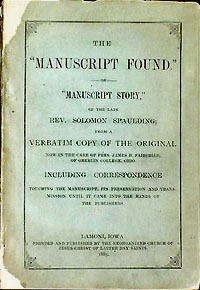
THE

"MANUSCRIPT  FOUND."


---- OR ----


"MANUSCRIPT  STORY."

OF  THE  LATE

REV.  SOLOMON  SPAULDING;

FROM  A

VERBATIM  COPY  OF  THE  ORIGINAL

NOW IN THE CARE OF PRES. JAMES H. FAIRCHILD,
OF OBERLIN COLLEGE, OHIO.


I N C L U D I N G   C O R R E S P O N D E N C E

TOUCHING THE MANUSCRIPT, ITS PRESERVATION AND TRANS-
MISSION UNTIL IT CAME INTO THE HANDS OF
THE PUBLISHERS.


LAMONI, IOWA:
PRINTED AND PUBLISHED BY THE REORGANIZED CHURCH OF
JESUS CHRIST OF LATTER DAY SAINTS.
1885.


[ 3 ]


THE

"MANUSCRIPT  FOUND."

A Verbatim Copy from the Original.


HEREWITH we present to the reader the notorious "Manuscript Story" {"Manuscript Found}, of the later Rev. Solomon Spalding. What gives this document prominence is the fact that, for the past fifty years it has been made to do duty by the opposers of the Book of Mormon and the Church of Jesus Christ of Latter Day Saints, as the source, the root, and the inspiration, by and from which Joseph Smith and Sydney Rigdon wrote said Book of Mormon and organized the Church. It has been popularly and persistently claimed that the plan, subject matter, including prominent names and localities, history of the origin of the aboriginal races of America, with their arts and sciences, civilizations and customs, were identical in this "Manuscript Found" and in the Book of Mormon. Thousands have believed this false and foolish statement, without giving its truth or falsity an hour's fair and unprejudiced investigation, and then fought the book and the church with a readiness and a zeal almost without a parallel. And now that this veritable "Manuscript Found," with an unbroken chain of evidence proving its identity and running back to E. D. Howe, D. P. Hurlbut, Spalding's "old trunk," and so back


4                             The  "Manuscript  Found."                        

to Pittsburgh, Conneaut, and to the very pen of Solomon Spalding, has by the providence of God been furnished us, and that, too, by those not of the Church, we take pleasure in exhibiting in the sunlight of solid facts, this hob-goblin of the pulpit, this "nigger-in-the-woodpile" of the press and the forum, that with which they have fooled and frightened the masses and blinded those inquiring into the origin and character of the Book of Mormon.

This seeming huge hindrance and insurmountable obstacle which is always thrown in the way of the investigator with all the skill and power that craft and cunning and malice and fear and blind zeal can invent and command, vanishes from the presence of this original witness in the case; for when it speaks it reveals the flimsiness and falsity of the claim that it was in any way or in any sense the origin of the Book of Mormon, or that there is the least likeness between the two. This newly found "missing link" completes the chain of evidence which proves that the "Manuscript Found" never was and never could be made the occasion, cause, or germ of the Book of Mormon.

Mr. Spalding has been exalted by the opposers of the Latter Day Saints to the very pinnacle of fame, as a very learned, very moral, and very pious man. It is fortunate that his true measure and worth in respect to his learning, his morals, and his piety, is now furnished us in this "Manuscript Story." God judges men by their words, and it is wise for men to judge of each other after this manner. And when we estimate Mr. Spalding by the character of his work as exhibited in this document, we must grade him down to a very low level, whether in respect to scholarship. mental power, moral purity, or pious attainments and tendencies.


                            The  "Manuscript  Found."                          5

==> The following Correspondence explains the manner in which the Manuscript was preserved and placed in the hands of the present publishers.


This from the Bibliotheca Sacra was republished in many leading journals east and west, among them the Herald of Grinnell, Iowa; the Western Watchman, Eureka, California; the New York Observer, and Frank Leslie's Sunday Magazine.

"The theory of the origin of the Book of Mormon in the traditional manuscript of Solomon Spaulding will probably have to be relinquished. That manuscript is doubtless now in the possession of Mr. L.L. Rice, of Honolulu, Hawaiian Islands, formerly an anti-slavery editor in Ohio, and for many years State printer at Columbus, During a recent visit to Honolulu, I suggested to Mr. Rice that he might have valuable anti-slavery documents in his possession which he would be willing to contribute to the rich collection already in the Oberlin College Library. In pursuance of this suggestion Mr. Rice began looking over his old pamphlets and papers, and at length came upon an old, worn, and faded manuscript of about 175 pages, small quarto, purporting to be a history of the migrations and conflicts of the ancient Indian tribes which occupied the territory now belonging to the states of New York, Ohio and Kentucky. On the last page of this manuscript is a certificate and signature giving the names of several persons known to the signer, who have assured him that, to their personal knowledge, the manuscript was the writing of Solomon Spaulding. Mr. Rice has no recollection how or when this manuscript came into his possession. It was enveloped in a coarse piece of wrapping paper and endorsed in Mr. Rice's handwriting "A Manuscript Story."

There seems no reason to doubt that this is the long-lost story. Mr. Rice, myself, and others compared it with the Book of Mormon, and could detect no resemblance between the two, in general or in detail. There seems to be no name or incident common to the two. The solemn style of the Book of Mormon, in imitation of the English


6                             The  "Manuscript  Found."                        

Scriptures, does not appear in the manuscript. The only resemblance is in the fact that both profess to set forth the history of lost tribes. Some other explanation of the origin of the Book of Mormon must be found, if any explanation is required.   Signed, James H. Fairchild

The letter below was written in answer to our suggestion that the Manuscript be sent for safe keeping to some Historical Society in Chicago, Illinois.


HONOLULU, Sandwich Islands,    
March 28th, 1885.        

MR. JOSEPH SMITH:
The Spaulding Manuscript in my possession came into my hands in this wise. In 1839-40 my partner and myself bought of E. D. Howe the Painseville Telegraph, published at Painesville, Ohio. The transfer of the printing department, types, press, &c., was accompanied with a large collection of books, manuscripts, &c., this manuscript of Spaulding's among the rest. So, you see, it has been in my possession over forty years. But I never examined it, or knew the character of it, until some six or eight months since. The wrapper was marked, "Manuscript Story -- Conneaut Creek." The wonder is, that in some of my movements, I did not destroy or burn it with a large amount of rubbish that had accumulated from time to time.

It happened that Pres't Fairchild was here on a visit, at the time I discovered the contents of it, and it was examined by him and others with much curiosity. Since Pres't Fairchild published the fact of its existence in my possession, I have had applications for it from half a dozen sources, each applicant seeming to think that he or she was entitled to it. Mr. Howe says when he was getting up a book to expose Mormonism as a fraud at an early day, when the Mormons had their head-quarters at Kirtland, he obtained it from spme source, and it was inadvertently transferred with the other effects of his printing office. A. B. Deming, of Painesville, who is also getting up some kind of a book I believe on Mormonism, wants me to send it to him. Mrs. Dickinson, of Boston, claiming to be a relative of Spaulding, and who is getting up a book to show that he


                            The  "Manuscript  Found."                          7

was the real author of the Book of Mormon, wants it. She thinks, at least, it should be sent to Spaulding's daughter, a Mrs. Somebody -- but she does not inform me where she lives. Deming says that Howe borrowed it when he was getting up his book, and did not return it, as he should have done, &c.

This Manuscript does not purport to be "a story of the Indians formerly occupying this continent;" but is a history of the wars between the Indians of Ohio and Kentucky, and their progress in civilization, &c. It is certain that this Manuscript is not the origin of the Mormon Bible, whatever some other manuscripts may have been. The only similarity between them, is, in the manner in which each purports to have been found -- one in a cave on Conneaut Creek -- the other in a hill in Ontario county, New York. There is no identity of names, of persons, or places; and there is no similarity of style between them. As I told Mr. Deming, I should as soon think the Book of Revelations was written by the author of Don Quixotte, as that the writer of this Manuscript was the author of the Book of Mormon. Deming says Spaulding made three copies of "Manuscript Found," one of which Sidney Rigdon stole from a printing office in Pittsburg. You can possibly tell better than I can, what ground there is for such an allegation.

As to this Manuscript, I can not see that it can be of any use to any body, except the Mormons, to show that it is not the original of the Mormon Bible. But that would not settle the claim that some other manuscript of Spaulding was the original of it. I propose to hold it in my own hands for a while, to see if it can not be put to some good use. Deming and Howe inform me that its existence is exciting great interest in that region. I am underf a tacit, but not a positive pledge to President Fairchild, to deposit it eventually in the Library of Oberlin College. I shall be free from that pledge, when I see an opportunity to put it to a better use.

Yours, &c.,                
L. L. RICE.      

P. S. -- Upon reflection, since writing the foregoing, I am of the opinion that no one who reads this Manuscript will give credit to the story that Solomon Spaulding was in any wise the author of the Book of Mormon. It is unlikely that any one who wrote so elaborate a work as the Mormon Bible, would spend his time in getting


8                             The  "Manuscript  Found."                        

up so shallow a story as this, which at best is but a feeble imitation of the other. Finally I am more than half convinced that this is his only writing of the sort, and that any pretence that Spaulding was in any sense the author of the other, is a sheer fabrication. It was easy for any body who may have seen this, or heard anything of its contents. to get up the story that they were identical.

L. L. R.      


HONOLULU, Sandwich Islands,        
May 14th, 1885.    

MR. JOSEPH SMITH;  Dear Sir: --

I am greatly obliged to you for the information concerning Mormonism, in your letters of April 30th and May 2d. As I am in no sense a Mormonite, of course it is a matter of curiosity, mainly, that I am interested in the history of Mormonism.

Two things are true concerning this manuscript in my possession: First, it is a genuine writing of Solomon Spaulding; and second. it is not the original of the Book of Mormon.

My opinion is, from all I have seen and learned, that this is the only writing of Spaulding, and there is no foundation for the statement of Deming and others, that Spaulding made another story, more elaborate, of which several copies were written, one of which Rigdon stole from a printing office in Pittsburgh, &c. Of course I can not be as certain of this, as of the other two points. One theory is, that Rigdon, or some one else, saw this manuscript, or heard it read, and from the hints it conveyed, got up the other and more elaborate writing on which the Book of Mormon was founded. Take that for what it is worth. It don't seem to me very likely.

You may be at rest as to my putting the manuscript into the possession of any one who will mutilate it, or use it for a bad purpose. I shall have it deposited in the Library of Oberlin College, in Ohio, to be at the disposal for reading of any one who may wish to peruse it; but not to be removed from that depository. My friend, President Fairchild, may be relied on as security for the safe keeping of it. It will be sent there in July, by a friend who is going there to "take to himself a wife." Meantime, I have made a literal copy of the entire document -- errors of orthography, grammar,


                            The  "Manuscript  Found."                          9

erasures, and all -- which I shall keep in my possession, so that any attempt to mutilate it will be of easy detection and exposure. Oberlin is a central place, in the vicinity of Conneaut, where the manuscript was written.

I have had an idea, sometimes, that it is due to the Mormons to have a copy of it, if they took interest in it enough to publish it. As it is only of interest as showing that it is not the original of the Book of Mormon, no one else is likely to wish it for publication.

Miss Dickinson, whom you call a granddaughter of Solomon Spaulding, represents herself to me as his grandniece: "My great uncle, Rev. Solomon Spaulding," she writes.

Rev. Dr. Hyde, President of the Institution, in this place, for training Native Missionaries for Micronesia, (a very prominent and successful institution), has written an elaborate account of this manuscript, and of Mormonism, and sent it for publication in the Congregationalist, of Boston. I presume it will be published, and you will be interested in reading it.

Very respectfully, yours,            
L. L. RICE.    


In a postscript Mr. Rice says he found the following endorsement on the Manuscript:

"The writings of Solomon Spaulding proved by Aron Wright, Oliver Smith, John N. Miller and others. The testimonies of the above gentlemen are now in my possession.

(Signed)             D. P. HURLBUT."    


COPY OF MR. RICE'S LETTER

HONOLULU, H. I., June 12, 1885.    

PRESIDENT J. H. FAIRCHILD: --
Herewith I send to you the Solomon Spalding Manuscript, to be deposited in the Library of Oberlin College, for reference by any one who may be desirous of seeing or examining it. As a great deal of inquiry has been made about it since it became known that it was in my possession, I deem it proper that it be deposited for


10                             The  "Manuscript  Found."                        

safe keeping, where any one interested in it, whether Mormon or Anti-Mormon, may examine it. It has been in my possession forty-six years -- from 1839 to 1885 -- and for forty-four years of that time no one examined it, and I was not aware of the character of its contents. I send it to you enclosed in the same wrapper, and tied with the same string that must have enclosed it for near half a century -- certainly during the forty-six years since it came into my possession. I have made and retain in my possession a correct literal copy of it, errors of orthography, of grammar, erasures and all. I may allow the Mormons of Utah to print from this copy, which they are anxious to do; and a delegation is now in the Islands, awaiting my decision on this point. They claim that they are entitled to whatever benefit they may derive from its publication; and it seems to me there is some justice in that claim. Whether it will relieve them in any measure, from the imputation that Solomon Spalding was the author of the Book of Mormon, I do not attempt to decide. It devolves upon their opponents to show that there are or were other writings of Spalding -- since it is evident that this writing is not the original of the Mormon Bible.

Truly, yours, &c.,                
L. L. RICE.      

P. S. -- The words "Solomon Spaulding's Writings" in ink on the wrapper were written by me, after I became aware of the contents. The words "Manuscript Story -- Conneaut Creek," in faint penciling, were as now when it came into my possession.

L. L. R.      


OBERLIN COLLEGE, OBERLIN, O.,    
July 23, 1885.          

I have this day delivered to Mr. E. L. Kelley a copy of the Manuscript of Solomon Spaulding, sent from Honolulu by Mr. L. L. Rice, to the Library of Oberlin College, for safe keeping, and now in my care. The copy was prepared at Mr. Kelley's request, under my supervision, and is, as I believe, an exact transcript of the original manuscript, including erasures, misspellings, &c.

JAS. H. FAIRCHILD,                
Prest. of Oberlin College.    


                            The  "Manuscript  Found."                          11

KIRTLAND, O., 24th July, 1885.    

PRES. W. W. BLAIR, Lamoni, Iowa:
Herewith I transmit to you the copy of the Spaulding Manuscript prepared by Pes. Fairchild, as attested by him, together with his certificate, and photograph sheets.

E. L. KELLEY.          


Words and sentences underlined were stricken out in the Manuscript.
Placeds marked thus - - - - the copy was illegible.


INTRODUCTION,

Near the west bank of the Coneaught River there are the remains of an ancient fort. As I was walking and forming various conjectures respecting the character, situation, & numbers of those people who far exceeded the present Indians in works of art and ingenuity, I hapned to tread on a flat stone. This was at a small distance from the fort, & it lay on the top of a small mound of Earth exactly horizontal. The face of it had a singular appearance. I discovered a number of characters which appeared to me to be letters, but so much effaced by the ravages of time, that I could not read the inscription. With the assistance of a leaver I raised the stone. But you may easily conjecture my astonishment when I discovered that its ends and sides rested on stones & that it was designed as a cover to an artificial Cave. I found by examining that its sides were lined with stones built in a connical form with - - - - - down, & that it was about eight feet deep. Determined to investigate the design of this extraordinary work of antiquity, I


12                             The  "Manuscript  Found."                        

prepared myself with necessary requisites for that purpose and decended to the Bottom of the Cave. Observing one side to be perpendicular nearly three feet from the bottom, I began to inspect that part with accuracy. Here I noticed a big flat stone fixed in the form of a doar. I immediately tore it down and Lo, a cavity within the wall presented itself it being about three feet in diamiter from side to side and about two feet high. Within this cavity I found an earthen Box with a cover which shut it perfectly tite. The Box was two feet in length one & half in breadth & one & three inches in diameter. My mind filled with awful sensations which crowded fast upon me would hardly permit my hands to remove this venerable deposit, but curiosity soon gained the assendancy & the box was taken & raised to open it. When I had removed the Cover I found that it contained twenty-eight rolls of parchment -- & -- that when - - - appeared to be manuscrips written in eligant hand with Roman letters & in the Latin Language.

They were written on a variety of Subjects. But the Roll which principally attracted my attention contained a history of the author's life & that part of America which extends along the great Lakes & the waters of the Mississippy.

Extracts of the most interesting and important matters contained in this Roll I take the liberty to publish.

Gentle Reader, tread lightly on the ashes of the venerable dead. Thou must know that this Country was once inhabited by great and powerful nations, considerably civilized & skilled in the arts of war, & that on ground where thou now treadest many a bloody Battle hath been fought, & heroes by thousands have been made to bite the dust.


                            The  "Manuscript  Found."                          13

In the history given of these nations by my author you will find nothing but what will correspond with the natural sentiments we should form on viewing the innumerable remains of antiquity which are scattered over an extensive Country. This is an evidence of the author's impartiality and veracity. But if any should pretend that the whole story is fictitious or fabulous

To publish a translation of every particular circumstance mentioned by our author would produce a volume too expensive for the general class of readers. But should this attempt to throw off the veil which has secluded our view from the transactions o nations who for ages have been extinct, meet the approbation of the public, I shall then be happy to gratify the more inquisitive and learned part of my readers by a more minute publication. Apprehensive that skeptical illiberal or superstitious minds may censure this performance with great acrimony I have only to remark that they will be deprived of a great fund of entertainment - - - - of a contrary disposition will obtain. My compassion will be excited more than my resentment and there the contest will end.

Now, Gentle Reader, the Translator who wishes well to thy present and thy future existence entreats thee to peruse this volume with a clear head, a pure heart, and a candid mind. If thou shalt then find that thy head and thy heart are both improved it will afford him more satisfaction than the approbation of ten thousand who have received no benefit.

And now permit me to admonish thee, that if thou shouldst reside in or travel through any part of the Country


14                         The  "Manuscript  Found."                        


CHAPT. I.

AN EPITOME OF SOME PART OF THE AUTHOR'S LIFE & OF HIS
ARRIVAL IN AMERICA.

As it is possible that in some future age this part of the Earth will be inhabited by Europeans & a history of its present inhabitants would be a valuable acquisition, I proceed to write one & deposit it in a box secured - - - - so that the ravages of time will have no effect upon it that you may know the author I will give a succinct account of his life and of the cause of his arrival which I have extracted from a manuscript which will be deposited with this history.

My name was Fabius The family name I sustain is Fabius, being descended from the illustrious general of that name. I was born at Rome & received my education under the tuition of a very Learned Master.   At the time that Constantine arrived at that city and had overcome his enemies & was firmly seated on the throne of the Roman empire I was introduced to him as a young Gentleman of genius and learning & as being worthy of the favourable notice of his imperial majesty. He gave me the appointment of one of his secretaries, & such were the gracious intimations which he frequently gave me of his high approbation of my conduct that I was happy in my station.

One day he says to me Fabius you must go to Britain & carry an important - - - - to the general of our army there - - - - sail in a vessel & return when she returns. Preparation was made instantly and we sailed - - - The vessel laden with provisions for the army - - - Cloath -- knives


                          The  "Manuscript  Found."                          15

and other impliments for their use had now arrived near the coasts of Britain when a tremendous storm arose & drove us into the midst of the boundless Ocean. Soon the whole crew became lost & bewildered. They knew not the direction to the rising Sun or polar Star, for the heavens were covered with clouds; & darkness had spread her sable mantle over the face of the raging deep. Their minds were filled with consternation and despair. & unanimously agreed that What could we do? How be extricated from the insatiable jaws of a watery tomb? Then it was that we felt our absolute dependence on that Almighty & gracious Being who holds the winds & floods in - - - hands. From him alone could we expect deliverance. To him our most fervent desires assended. Prostrate & on bended nees we poured forth incessant Supplication & even Old Ocean appeared to sympathize in our distress by returning the echo of our vociferos cries & lamentations. After being driven five days with incridable velocity before the furious wind the storm abated in its violence. but still the wind blew strong in the strong as I now believe in the same direction. Doubtful whether the wind had not changed her point we gave the ship full sail & let her drive. On the sixth day after, the storm wholly subsided, the sun rose clear and the heavens once more appeared to smile. Inexpressible was the consternation of all the crew. they found themselves in the midst of a vast Ocean. No prospect of returning. All was lost. The wind blowing westwardly, & the presumption was that it had been blowing in that direction during the whole of the storm. No pen can paint the dolorous cries & lamentations of the poor mariners, for the loss of friends for the loss of everything they held


16                         The  "Manuscript  Found."                        

most - - - - At length a Mariner stept - - - - the midst and proclaimed. Attend O friends & listen to my words. A voice from on high hath penetrated my soul & the inspiration of The Almighty hath bid me proclaim. Let your sails be wide spread & the gentle winds will soon waft you into a safe harbor. a Country where you will find hospitality. Quick as the lightnings flash joy sparkled in every countenance. A Hymn of Thanksgiving spontaneously burst forth from their lips. In full confidence that the divine prediction would be accomplished they extoled the loving kindness and tender mercies of their God & promised by the assistance of his grace to make ample return of Gratitude. On the fifth day after this we came in sight of land, we entered a spacious river & continued sailing up the - - - - many leagues until we came in view of a town. Every heart now palpitated with joy, & loud shouts of gladness expressed the enthusiastic transports of our souls. We anchored within a small distance from shore. Immediately the natives ran with apparent signs of surprize & astonishment to the bank of the River. After viewing us for some time, & receiving signs of Friendship, they appeared to hold a counsel for a few minutes. Their King then stept forward to the edge of the bank & proffered us the hand of friendship, & by significant gestures invited us to Land, promising us protection and hospitality. We now found ourselves once more on terra firma, & were conducted by the king & four chiefs into the town whilst the multitude followed after, shouting & performing many odd jesticulations. The King ordered an entertainment to be prepared for his new friends which consisted of - - - - fish boiled beans & samp - - - - The whole was placed under a wide-spreading Oak in wooden dishes. A large clam shell


                            The  "Manuscript  Found."                          17

& a Stone Knife were provided for each one. The king then came forward with about twenty of his principal subjects, & con seated us (being about twenty in number) & seated us by the side of our repast. He and his company then took seats in front. After waving his hand & bowing all fell to eating & a more delicious repast we never enjoyed. The repast being finished, our attention was called to a collection of about one thousand men & women who had formed a ring & invited our company to come forward into the midst. After gazing upon us for some time with surprize we were permitted to withdraw & to take our stand in the Ring. About forty in number then walked into the middle of the Ring & began a song with but a discordant and hideous modification of sounds, & such frantic jesticulations of body that it seemed that chaos had bro't her furies to set the world in an uproar. And an uproar it was in a short time for the whole company fell to dancing, shouting, whooping, & screaming at ontervals, then dancing jumping & tumbling with many indescribable distortions in their countenance & indelicate jestures. In fact, they appeared more like a company of devils than human Beings. This lasted about one hour. They then took their places in a circle & at a signal given gave three most tremendous whoops, they then instantly dispersed playing many antike capers & making such a confused medley of sound by screaming, whooping, screeching like owls, Barking like dogs and wolves & bellowing croaking like Bull-frogs, that my brain seemed to be turned topseturvy, & for some time I could scarce believe that they belonged to the human species.


18                       The  "Manuscript  Found."                          


CHAPT. II.

AN ACCOUNT OF THE SETTLEMENT OF THE SHIP'S
COMPANY & MANY PARTICULARS RESPECT-
ING THE NATIVES.

As no alternative now remained but either to make the desperate attempt to return across the wide boisterous Ocean, or to take up our residence in a country in a land of savages inhabited by savages & wild ferocious beasts, we did not long hesitate. We held a solemn treaty with the King & all the chiefs of his nation. They agreed to cede to us a tract of excellent land on the north part of the town on which was six wigwams & engaged perpetual amity & hospitality & the protection of our lives & property. In consideration of this grant we gave them fifty yards of scarlet cloth & fifty knives With this present they were highly pleased.  

Arrangements must now be made for - - - - settlement. Vessel & cargo had received no material damage & by striping the vessel of its plank we could erect a house in which we could deposit the whole cargo in safety. All hands were immediately employed, some in procuring timber which was hewed on two sides & then locked together, some in procuring shingles & some in striping the vessel of its plank; & having a large quantity of nails on board, in ten days we finished a very convenient store-house, sufficiently spacious to receive the whole cargo. We also built a small house adjoining which was to be the habitation of


                            The  "Manuscript  Found."                          19

the Captain & myself. Having secured all our property, we then found it necessary to establish some regulations for the government of our little society. The Captain whose name was Lucian & myself were appointed judges in all matters of controversy & managers of the public property to make bargains with the natives & barter such articles as we did not need for necessaries. As we all professed The next thing to be done was to to believe in the religion of Jesus Christ we unanimously chose Trojanus, the mate of the ship, a pious good man to be our minister, to lead our devotions every morning & evening & on the Lord's day.

But now a most singular & delicate subject presented itself for consideration. Seven young women we had on board, as passenjers to viset certain friends in Britain. Three of them were ladies of rank & the rest were healthy bucksom lasses. Whilst deliberating on this subject a mariner arose whom we called Droll Tom Hark, ye shipmates says he. Whilst tossed on the foaming billows what brave son of Neptune had any more regard for a woman than a Sturgeon but now we are all safely anchored on Terra firma, our sails furled & ship keeled up, I have a huge longing for some of those rosy dames. But willing to take my chance with my shipmates, I propose that they should make their choice of husbands. The plan was instantly adopted. As the choice fell on the young women they held a consultation on the subject & in a short time made known the result. Droll Tom was rewarded for his benevolent proposal with one of the most sprightly, rosy dames in the company. Three other of the most cheerful resolute mariners were chosen by the other three bucksom Lassies. The three young Ladies of rank fixed their choice on the Captain the Mate & myself. Happy indeed in my partner,


20                           The  "Manuscript  Found."                          

I had formed an high esteem for the excellent qualities of her mind. The young Lady who chose me for a partner was possessed of every attractive charm both of body & mind. We united heart & hand with the fairest prospect of enjoying every delight & gratification which are attendant on the connubial state. Thus ended the affair. You may well conceive our singular situation. The six poor fellows who were doomed to live in a state celibacy or accept of savage dames, discovered a little chagrin & anxiety. However they consoled themselves with the idea of living in families where they could enjoy the company of the fair sex, and be relieved from the work which belongs to the department of women.

Our community might be said to be one family, tho' we lived in seperate houses situate near each other. The property was common stock. what was produced by our labor was likewise to be common. All subject to the distribution of the judges, who were to attend to each family & see that propper industry & economy were practised by all.

The Captain & myself, attended with our fair partners & two mariners, repaired to our new habitation, which consisted of two convenient apartments. After having partook of an elligant dinner & drank a bottle of excellent wine our Spirits were exhilerated & the deep gloom which beclouded our minds evaporated. The Captain assuming his wonted cheerfulness, made the following address. "My
" sweet good soul'd fellows, we have now commenced a
" new voyage. Not such as bro't us over mountain billows
" to this butt end of the world. No, no, our voiage is on dry
" land, & now we must take care that we have sufficient
" ballast for the rigging. Every hand on board this ship


                            The  "Manuscript  Found."                          21

" clasp hands & condescend to each other's humour. This
" will promote good cheer & smooth the raging billows of
" life. Surrounded by innumerable hordes of human beings,
" who resemble in manners the Orang outang, let us keep
" aloof from from them & not embark in the same matrimonial
" ship with them. At the same time, we will treat
" them with good cheer & inlighten their dark souls with
" good instruction. By continuing a different people &
" prefering our customs, manners, religion & arts & sciences
" & other things another Italy will grow up in this wilderness,
" & we shall be celebrated as the fathers of a great &
" happy nation."

May God bless your soul, says one of the mariners, what would you have us do who have had the woful luck not to get mates to cheer our poor souls and warm our bodies. Methinks I could pick out a healthy plum lass from the copper colored tribe that by washing & scrubing her fore & aft & upon the labbord & stabbord sides she would become a wholesome bedfellow. I think, may it please your honour, that I could gradually pump my notions into her head & make her a good shipmate for the cupboard & as good hearted a Christian as any of your white damsels & upon my Soul I warrant you if we have children, by feeding them with good fare, & keeping them clean, they will be as plump & as fair & nearly as white as your honour's children. Upon this I filled the bottle with wine & observing to honest Crito that he was at liberty to make the experiment if he could find a fair - - - - to his liking. I then expressed the great pleasure I received from the addresses of the speakers & wished drank success to the new voige. All drank plentifully, & the exhileration


22                           The  "Manuscript  Found."                          

produced the greatest cheerfulness & hilarity. By this time the Sun had hid his head below the horizon & darkness invited all the animal creation to sleep & rest. We retired two & two, hand in hand. Ladies' heads a little awri, blushing like the morn & - - - - But I forgot to mention that our society passed a resolution to build a church in the in the midst of our vilage.


CHAPT. III.

MANY PARTICULARS RESPECTING THE NATIVES.

Interest as well as curiosity invited an acquaintance with our new neighbors. They were called in their Language Deliwanucks. They were Tall, bodies weel proportioned, strait limbs, complections of a brownish hue broad cheek bones, black wild roling eyes, & hair black & course. To strangers they were both - - - - true to their engagements, ardent in their friendship, but to enimies implacable, cruel & barbarous in the extreme. Innumerable hordes of this description of people were scattered over an extensive country, who gained their living by hunting the elk, the deer & a great variety of other wild animals by fishing & fowling & by raising corn, beans & squashes Shooting the arrow, flinging stones, wrestling, jumping,


                            The  "Manuscript  Found."                          23

hoping, and running were their principal amusements, & prizes would often be staked as a reward to the conqueror. Their clothing consisted of skins dressed with the hair on, but in warm weather only the middle part of their bodies were incumbered with any covering. The one half of the head of the men was shaved & painted with red & the one half of the face was painted with black. The head was adorned with feathers of various kinds, & their ears & noses were adorned ornamented with rings formed formed from the sinues of certain animals, on which were suspended smooth stones of different coulors. Thus cloathed, thus painted, thus ornimented a Deliwannuck made a most terrif - - - - They held festivals at stated times which varied in the manner of conducting them, according to the object they had in view. At one of their annual festivals their ceremonies were particularly singular & different from any that were ever practised by any nation. Here a description would give us some idea of their religion, & would gratify the curiosity of an injenious mind.

When the time arrives, which is in September, the who whole tribe assemble. They are dressed & ornimented in the highest fashion. The women in particular have their garments & heads so adorned with feathers, shells, & wampum, that they make a very brilliant & grotesque appearance. The form a circle: their countenances are solemn. A Speaker mounts a stage in the midst. At this moment two Black Dogs led by two Boys & two white Dogs led by two young damsels enter the circle & are tied together. The Speaker then extended his hands & spoke. Hail, ye favorite children of the great and good Spirit, who resides in the Sun who is the father of all living creatures & whose arms encircle us all around, who defends us from the


24                           The  "Manuscript  Found."                          

malicious designs of that great malignant Spirit that pours upon us all the evils we endure. He gives us all our meat & our life & causes the corn & the fruits to spring up & makes us to rejoice in his goodness. He hath prepared a delightful Country to receive us, if we are valiant in battle or are benevolent & good. There we can pick all kinds of delicious fruit, & have game & fish in abundance & our women being improved in beauty & sprightliness will cause our hearts to dance with delight. But wo unto you wicked, malicious, mischievous mortals. Your lot will be cast in a dark dreary, mirey swamp, where the malignant Spirit will torment you with musquetoes & serpents & will give you nothing to eat but toads, frogs & snails. But my dear friends, all hail, here is a custom which is sanctioned by time immemorial. Look steadfastly on the black dogs & let not your eyes be turned away, when they are thrown on the sacred pile & the flames are furiously consuming their bodies, then let your earnest prayer assend for pardon & your transgressions will flee away like shadows & your sins will be carried by the smoke into the shades of oblivion. When this solemn expiatory sacrifice is ended then prepare your souls to partake of the holy festival. Each one will receive a precious morsel from these immaculate snow colored dogs, in token that your offenses have all evaporated in the smoke of the holy sacrifice. & that you are thankful to him the Benevolent Spirit, for the abundance of good things that you enjoy, & that you humbly anticipate the continuance of his blessing that he will defend you against the evil designs of that malignant Spirit, who gives us gawl & wormwood, & fills our bosom with pain & our eyes with tears. He then proclaimed, let the sacred pile be erected & the solemn sacrifice performed. Instantly about one


                            The  "Manuscript  Found."                          25

hundred men came forward with small dry wood & bundles of dry sticks & having thrown them in one pile within the circle, they sat the pile on fire. The black dogs were knocked on the middle head, & thrown on the top, in a moment all was in a blaze & the flame assended in curls to heaven. The whole company assumed the most devout attitude & muttered in sounds almost inarticulate their humble confessions & earnest requests.

When the dogs were consumed & the fire nearly extinguished, the ceremonies of their sacred festival began. The white dogs which were very plump & fat were knocked on the head & their throats cut. Their hair was then singed off, having first their entrails taken out, & being suspended by the nose before a hot fire, they were soon roasted, thrown upon a long table & desected into as many pieces as there were persons to swallow them. The company immediately formed a procession, one rank of men the other of women, the men marching to the left & the women to the right of the table, each one took a piece & devoured it with as good a - - - - if it had been the most delicious morsel. Having completed these sacred ceremonies with great solemnity, the whole company formed themselves into a compact circle round the stage ten musicians immediately mounted, & facing the multitude on every side sang a song. The tune & the musical voices of the singers pleased the ear, whilst the imagination was delighted with the poetic inginuity of the composition. The multitude all joined in the chorus with voice so loud & multifarious that the atmosphere quaked with terror, & the woods & neighbouring hills sent back by way of mockery, sent back the sound of their voices, their vociferation improved by ten-fold confusion. Perhaps, reader, you have


26                           The  "Manuscript  Found."                          

the curiosity to hear the song. I can give you only the last stanzy & the chorus.

"For us the sun emits his rais
"The moon shines forth for our delight.
"The stars shine forth extol our heroes prais
"And warriors flee before our sight.

          CHORUS.

"Delawan to chakee poloo
"Manegango forwah toloo
"Chanepant, lawango chapah
"Quinebogan hamboo gowah.
The solemnities are ended & in their opinion their poor souls are completely whitewashed & every stain entirely effaced. A little - - - - will now dissipate the solemnity & inspire them with cheerfulness & meriment. The whole tribe repair to the top of an hill, at one place their is a gradual slope a small distance & then it desends about twenty-five feet in an almost perpendicular direction, at the bottom of which is a quagmire which is about ten feet in length. & the soft mud is about three feet deep. At each end the ground is soft, but not miry. Down this declivity twenty pair of very supple & sprightly young men & women are to desend. If by their dexterity & agility they escape the quagmire, a piece of wampum will be the reward of each fortunate champion; but if they plunge in their recompense will be the ridicule and laughter of the multitude. In making this desent, six young women & five young men by a surprising dexterity in whirling their bodies as they descended, cleared themselves from the quagmire. The rest as their turns came plunged in & came out most wofully muded to the great diversion of the Spectators. The incident which excited the most meriment hapned when the last pair desended. by an unlucky spring to clear himself from the


                            The  "Manuscript  Found."                          27

quagmire he bro't his body along side of the declivity & roled his whole length into the midst of the quagmire, where he lay his whole length in an horizontal position on his back neither heels up or head up, but horizontally, soft & easy. But alas, when one unlucky event happens another follows close on its heals. The fair plump corpulent damsel his affectionate sweetheart came instantly sliding with great velocity. She saw the woful position of her beloved. She wished him no harm, she raised her feet, this bro't the center of gravity directly over the center of his head, here she rested a moment, his head sunk, she sunk after him, his heels kicked against the wind like Jeshuran waxed fat, but not a word from his lips, but his ideas came in quick succession, tho't he, what a disgrace to die here in the mud under the pressure of my sweetheart, however his time for such reflections were short, the tender hearted maid collecting all her agility in one effort, dismounted & found herself on dry land in an instant, not a moment to be lost. She seized her lover by one leg, & draged him from the mud, a curious figure extending about six feet six inches on the ground, all besmeared from head to foot, spitting, puffing, panting & struggling for breath. Poor man, the whole multitude laughing at thy calamity, shouting, ridiculing, none to give thee consolation but thy loving and sympathetic partner in misfortune.

Upon my soul, exclaims Droll Tom, Stern foremost, That bouncing Lass ought to have the highest prize for draging her ship from the mud. She was cleaning the filth from his face.


28                           The  "Manuscript  Found."                          


CHAPT. IV.

A JOURNEY TO THE N. W. & REMOVALL

Gracious God! How deplorable our situation. Are we doomed to dwell among hoards of savages & be deprived of all social intercourse with friends & the civilized world? & what will be the situation of our offspring? Will they preserve our customs & manners, cultivate the arts & sciences, & maintain our holy religion; or rather will they not degenerate into savages, & by mingling with them become the most - - - race of beings in existence. Who can indure such reflections, such heart-rending anticipation? They pour upon my soul like a flood & bear me down with the weight of a milstone. O that my head were waters & my eyes a fountain of tears, Then my intolerable burthen should should be poured forth in a torrent & my soul set at liberty. But behold, the light springs up & beams upon my soul. She brings in her train Hope that celestial Godes, that sure & strong anchor that dispenser of comfort & pleasing anticipation, & that dispeller of corroding grief & blank despair. She bids me review the exploded reasoning of a great philosopher & compare it with my own observations, perhaps the result will point out a safe road to the land of our nativity. 

Thus I reasoned respecting the solar system of which the earth is a part. Provided the earth is stationary according to the present system of philosophy, then the sun the moon & the plannets, being at an immense distance from


                            The  "Manuscript  Found."                          29

the earth, must perform their revolutions round her with inconceivable velocity; Whereas, if according to the platonic system, the earth is a globe & the sun is stationary, then the earth by a moderate velocity - - - perform her revolutions. This scheme will represent the solar system as displaying the transcendant wisdom of its Almighty architect, for in this we behold the Sun suspended by Omnipotence & all the plannets moving round him as their common center in exact order & harmony. In this we can easily account for days & nights & the different seasons of the year. When the earth presents one part of her face to the sun it is day, & when that part is turned from his beams it is night. When she varies to the South the sun shines upon us in a more perpendicular direction, the sun beams become more dense & the heat increases, as she turns back the heat decreases in proportion as this part of earth loses its perpendicular direction, & to the sun & the cold becomes more intense in the same proportion. This account for the various seasons of the year appears correct & consistent & highly honourable to the divine perfection.

But behold the other system. The earth firmly fixed on a firm foundation; perhaps as some say, on a giants back who stands on a - - - back. Its surface widely extends nearly horizontal, & its cut down & its sides cut down strait or perpendicular to the very bottom, below which is a fathomless abiss. Pray, Mr. Philosopher, what man was ever there & looked down & what prevents the Ocean, unless it is damd with earth & rocks, from pouring down & loosing itself in this horrible abis? But how extensive is this teraqueous surface? Indeed I am of opinion if this


30                           The  "Manuscript  Found."                          

system is true, I am nearly at one end of it. But the hypothises is too absurd & inconsistent. The earth must be of a spherical form & a westerly course will lead us to the land of our nativity. Perhaps this is a part of the eastern continent, or perhaps only a narrow strip of the Ocean intervenes? On no other principle can we account for the emigration of the ancestors of those innumerable hords of human beings that possess this continent. Their tradition is that their ancestors came from the west, & they agree in their information that at the distance of fifteen days journey in a westerly direction there are nations vastly more numerous, powerful & civilized than themselves.

The earth therefore must be of a spherical form a Globe & a westerly course will lead us to the land of our nativity. On what principle can we account for the emigration of the ancestors of those innumerable hords of human beings that possess this Continent? Their tradition tells them that they emigrated from the westward. From this I draw the conclusion that the sea, if any, which intervenes between the two Continents at the westward is not so extensive but that it may be safely navigated. I have also learned from some of the natives We are also informed by some of the natives that at the distance of about fifteen days journey in a north westerly course there is a great river which runs in a south westerly direction, they cannot tell how far & that along the banks of this river there are great towns & mighty kings & a people who live in a state of civilization. From all these considerations I am determined to remove, pursue a westerly course, & seek the delightful country of


                            The  "Manuscript  Found."                          31

my ancestors. I immediately communicated my determination & the reasons on which it was founded to our little Society, who joyfully acquiessed. It was thot to be the most prudential to find out the disposition & character of the inhabitants. who were settled along the great River lest we should fall into the hands of Robbers. For this purpose my man Crito & myself & a Delawan for an interpreter set forth. We passed through a country interspersed with vilages, inhabited by the same kind of people as the Delawans, until we came to a great Mountain. Having passed over this, we had not traveled far before we came to the confluence of two great rivers which in conjunction produced a river which was called Owaho, deep enough for the navigation of ships. Here was a lagge to wnor city inhabited by a different race of people from any we had seen before. We were immediately conducted to the King & were received who received us very graciously, & having asked a number of very pertinent questions & received answer to his satisfaction, I then made known to him our business & had all my requests granted. As we proposed to move into his territory, he offered to furnish us for our convenience, with four Mammoons & four men to manage them. These were an animal of prodigious magnitude even biger than the elephant, which the natives had tamed & domesticated. They were very sagacious & docile & were employed in carying burthens & in drawing timber & in plowing their land. Their hair at the Spring season was about seven inches in length & was of a fine wooly consistence, & being sheared off at the proper season, was manufactured into coarse cloth. And the milk of the females which they produced in abundance afforded a very holesome nutriment. Having thus succeeded beyond our


32                           The  "Manuscript  Found."                          

expectation, we made as much expedition to return as possible. We arrived in safety without any material accidents. The Little Society I had left were greatly rejoiced on our returne, & highly pleased with the account we gave of the country we had visited, & at the sight of those extraordinary & prodigious animals Mammoons which we had bro't to convey our baggage. No time was lost to make preparation for the journey. The Captain, Mate & myself went to the King and held a conference with him & the chiefs & obtained leave to depart, tho' with apparent regret & reluctance. Sacks were provided from coarse cloth to receive the most valuable part of our goods & furniture. These were thrown across three of the Mammoons. The other was caparisoned in a manner too tedious to describe for the accommodation of our women & children. They were all mounted upon him & rode with great convenience & safety. Being thus prepared & ready Thus having resided among the Deliwans two years, & being prepared to take our departure. The King & his chiefs & many of his principal Subjects came forward to take an affectionate farewell. This was done on both sides with with mutual expressions of the most ardent & sincere friendship & the most earnest wishes & prayers for future prosperity & happiness. Having taken our final adieu I observed honest Crito sheding tears very plentifully. You seem to be affected, said I. God bless your honour said he, when I think how kind & generous these poor Deliwans have been to us, I can not help feeling an affection & friendship for them. We were obliged to anchor amongst them, we were strangers, & helpless, & they were ignorant Savages, yet they held out the hand of kindness, & treated us as brothers & sisters. Have they not fulfilled the law of Christian charity? O that they were


                            The  "Manuscript  Found."                          33

good Christians, may God forgive their ignorance & unbelief & reward them for their kindness & genosity. We passed on. No obstacles impeded our journey until we came to the great river Suscowan, which lies runs between the Deliwah River and the great moun mountain. The water being too deep for fording, we built a small boat & with this at several times, we conveyed the whole of the baggage & company & baggage across, except the managers of the Mammoons, who mounted them & forded & swam across. We then proceeded on by slow marches. - - - But in crossing the great mountain we had some difficulties to encounter, but however met with received no material damage, but finally arrived safely at the great city Owhahon on the twenty-fifth day after our departure from Deliwan.

Fatigued with a long & difficult journey great joy & gladness were visible in every >u>in countenance & all were disposed to establish our residence here, until further information could be obtained & further measures concerted to prosecute our journey to Europe. The King & his principal officers proffered us every assistance necessary to make our situation agreeable. They assigned us in compliance with our request conformity to our desire a number of houses on the bank of the river at a little distance from the city. We made him some valuable presents in return, which he received as a token of friendship, but not as a compensation. For such was the high sense of honor which this prince sustained, that when he made a present he would take it as an insult to offer him anything as a compensation.

Having now once more become settled our little community continued the same regulations which they had established at Deliwan & all things proceeded in peace & our affairs prospered.


34                           The  "Manuscript  Found."                          


CHAP. V.

A DESCRIPTION OF THE OHONS, & MANNER OF
PROCURING A LIVING.

I am now to describe A SOECIES nation who have but little resemblance to those to those innumerable tribes of savages who live along the coasts of the Atlantic. Their complexion, the form & construction of their bodies, their customs manners laws government & religion all demonstrate that they must have originated from some other nation & have but a very distant affinity with their savage neighbors. As to their persons they were taller on an average than I had ever seen in any nation, their bones were large limbs strait & shoulders broad. Their eyes rather small & sunk deep in the head. Their foreheads were prominent & the face below tapering in such a manner that the chin that was formed nearly to a point. As to their complexion it was bordering on an olive tho' of a lighter shade. Their eyes were generally of a dark brown or black. Their hair of the same color, tho' I have sometimes seen persons whose hair was of a reddish hue.  

They clothed themselves in choath which was manufactured among themselves from the hair of the Mammoons & from Cotton, which was transported from the South west ward. The men wore shoes & long stockings wide trousers, a waistcoat & a garment with wide short sleaves, which came down to their nees, & in cold weather a cloak over the whole. The covering for the head was


                            The  "Manuscript  Found."                          35

generaly a kind of a Cap which ran up high & tapered to a point. This was generally made of fur skins & was ornimented with feathers. It had a small brim in the shape of an half moon to project over the forehead. The women besides stockings & shoes wore a short petecoat a shirt of cotton a loose garment with sleaves which they girded round them with belts & a cloack. They had various orniments such as ribbons made from cotton & coulored with different coulars, the most beautiful feathers that could be obtained & shells of various kinds. Indeed the higher class of women were extremely fond of ornament, & wore placed a large share of their happiness in the brilliancy & gaudy appearance of their garments. The people obtained their living generally by the cultivation of the Land, & the manage by tending & managing certain animals which had been so long domesticated that they had lost their wild nature & become tame. Corn, wheat, beans, and squashes & carrots they raised in great abundance. The ground was plowed by horses & generally made very mellow for the reception of the seed.

It was the occupation of a certain part of the men to tend upon the tame animals, to drive them to pasture & keep them from straying, & feed them when the snow was on the ground. Two men would tend twenty Mammouth, which were indifferent whether they fed on grass or cropt the bushes. When these animals were fat their flesh was highly esteemed. They had droves of Elk, which they had so tamed & tutored that they could manage them as they pleased. These had their tenders (several words illegible) & would follow them like a flock of sheep. & it was but seldom that any would leave their companions. The elk constituted a considerable part of their animal


36                           The  "Manuscript  Found."                          

food. The horses were managed in the same way & the people tho't their meat to be a savoury dish. They had large numbers of turkies & gees, which thou' originally wild, yet by treating them with great familiarity by croping their wings & feeding them they frequently they discovered no disposition to ramble off, but would propagated their species & laid eggs in abundance.

Hunting and fishing were the employments of some others followed mechanical buciness & others carried on a bartering trade to the Southwestward, in order to furnish to furnish the people with cotton & other articles whose production was not congenial to their climate. By pursuing these various employments they generally had an abundance of provision & were at all seasons comfortably cloathed. And here I would remark as one striking characteristic of this people, that they observed great neatness in their dress, in their cookery & in their houses.

The manufacturing of lead Iron & lead was understood but was not carried on to that extent & perfection as in Europe. A small quantity of Iron in proportion to the number of Inhabitants served to supply them with all the impliments which custom had made necessary for their use. By hammering & hardening their Iron they would convert it nearly into the consistency of Steal & fit it for the purpose of edged tools.

The potery business was conducted with great ingenuity & great quantities of stone & earthen ware consisting of every kind of vessel of every construction which were needed for family use, were manufactured in every part of this extensive country. They would These vessels they ornimented with pictures with the likenesses of


                            The  "Manuscript  Found."                          37

various kinds of animals & trees & impressed upon them such coulars as would strike the fancy with delight. The females of the high Class most welthy Class would often have a large & superfluous quantity of this brittle furniture to decorate one apartment of the house. The vessels they arranged in such order as to make a display of taste & impress the mind with the agreeable sensation of beauty.

In architecture there can be no comparison with the civilized nations of Europe. In their most wealthy & populous Cities they their houses & public buildings exhibit no eligance, no appearance of wealth and grandeur, all is plain & nothing superfluous. But convenience seems to be the whole object they had in view in the construction of their buildings of every kind.

Their houses were generally but one story high built of wood, being framed & covered with split clapboards or shingles, & in the inside the walls were formed of clay, which was plastered over with a thin coat of lime. Their houses seldom consisted of more than three apartments. As to their chimneys they built construct a wall of stone about five feet hight for the fire against which they build their fire, from the top of this wall they construct the chimney with thin pieces of split timber, on the inside with wet dirt or clay of which they plaster wet dirt or clay which completely covers & adheres to the timber & prevents the fire from having any operation upon it. The inside of their houses as the women generally practise neatness, makes a much better appearance than the outside.

It is my opinion says Trojanus that this people display a taste in building which is formed upon the true principles of Reason. Their houses are sufficiently spacious for convenience. No expense or Labour are thrown away in


38                           The  "Manuscript  Found."                          

building useless apartments or in erecting their houses higher than what convenience requires. The whole catalogue of ornamental trumpery is neglected. This in Rome produces more than half the Labour & expense in building. Yes says Lucian, and without this these labouring people must starve for the want of employment & the citizens of the Roman empire would be deprived of the honor of possessing a splendid Capital & of the exquisite pleasure of beholding the greatest exhibition of human ingenuity in the eligance the splendour the purity & beauty of their houses, their palaces & public edifices. True indeed, replies Trojanus, men may be dazed & delighted with such objects for the moment, But could not wealth be better bestowed upon to promote the interest of the community & for charitable purposes & these artists better employ their strength & ingenuity in producing some substantial benefits to themselves and others? Rejoins Lucian, the course reason dictates is to avoid extremes. A slab coulared world would tire the senses by its uniformity & too much orniment & splendor, would cease to please by its frequency.

Besides, lofty houses can more easily be overthrown by tornadoes or tumbled down upon our heads by earthquakes. The course, says Lucian that reason dictates is to avoid extremes. A slab coulored world by its uniformity would tire the senses, & by its possessing too much ornament & splendor it would cease to please. (But the wonder wont cease when it is considered that mankind with but few exceptions to walk in the tracks of their fathers & to pursue the road marked out by their education)


                            The  "Manuscript  Found."                          39


CHAP. VI.

DESCRIPTION OF THE LEARNING, RELIGION &
CUSTOMS OF THE OHONS.

Learning appears to be so important to the nature of man & a convenient share of it so easy to obtain, that some may wonder why it is not universally defused thro' the world. But If we can place any reliance on the dark annals of antient history, it is certain that letters are indebted for their existence to the inventive genius of certain extraordinary characters. Egypt & Chaldea contended for the honour of being the first who i- - - d letters. Perhaps they were invented in each nation nearly at the same time. But Let this be as it may could no other nation in the world produce as great geniuses as Egypt or Chaldea? * Is there any natural obsticle to prevent their production in America as well as in Asia?  Whatever may be the reasoning of some on this subject, the fact is that I found Letters or some share of learning, tho' in a very imperfect state among this people. At present I shall wave the account of its introduction & shall merely describe the state of learning as it existed among the Ohons. They had characters which represent words & all compound words were had each part represented by its appropriate character. The variation of cases, moods & tenses was designated by certain marks placed under the characters. They generally wrote on
________
* Note. The most probable conjecture is that they were communicated from one nation to the other.


40                           The  "Manuscript  Found."                          

parchment beginning at the right wrote from the top to the bottom, placing each character directly under the preceeding one & having finished one column or line they begin with write the next on the left of that & so continue on until they cover the parchment if the subject requires it. It is a work of considerable labour & time to obtain such a knowledge of their characters & the application as to be able to read with fluency & to write with ease & accuracy.

In their principal Cities and Towns the government appoints learned men to instruct the sons of the higher class of Citizens & in the course of four or five years they will make such proficiency as to become tolerable schollars.

The works of the learned are not very voluminous. Records are kept of the transactions of their Government. Their constitution & laws are committed to writing. A sacred Roll in manuscript is preserved among the Records of their Emperors & kings. & are dispersed thro' the Empire & much pains taken to deffuse the knowledge of them among the people. In all their large towns & Cities they have deposited under the care of a priest a sacred Roll which contains the tenets of their Theology & a description of their religious ceremonies. This order of men publish comments upon these sacred writings. They publish some tracts on moral philosophy & some containing a collection of proverbs & the wise sayings of their sages.

But the kind of composition in which they most exult is poetry. In poetic numbers they describe the great events which take place & the exploits & mighty achievements of their heroes. In soft elegies they describe paint the Amours of Lovers & in pathetic strains they delineate the calamities and sorrows of the unfortunate.


                            The  "Manuscript  Found."                          41

In their assemblies it is very common for a certain class of the learned poets to entertain the company ( - - - line gone - - - -) with a resital of poetic pieces describing the batles & exploits of their warriors, or to sing some amourous or witty ballad. As for theaters they have none. But as a kind of substitute there are actors who entertain the people by pronouncing dialogues or plays in which they display all the arts of mimicry & express in their countenance their gesture & the tone of their voices the different passions of the human mind. As only a small portion of the people are instructed in the arts of reading & writing, of consequence the great mass must possess a large share of ignorance, but not so great a share as savages who have no learning among them. They hear the conversation & the lectures of their sages, they are entertained with Their poetic orators entertain them with the productions of their poets, containing the history of great events & mighty achievements. Their actors divert & please them by exciting the various passions at the same time communicating instruction & correcting the natural savageness of manner by & as the epics they rehearse contain many ideas & sentiments tending to expose the deformity of vice & the folly of superstition & the disgustingness of rude & clownish manners, the people are of consequence improved & considerably refined & add to this their living in compact towns or considerable cities in which there is a constant & reciprocal communication of ideas, which of course would have no small effect to inform their minds. To all these causes combined the Ohons great mass of the people are indebted for possessing a considerable share of knowledge & civilization.


42                           The  "Manuscript  Found."                          


RELION VII.

In every nation there is some kind of Religion & in every religion, however adulterated & corrupted, ther are some things which are commendable, some things which serve to improve the morals & influence mankind to conduct better than what they would do provided they pursued the natural dictates of their depraved mind. without any restraint As this sentiment is an established maxim which has been believed in every nation from the earliest ages in every nation, hense it has been the policy of all governments to encourage & protect some kind of religion. In examining the religious systems, sentiments & precepts which are believed & practiced throughout this extensive Empire & which are encouraged & protected by the government. I found some things which are common to the various systems of theology in Europe and Asia, & some things which have no resemblance to either. From the sacred Roll as it is denominated I shall extract the tenets of their theology & a description of their religious ceremonies. It expresses them to this effect. 

"There is an Intelligent omnipotent Being, who is self-existent & infinitely good & benevolent. Matter eternally existed. He put forth his hand & formed it into such bodies as he pleased. He presides over the universe & has a perfect knowledge of all things. From his own spiritual substance he formed seven sons. These are his principal


                            The  "Manuscript  Found."                          43

agents to manage the affairs of his empire. He formed the bodies of men from matter. Into each body he emitted infused a particle of his own spiritual substance, in consequence of which man in his first formation was inclined to benevolence & goodness. There is also another great intelligent Being who is self-existent & possessed of great power but not of Omnipotence. He is filled with infinite malice against the good Being & exerts all his subtlety & power to ruin his works. Seeing the happy situation of man he approached so near as to tuch his soul with his deleterious hand. The poison was immediately defused & contaminated his passions & appetites. His reason & understanding received no injury. The good being looking upon his unhappy offspring with infinite love & compassion, made a decree that if mankind would reduce their passions & appetites under the government of reason, he should be enjoy blessings in this world, & be completely happy after death his soul quits his body. Death dissolves the connection. Material bodies are prepared for the souls of the righteous. These bodies can pass thro' any part of the universe & are invisible to mortal eyes. Their place of residence is on a great & city vast plain, which is beautified with magnificent buildings, with Trees fruits & flowers. Here they enjoy every delight which No imagination can paint the delights the felicity of the Righteous. But the wicked have no etherial are denied ethereal bodies. Their souls naked & incapable of seeing light, dwel in darkness & are tormented with the keenest anguish. Ages roll away & the good Being has compassion upon them. He permits them to take possession of ethereal bodies & they arise quick to the abodes of delight & glory. Now, O man, attend to thy duty &


44                           The  "Manuscript  Found."                          

thou shalt escape the portion of the wicked & enjoy all the delights of the righteous. Avoid all acts of cruelty to man & beast. *

defraud not thy neighbours nor suffer thy hands secretly to convey his property from him. Preserve thy body from the contamination of lust, & remember that the seduction of thy neighbours wife would be a great Crime. Let thy citizens be numbered once in two years, & if the young women who are fit for marriage are more numerous than the young men, then wealthy men who are young & who have but one wife, shall have the privilege with the permission of the king to marry another until the numbers of the single young men & the single young women are made equal. But he that hath two wives shall have a house provided for each & he shall spend his time equally with each one.

Be grateful for all favours & forsake not thy friend in adversity. Treat with kindness & reverence thy Parents. Forsake them not in old age, nor let their cheeks be furrowed with tears for the want of bread. Bow down thy head before the aged, treat thy superiors with respect, & place thy rulers & thy teachers in the most honourable seats. Let Rulers consult the welfare of the people & not agrandize themselves by oppression & base bribes. Let Religious Teachers walk in the road which leads to celestial happiness & lead the people after them. Let Parents restrain the vices of their children & instruct their minds in useful knowledge. Contention & Strife is is the Bane of Families & the destruction of domestic happiness, being yoked

-------
* No crime is so horrid as maliciously to destroy the life of man.


                            The  "Manuscript  Found."                          45

together the husband & wife ought to draw in the same direction. Their countenances will then appear beautiful shine with the effulgent Beams of friendship & love, peace & harmony will attend their habitation & their affairs will prosper.

Hold out the hand of kindness & friendship to thy neighbor, consider him when reduced to indigence & distress. He is as dear to the great & good being as what thou art. & thou hast an opportunity to manifest the disposition of thy heart To afford him relief will be pleasing to thy Maker & an expression of thy gratituge.

Envious & malicious souls are almost incurably contaminated with that hellish poison which which was first disordered the soul of man. Partake not of their guilt by joining them in the malignant work of slander & detraction. Their intended mischief returns upon their own heads, & the slandered character of the innocent & just shines forth with increasing luster. Let the stranger find an hospitable resting place under thy roof. Give him to eat from thy portion that when he departs he may bless thee & go on his way rejoicing.

Industry will Say not to thyself I will indulge in inactivity & idleness & lie upon the bed of sloth & slumber away the precious moments of time, for in this thou art unwise, for unwise disease will attend thee, hunger will torment thee & Rags will be thy clothing. Let industry & economy fill up the measure of thy waking moments. So shall thy countenance display health & sprightliness, plenty shall supply the wants of thy family & thy reputation shall be respectable.

But I behold a being in human form from whom I turn


46                           The  "Manuscript  Found."                          

away with disgust & abhorrence. He is covered with so much dirt & filth that no ethereal body is provided for him nor can he be received into the abodes of the blessed. Suffer not thy bodies or thy garments to remain long besmeared with dirt & filth. Cleanliness prevents many diseases & is pleasant to the sight. But from a dirty filthy mortal we turn with disgust & abhorrance. As the great Author of our existence being is benevolent to all his offspring, so it becomes us to be benevolent to our fellow beings around us. Oou country is one body & we are part of its members. We are therefore bound to maintain the rights & privileges & the honour & dignity of our Country at the risk of our lives. Great rewards attend the brave: their exploits & achievements in contending against tyrants & in defending the Rights of their Country will be celebrated on the plains. But the vision now expands & directs our contemplation to fix on his attributes, whose spiritual substance is commensurate with infinity. As only a single particle from his substance constitutes our souls, how small how diminutive must we appear in the view of Omniscience. We must therefore contemplate his attributes thro' the medium of his works, & admire with profound reverence & adoration his wisdom goodness & power which are visible in the formation & arrangement of all material bodies and spiritual beings. He requires us to supplicate His favours, & when received to express our gratitude. As our passions & appetites often get the ascendence of our reason, we are therefore bound to confess our faults & implore forgiveness.

Now that you may know and keep all these thing which were made known by divine inspiration, it is ordained


                            The  "Manuscript  Found."                          47

that on every eighth day, ye lay aside all unnecessary labour, that ye meet in convenient numbers & form assemblies, that at each assembly a learned holy man shall preside, who shall lead your devotions & explain this sacred Roll & give you such instruction as shall promote your happiness in this life & in the life to come. Once in three months ye shall hold a great festival in every city & town, & your priests shall sacrifice an Elk as a token that your sins deserve punishment, but that the divine mercy hath banished them into shades of forgetfulness.

Be attentive, oh man, to the words of truth which have been recorded & & respect to all the commandments which have been written for your observance. Your Maker will then be rejoiced to see you rejoice in the participation of his favour & to behold your faces brighten with the cheering benign beams of cheerfulnesss. 


AN ACCOUNT OF BASKA  CHAP VIII

Among the great & illustrious characters who have appeared in the world in different ages as instructors & reformers of mankind, Baska holds is entitled to a conspicuous place.

The place of his nativity is not recorded. But the first notice which is given of him is his appearing at the great City of Golanga, which is situate on the Banks of the Siota River. He was attended by his wife & two little sons. The fashion of their garments was different from the natives. Their complexion likewise was of a little whiter. They were Baska was grave solemn & sedate reserved in his conversation, but when he spoke wisdom proceeded from his lips. His fame spread rapidly thro' city &


48                           The  "Manuscript  Found."                          

country, & he was celebrated as a man of the most brilliant & extraordinary talents. He was conducted to the King & introduced to him. The King asked him from what country he came. His reply was, at a great distance from the westward. He then asked him induced him to come into his country. He replied.

 
--   --   --   --   --   --   --   --   --   --   --   --   --   --   --   --   --


CHAP VIII

Perhaps reader, before we describe the government of the Ohons, it might be proper to relax our mind by with a few sceches of Biography. The character which will best connect with the history of the learning & religion & the government & laws of the Ohons is that of the great and illustrious Lobaska.

He is the man who first introduced their present method of writing who first presented them with the sacred Roll which contains the tenets & precepts of their religion, & who formed their political constitution as it respects the connection of various kingdoms or tribes under one government.

There are many anecdotes, which tradition has handed down respecting this extraordinary man, which have the complexion of fables the miraculous & hence I conclude they must be fabulous Such as his As for instance he is represented as forming a curious machine by which & having placed himself upon it he mounted into the Atmosphere &


                            The  "Manuscript  Found."                          49

assended a great height & having sailed a considerable time distance through the air, he descended slowly & received no damage & that multitudes of astonished Spectators had a number of times seen him perform this miraculous exploit, & that he declared that when he took these excursions, his extraordinary wisdom & knowledge was communicated to him. If he did in fact perform such exploits no wonder that he managed an ignorant people as he pleased. But as it is not my intention to amuse my readers by a splendid relation of fables, I shall confine myself to facts which cannot be contested. The place of his nativity is not recorded. The first account given of him was his appearance in the great City of Golanga which is situate on the Banks of the Siota River. When he entered that city he was attended by his wife & four sons the the eldest of whom was about eighteen years of age. He himself appeared to be about forty. His personal appearance was commanding being of middling Stature of a bold frank countenance & eyes lively & penetrating. In his general deportment he was cheerful yet displayed much sedateness & gravity. He was affable & familiar in conversation but not loquacious, he never would converse long on trifling subjects, had a wonderful facility to intermix some wise sayings & remarks that should improve & of turning with dignity and gracefulness the attention of the company to subjects that were important & interesting. None could then withstand the energy of his reasoning, & all were astonished at the ingenuity of his arguments and the great knowledge and wisdom which he displayed. His fame spread thro' the City & multi & country & multitudes frequently assembled & importuned him to give them instruction. Always cheerful to gratify the curiosity & comply with the reasonable


50                           The  "Manuscript  Found."                          

requests of the multitude, he entertained them by conversing with them familiarly & by exhibiting public discourses. All were charmed with his wisdom & eloquence, and all united in pronouncing him to be the most extraordinary man in existence, & generally believed that he had conversation with celestial beings, & always acted under the influence of divine inspiration. The people were very liberal in their donations, which enabled him to support his family in affluence. Having thus in a short time established a character with respect to wisdom & eloquence to any man who had ever appeared before him in the nation, he then at an interview which he held with the king & the chiefs told them that he had invented the art of expressing ideas by certain marks or characters, and having explained the nature of the subject to their full satisfaction, he then proposed to establish a school for the instruction of the sons of the principal subjects of the King. The proposal was received and accepted with much gratitude & cheerfulness. A house was immediately prepared for the accommodation of Schollars, & in a short time the number amounted to nearly two hundred. But here it must be observed that the art of making & applying the characters to the words which they represented, was taught principally by his sons. They had all received an education from their father & even the youngest who was but about eleven years old could read & write with great correctness. & facility. He superintended their instruction & very frequently gave them lectures on scientific & moral subjects, his schollars made great progress in learning & delighted their parents with the improvement they had made in literature civilization & refinement. He still continued to associate among the people, & was indefatigable in his labours to dispel their


                            The  "Manuscript  Found."                          51

ignorance, correct their superstition & vices & to diffuse a more accurate knowledge of the mechanical arts. The manufacture of Iron in particular was not known. This he taught a number by showing them how to build a small furnace, & to cast iron ware & then how to build a small forge & there refine pigs, & convert them into Iron.

He had resided among the Sciotans about three years, & the happy effects of his labours were visible to all observers. A great reformation had taken place in the morals & manners of the people, Industry had increased, & agriculture & the mechanical arts had received great improvement & houses were built on a more commodious & eligant construction. But not willing to stop here the benevolent mind of the great Tobaska meditated a more important revolution. Now was the propitious era yo had arived & the way was prepared for the introduction of that system of Theology, which is comprized in the sacred Roll.

In the first place he read & explained the whole system to the King & the chiefs of the nation, who cordially gave it their approbation & gave permission to propagate it among the people. Under a pretense that this system was revealed to him in several interviews which he had been permitted to have with the second son of the great & good Being, the people did not long hesitate, but received as sacred & divine truth every word which he taught them. They forgot their old religion which was a confused & absurd medley of Idolatry & superstitious nonsense & embraced a religion more sublime & consistent, & more fraught with sentiments which would promote the happiness of mankind in this world.

Whilst the Siotans were thus rapidly progressing in their improvements they were unhappily disturbed by the


52                           The  "Manuscript  Found."                          

certain prospect of war. Bombal, the King of the Kentucks, a nation that lived on the south side of the great River Ohio, had taken great umbrage against Kadokam the King of Siota. This Bombal was the most haughty & the most powerful prince who reigned in this part of the western Continent. It had been the custom for several ages for the King and chiefs of the Kentucks to have the exclusive right to wear in their caps, a bunch of blue feathers, which designated their preeminence over every nation. The Siotan princes envying them this distinguished honor & considering themselves as being at least their equals assumed the liberty to place bunches of Blue feathers upon their caps. This in the opinion of the Kentucks was an unpardonable offense if persisted in, & a most daring insult upon their supreme dignity. A messenger was immedi After a solemn Council was held with his chiefs, Bombal, with their unanimous consent dispatched a messenger to Kadokam, who thus proclaimed.

Thus saith Bombal, the king of kings & the most mighty prince on earth: Ye have insulted my our honour & dignity, in assuming blue feathers, which was the badge of our preeminence. Know ye that unless you tear them from your caps, ye shall feel the weight of our ven-geance.

Kadokam replied. Tell your master that a great Company of Wolves made an attack upon a City to rob the citizens of their deer and elk, & they let forth their dogs upon them, which attacked them with such fury, & courage that they fled mangled & torn, to a most dreary swamp. Here they by the most tremendous the most plaintive howling, they lamented their sad disaster & disgrace.

An answer so shrewd & insulting it was expected would soon be followed by an invasion. Measures must


                            The  "Manuscript  Found."                          53

immediately be taken for the defense of the kingdom. Lobaska was invited to sit in council. All were unanimously of opinion that to comply with the haughty demand of Bombal, by tearing the Blue feathers from their caps would be degrading the honour of the nation & a relinquishment of their natural right, that they were likewise sensible that the most vigorous exertions were necessary to save the country from ruin. The opinion & advice of Lobaska was requested. It is my opinion says he that by using a little stratigem, this war might be bro't to a conclusion, which will be honourable to this kingdom. We will pursue, says the King your advice & directions. I shall be happy says Lobaska to assist you with my best advice. Call immediately into the field an army of three Thousand men, provide two thousand shovels five hundred mathooks & five hundred wheelbarrows, & one hundred axes. I will give directions how to make them. Not a moment was lost. The army was assembled, & impliments provided with the utmost expidition. & they marched down the river to a certain place where the Army of the Enimy must pass in order to arrive at the city of Golanga. At this place the hills or mountains came within less than a mile of the river, & a flat or level land intervened. Here Lobaska directed that a canal should be cut from the River yo the River to the Hill. That it should be eight feet wide & eight deep & that the dirt which they dug should be thrown into the river. That the canal except what should be wanting to lay over thin pieces of split timber, which should be extended over the canal, and so weak & slender that the weight of a man would break them down. This novel invention invention was soon carried into effect & the work compleatly finished.


54                           The  "Manuscript  Found."                          

Every precaution was used to prevent any intelligence of these transactions from getting to the enimy.

In the meantime Kadokam bro't into the field seven thousand more of his warriors, men of brave hearts & valiant for the battle. The indignant king of the Kentucks had by this time assembled an army of Thirty Thousand men, who were ready at the risk of their lives to vindicate the preeminence of their nation. & the transendent dignity of their King & his chiefs. Had of this At the head of this army Bombal began his march to execute his threatened vengeance on the Siotans. As he entered their country he found the viliges deserted, & all the movable property conveyed away. not a man or wom was to be seen until he came in view of the army of Kadokam, who was encamped within a small distance of the Canal. Bombal halted & formed his men in two Ranks, extending from the River to the Hill. He had a reserved core, who were placed in the rear of the main body, Having thus arranged them for battle he went from one wing to the other, proclaiming aloud, we have been insulted, brave Soldiers, by these cowardly Siotans. They have assumed the blue Deather the badge of our preeminance & exalted dignity. Behold it flying in their Caps. Will your highborn souls submit to behold such Dastards place themselves on equal terms with you? No, my valiant warriors, let us revenge the insult by the destruction of their puny army, & the conflagration of their city. Make a furious charge upon them & & the victory is ours. Let your motto be blue Feather & you will fight like wolves robbed of their puppies. Hadokam had by this time formed his army in order of Battle close to the edge of the canal & extended them only in one rank only from the River to the Hill. As the Kentucks approached


                            The  "Manuscript  Found."                          55

within a small distance, the Siotans gave back & began a retreat with apparent confusion, notwithstanding the pretended efforts of the King & his officers to prevent their retreating. Bombal, observing this commanded to rush forward on the full run, but to keep their ranks in order. This they instantly obeyed as one man, & as soon as their feet stept on the slender covering of the canal it gave way & they fell to the bottom, some in one position & some in another. A disaster so novel & unexpected might have appalled the stoutest & filled their minds with amazement & terror. Nor did this complete their misfortune of the army of Bombal. An ambush of the Siotans, who lay on the side of the hill opposite to the reserved Corps of the Kentucks, rushed down upon them in an instant. Surprize & terror prevented resistance, they threw down their arms & surrendered. The retreating army of Hadocam immediately returned with shouting to the edge of the Canal. Their enemies, who but a moment before thot themselves invincible & certain of victory, were now defenceless & wholly in their power. When Lobaska was present & saw the success of his stratigem, his great soul disdained revenge on an enimy helpless & prostrate enimy. He conjured the Siotans not to shed one dop of Blood, but to be generous & merciful. Bombal had now recovered from his surprize & seeing the deplorable situation of his army, his haughty soul felt the keenest anguish. Where says he is the King of the Siotans? Here I am says Hadokam. What is your re-quest my brother? Reduced says he by a stratigem the most ingenious & artful to a situation which subjects us wholly under your power, & in which you can take ample revenge, I now implore your generosity & compassion for my army. Spare their lives & then name your terms, & if


56                           The  "Manuscript  Found."                          

I can comply with them without degrading the honour of my crown, it shall be done. Your request says Hadokam is granted. Surrender your army, & let your army return in peace. As for your majesty & the chiefs of your nation who are present, you will give us the pleasure of your company in our return to the city of Golanga, there we will execute a treaty of peace & amity, that shall be advantageous & honourable to both nations. These terms were accepted & the Kentucks returned in peace to their own Country not to describe exploits & bloody victories, but the curious stratigem of Lobaska.

The two kings & their splendid retinue of princes having arrived at Golanga every attention was paid by the Hodokam & his chiefs to their honorable visitors. Hadokam made a sumptuous entertainment at which all were present. The next day both parties met for the purpose of agreeing to terms of peace & perpetual amity. What are your terms says Bombal? Lobaska, says Hadokam, shall be our Arbitrator. He shall name the terms his wisdom will dictate nothing which will be dishonourable for either party. Your proposal, says Bombal is generous. Lobaska shall be our Arbitrator. Lobaska then rose. Attend, says he to my words, ye princes of Siota & Kentuck. You have all derived your existence from the great Father of Spirits, you are his children & belong to his great family. Why, then have you thirsted for each other's blood? for the blood of Brothers? & what has, & what has produced this mighty war? A blue feather, may it please Your majesties, a blue feather, a badge of preeminence. It is pride; it is unruled ambition & avarice which devastate the world & produce rivers of human Blood. & the wars


                            The  "Manuscript  Found."                          57

which take place among nations generally originate from as trifling causes as the blue feather.

Let this be the first article of your treaty that any person may wear a blue feather in his Cap, or any other feather that he pleases.

Let this be the second, that the individuals of each nation may carry on a commerce with each other & that they shall be protected in their persons & property.

Let this be the third, that I shall be at liberty to establish a school or schools in any part of the dominion of Kentuck & furnish them with such instructors as I please That none shall be restrained from hearing our instructions & that we shall be patronized & protected by the King & his chiefs.

Let this be the fourth, that perpetual peace & amity shall remain between both nations & as a pledge for the fulfillment of these articles on the part of the princes of Kentuck, that the eldest son of the King & four sons of the principal chiefs, shall be left as hostages in this City for the term of Term of Three years. These terms met the cordial approbation of both parties & were ratified in the most solemn manner.

Thus happy was the termination of the war about the blue feather having taken place Lobaska proceeded with indefatigable industry & perseverance in his benevolent scheme of enlightening & reforming mankind. And how happy would it be for mankind if all wars about as trifling causes as this might terminate in the same way. The benevolent mind of Lobaska soared above trifles viewing all mankind as brothers & sisters he wished the happiness of all. He then made provision in the treaty with the Kentucks


58                           The  "Manuscript  Found."                          

for the introduction of schools in Kentuck amongst them. This was the first step, which he foresaw would introduce improvement in agriculture & the mechanical arts, produce a reformation in their morals & religious principals & a happy revolution in some part of their political institutions.

Bombal had become so captivated with Lobaska, that he invited him to bear him company to his own dominions. He consented, & when he had arrived at the royal City of Gamba, which is situate on the River Kentuck, he there pursued the same course which he had done at Golanga, & his success answered his most sanguine expectations. The people were now prepared for the introduction of a school. He returned back to Tolanga, & sent his second son & three of the most forward scholars of the Siotans to establish a school at Gamba.

In the meantime his intention was to make some amendments in the government of Sciota. But as there were several Cities & a great number of viliages that acknowledged the jurisdiction of the Sciotan king, which still were ignorant of the principles & doctrines which he taught, he found it necessary to visit them & to introduce instructors amongst them. In this work he was engaged about two years, & the happy effect of his labors were now visible, in various kinds of improvement & in the reformation of manners morals & religion. The way was now prepared to introduce his system of government. The chiefs of the nation were invited to attend a grand council at Tolanga. When they were met, Lobaska rose, & presented them with the following constitution of government.


                            The  "Manuscript  Found."                          59

The king of Siota shall be stiled the Emperor of Ohion & the King of Siota, his crown shall be hereditary in the oldest male heir of his family. The cities & vilages who acknowledge his jurisdiction or who may hereafter do it, shall be entitled to protection from the Emperor. If invaded by an enemy, he shall defend them with the force of the Empire. Once every year, the chiefs shall meet at Golanga to make laws for the good of the nation.

These young men having imbibed the spirit & principles of their great preceptor, spared no exertions to instruct the schollars & to diffuse useful knowledge amongst the people. The happy effects of their Labors were visible in a short time. The people The people embraced the religion of Lobaska & became more industrious & civilized. In their various improvements in agriculture, the mechanical arts they & literature they even exeled the Sciotans, & appeared to be as prosperous & flourishing. Even Bombal himself declared that the termination of the war about the blue feather, which at first appeared unfortunate, yet as it occasioned such happy effects among his people, it gave him more satisfaction & pleasure than the reputation of being a great Conqueror, what he could have received from the reputation of being a great Conqueror.


60                           The  "Manuscript  Found."                          


CHAP. IX.

GOVERNMENT & MONEY.

The people who were denominated Ohians were settled on both sides of the River Ohio from & along the various branches of the river. The settlements extended to a great distance in the time of Lobaska, but how far it is not mentioned. They lived in comfortable villages or towns. except the cities. We might except the cities, Golanga on the River Sciota & Gamba on the which River Kentuck. The various villiges or towns formed independent sovereignties, & were governed by their respective chiefs.  

Excepting the Cities of Golanga & Gamba, whose Kings claimed jurisdiction over an extent of country of about one hundred & fifty miles along the River Ohio & about the same extent distance back from the River, the remaining part of this extensive country was settled in compact vialiges or towns & These formed independent sovereignties & were governed by their respective chiefs. Frequent bickerings contentions & wars took place among these chiefs, which were often attended with pernicious consequences. To remedy these evils & to facilitate & accomplish the general & benevolent plan, of reforming & civilizing the Ohians, Lobaska had formed a system of Government, with a design of establishing two great Empires, one on each side of the River Ohio. Their different constitutions were on the same plan & were presented by the hand of Lobaska to the respective kings of Sciota & Kentuck.


                            The  "Manuscript  Found."                          61

The Sciotan Constitution was comprised in these words.

The country east of the Great River Ohio shall form the Empire of Sciota. At the head of this Empire shall be placed, with the title of Emperor, Labamack the oldest son of Lobaska. The office shall be hereditary in the eldest male of his family. He and his sons successively shall marry natives of the kingdom of Sciota & all their daughters shall marry within their own dominions. He shall have four counsellors. He, with the advice of his counsellors, shall have the exclusive right of making war & peace & of forming treaties with other nations. He shall be the commander in chief of all the forces of the King & the King of Sciota shall be next to him. All controversies between the rulers or chiefs of the different tribes shall be referred to the decision of him & his counsellors, & he is authorized to compel a compliance. He shall hold his settings annually in four different parts of the Empire. The King of Sciota & the ch