SPALDING STUDIES LIBRARY -- SPECIAL  COLLECTIONS

Sp. Col. Index   |   Mormon Classics   |   Bookshelf   |   Newspaper Articles   |   History Vault


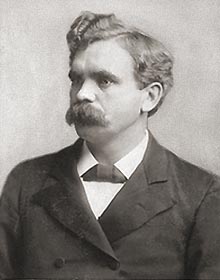
Brigham H. Roberts
(1857-1933)
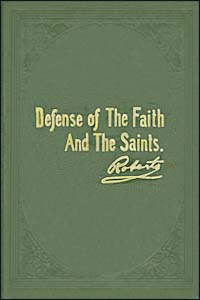
Defense of the Faith... I
(SLC: Deseret News, 1907)
  • Contents   Volume II
  • 013   Spalding claims
  • 250   Book of Mormon
  • 255   Translation
  • 315   A Brief Debate
  • 365   Spalding claims

  • Transcriber's Comments


  • 1888 Contributor  |  1903 YMMIA Manual  |  1904 YMMIA Manual  |  1904 Imp. Era
    1905 YMMIA Manual  |  1906 Imp. Era  |  1908 Am. Hist. Mag.  |  1909 New Witnesses

    (Note: Incomplete footnotes and punctuation for this text will be corrected in a forthcoming update)


    CONTENTS.

    iii  General Foreword

    001  Part I. Position and Defense.

      005  I. Mormonism: Foreword

      024  II. the Relationship Church to Christian Sects: the Doctrine of Two Churches Only.

      039  III. Some Recent Literature on Mormonism.

      081  IV. A Brief Defense of the Mormon People.

      109  V. Which of the Sects Has Opposed Mormonism Most?

      119  VI. "How."

      143  VII. Relations of Church and State: Religious Liberty in America.

      171  VIII. "Conditions in Utah." 1905.

    250  Part II. Book of Mormon Controversial questions.

      255  I. The Manner of Translating the Book of Mormon.

      313  II. A Brief Debate on the Book of Mormon.

      371  III. "The Fifth Gospel."

      401  IV. Mormon Views of America.

    443  Part III. Historical and Doctrinal Papers.

      445  I. The Lord's Day.

      461  II. Anglican Orders -- Decision of Leo XIII Considered -- The Protestant Dilemma.

      477  III. Reformation or Revolution?

      499  IV. Revelation and Inspiration.


    [ iii ]


    GENERAL  FOREWORD.
    ________


    Fifteen years ago, in announcing what was then a list of prospective books, the writer declared his intention to publish a "Scrap Book," promising that it should be a choice selection of his miscellaneous writings, and mentioned as among the probable articles, Corianton, a Book of Mormon story; Mariam, a story of Zarahemla; Spirit Promptings, etc., etc., all which are here recalled as foreshadowing the author's intention at that time. About then, however, the writer's energies began to be devoted more exclusively to doctrinal and historical themes, and one circumstance after another arose which called him to the defense of the Mormon faith and the Mormon people, so that the character of his literary efforts were turned away from the line of purpose fiction work he had proposed to himself. But the scrap-book, nevertheless, became a possibility through the multiplication of the defensive articles, though its character would be changed, owing the change in the writer's line of work. Through the years have elapsed since the "Scrap Book" idea was first entertained as a depository of the author's miscellaneous writings, a great mass of material in the form of


    iv                             GENERAL  FOREWORD.                            


    discourses and papers, contributed to magazines and newspapers has accumulated and it is from this mass of materials that following collection of articles has been chosen; and as there is still much material on hand, and the end of the writer's work is not yet in sight, he has ventured to call this Volume I, indicating by that the probability that other volumes in time will follow, if the writer is not mistaken in his judgment as to the demand for such publications.


    [ 1 ]


    Part I.

    Position and Defense.


    [ 3 ]


    I.

    MORMONISM.


    [ 5 ]


    FOREWORD.

    The following paper was prepared by the writer for presentation at the Parliament of Religions, held at the World's Columbian Exposition, Chicago, 1893. The Church of Jesus Christ of Latter-day Saints was not invited to participate in the proceedings of that Parliament, although Mormonism is the most distinctively American religious movement yet developed in our country; and as such the position and doctrine of the Church should have been of special interest in such a gathering as the Parliament purported to be. Learning that the Church would not be invited to the Parliament, under a sense of duty to make known the faith and message to the world, her presiding authorities sought opportunity for a hearing from the Parliament platform. After much solicitation and persistent urging as to the right of the Church to a hearing in such a gathering, a reluctant consent was finally given for a presentation of the following paper. But after this consent was given, a very unworthy effort was made by the President and chairman of the Parliament to side-track the paper by asking the representative of the Church to read it in one of the auxiliary departments of the Parliament, -- namely, the Scientific Department, which meetings were held in a room capable of accommodating about fifty hearers, and presided over by Mr. Mervin Marie Snell. In response to that suggestion the writer, who had the honor to the representative of the Church to the Parliament, replied that such a hearing as could be had in Hall III Department of the Parliament) was not the kind


    6                         DEFENSE  OF  THE  FAITH.                        


    of hearing the Mormon Church had asked for or could accept. She had asked to speak from the same platform from which the great religious faiths had spoken -- Christianity, Judaism, Islam, Buddhism -- from the platform of Columbus Hall, where her position and principles could be compared and contrasted with the viewpoint and doctrines of other religions, by the enlightened thought of the age. The officers in charge of the Parliament, however, refused to change the terms on which a hearing could be obtained for Mormonism, and the Church of Jesus Christ of Latter-day Saints had the distinction of being refused a hearing in the World's Parliament of Religions.


    [ 7 ]


    I.

    "MORMONISM."


    One of the most instructive as well as the most important religious movements of the nineteenth century is the rise of what the world has learned to call "Mormonism." In an age which believed that God's voice would no more be heard giving revelation; that said the volume of scripture was completed and forever closed; that declared angels would no more visit the earth to communicate the divine will; and that sedulously taught that all miracles had ceased -- the world beholds a religion arising based upon these forces that men had been taught to believe had forever become inactive. True, it has met with many obstacles in consequence of making these rejected stones of ancient Christianity the chief corner stones of its structure; but notwithstanding the fierceness of the opposition it has aroused, it is now so firmly established that it claims the respectful attention of the world.

    New religions, when struggling for existence in the face of adversity, with few followers and no influence, may expect to be treated with silent contempt by the supposedly orthodox; but when a religion has fought its way through all opposition to a position of influence, and counts within its pale hundreds of thousands of sincere and intelligent followers, it gives proof that its doctrines contain some measure of truth at least, and by reason of that fact, has a claim upon the respect and thoughtful consideration of mankind.

    Such is the position of "Mormonism." Sixty-three


    8                         DEFENSE  OF  THE  FAITH.                        


    years ago [a] the Church of Jesus Christ of Latter-day Saints was organized with but six members, in the State of New York. That organization was effected in a log room not more than fourteen feet square, by men who made no pretensions to ecclesiastical scholarship, but claimed to be directed by divine revelation. It could but be expected that the great Christian sects, by which the new church was surrounded, and that considered themselves strongly entrenched behind a fullness of religious truth -- would scoff at the pretensions of these men. But when, after a lapse of sixty-three years, the work having so humble an origin is still in existence with a membership of over three hundred thousand, it is time the scoffing ceased and earnest attention be given to its pretensions, especially when account is taken of its history between the two points indicated -- its origin and present standing.

    Within that period it has fallen to the lot of the "Mormon" Church to make more history than any other religious denomination of modern times. Ridicule has laughed at it; Satire has mocked it; Bigotry has refused to hear its defense; Hatred has slandered it; Intolerance has armed the red, right hind of persecution against it; the Government of the United States has seized upon and escheated its property; Mob Violence has opposed its promulgation by murdering its missionaries and driving its devotees from city to city, from county to county, from state to state; and the Civil Authorities refusing the protection guaranteed alike in state and national constitutions, at last permitted those who accepted its faith to be exiled from their native country.

    "Mormonism," however, has survived not only the

    __________
    [a] This was written in 1893.


                                      MORMONISM.                                   9


    violence which murdered its prophets, burned the houses of the Saints, laid waste their fields and destroyed their temples, but also an exodus which, for the distance covered and the dangers encountered, has not a parallel in ancient or modern history. Its followers settling in a desert land a thousand miles from the frontiers of civilization, like drilled cohorts made war upon the sterile elements of the inter-Rocky Mountain region, and like magic there sprang into existence, as the result of their Untiring efforts and divine blessing, cities, towns, hamlets; temples, churches, schoolhouses; peaceful homes surrounded by fruitful fields and gardens and orchards, which, with the peace and good order everywhere prevailing, challenge the admiration of all who become acquainted with the Saints and the land they inhabit.

    Meantime, the Elders of the Church, full of sublime faith and trust in God, without purse or scrip, have visited nearly all the nations of the earth and have preached the gospel to them. Not, perhaps, with that nice skill and polish which refined education in renowned institutions of learning may give, but in the power and demonstration of God's Holy Spirit; and nearly every nation under the whole heaven has given to the new faith some of its sons and daughters. By reason of this missionary work "Mormonism" is becoming recognized in the earth as one of the potent religious forces of the age, and as such claims the right to be heard in this Parliament, in giving expression to its faith and distinguishing characteristics.

    "Mormonism," like all religions which have any hold either upon the intelligence or affections of men, has, as its foundation principle, faith in God, the Creator of heaven and earth and the Power by which they are sustained. But


    10                         DEFENSE  OF  THE  FAITH.                        


    "Mormonism" not only believes in this fundamental truth of all religions, but it has another belief equal unto it, viz., that Jesus Christ is the Son of God, and who through the atonement made by him on Calvary, is the Savior of the world. These two personages and the Holy Ghost, that divine Spirit which bears, record of God and operates throughout the universe as his witness and agent, constitute the God-head -- the Holy Trinity, the Grand Presidency of heaven and earth. In attributes, in purpose, in will, these three are one; perfectly united in mind and action.

    To this great Presidency, "Mormonism" teaches that man owes praise, adoration, and as best of all worship -- obedience; for submission of the mind and the will to God, is alone true worship. Such a result as this can only be obtained through faith, for he who cometh thus to God must believe that he is. But the evidences of God's existence are so overwhelming that none shall be able to find an excuse for unbelief. Such evidences are to be found in the works of God as seen in the works of nature. The orderly procession of the seasons proclaim it; and when man uplifts his eyes from earth to the dome of heaven stretched above him, he beholds, like the Psalmist, the evidences of God's existence and of his majesty and glory. The unbroken line of testimony of prophets and righteous men as recorded it, the Jewish Scriptures, both in the old and New Testament, bear witness of it. But to this testimony, the common inheritance of all Christendom, "Mormonism" adds special evidences of its own. It has prophets, who, through righteousness and faith, coupled with the grace of God, have stood in his presence, heard his voice, and beheld in part, his glory. They bear record that God lives, and that Jesus is


                                      MORMONISM.                                   11


    the Christ; and that testimony, like the ancient prophets, they have sealed with their blood.

    To the volume of Jewish scripture "Mormonism" adds a volume equal in bulk and equal in importance to the New Testament -- the Book of Mormon. This book is an abridgement of more extensive records kept by the ancient-inhabitants of the western hemisphere, the existence of which was revealed to the Prophet Joseph Smith by the ministry of an angel and translated by him into the English language by means of the Urim and Thummim hidden with the golden plates upon which the record was engraven.

    From this new volume of scripture we learn that the mercies and favors of God are not confined to the inhabitants of the eastern hemisphere; but he of whom it is said that he is "no respecter of persons," had regard for the races of men who inhabited the western half of the world. He raised up wise men and prophets among them to whom he revealed his will, made known his purposes concerning the creation of man, and taught him the way of life. Previous to the coming of the Son of God in the flesh, their prophets taught this ancient people as Isaiah, Jeremiah and others taught the Jews, to look forward to the coming of Messiah, to make an atonement for the sins of the world. And when Jesus had completed his mission to the Jews in Palestine, in fulfillment of his own prophecy which says, "I lay down my life for the sheep; and other sheep I have which are not of this fold: them also I must bring, and they shall hear my voice, and there shall be one fold and one shepherd," -- in fulfillment of this, I say, he visited the land of America, revealed himself to the people, taught the same divine truths which warmed the hearts and purified the lives of men of good will in Palestine; gave them the same ordinances of


    12                         DEFENSE  OF  THE  FAITH.                        


    salvation; and organized the church in their midst for their instruction in righteousness.

    Of these things their poets sang, their prophets wrote; and when, through wickedness, anarchy overthrew their civilization, righteous men hid away their records that in the last days they might come forth and be united with the testimony of prophets and men of God who had lived in other lands; to the end that the evidences of God's existence, the Messiahship of Jesus Christ, and the truth of the gospel might be so increased that unbelief would have no excuse for its infidelity; and that they who scoff at faith might be reproved and learn to believe.

    One thing has occurred to me while in attendance at this Parliament which has raised in importance the humble part allotted to me in it; and that is, while we have heard from this platform voices from all nations and races of men -- voices from Asia, from Europe, from Africa and the islands of the sea; we have had voices from the dead religions and the living religions, and they have united in saying that in all these lands and in all ages God has not left himself without witnesses among them, but has raised up prophets among them who taught them at least some measure of the truth -- perhaps all they could accept and incorporate in their lives. But where is the voice to tell us that God remembered the races and nations which flourished for ages throughout this whole western hemisphere before Europeans discovered it? Races that had attained a high state of civilization, too, as proclaimed by the ruins of their temples and cities. Are we to suppose that they were without God while all the rest of mankind found him? Perish the thought. If no other voice is to be heard proclaiming that God was just and merciful to these races, and that he revealed


                                      MORMONISM.                                   13


    himself to them -- then let the pleasing task be mine, and here in this august presence I proclaim the revelation of their record which bears witness of God's goodness to them; and that record is the Book of Mormon.

    A word further in regard to that book. Men have usually satisfied themselves as to its origin by accepting that flimsiest of all theories that it was the production of one Rev. Solomon Spaulding, who wrote it as a romance. This theory of its origin, without any investigation, has generally satisfied those who have heard it. In 1886, however, the long lost manuscript of the Rev. Mr. Spaulding unexpectedly came to light, has been identified beyond the peradventure of a doubt, and is now in the possession of President James H. Fairchild of Oberlin College, Ohio, or rather is in the museum of that institution for the inspection of all. It has been published by the Church, every word of it, with even the erasures made by its author so far as they can be deciphered, and lo there is not an incident, not a circumstance, not a proper name either of place or person, nor any similarity of construction or purpose common to the Book of Mormon and Mr. Spaulding's production. President Fairchild himself says that whatever theory shall be put forth for the origin of the Book of Mormon, the Spaulding theory must be abandoned.

    By accepting the records of the ancient peoples of America the "Mormons" have double the amount of evidence for the existence of God and the truth of the gospel that other people possess; and since faith must ever have its foundation in evidence, the enlarged evidences accepted by "Mormons" must account for that mightier faith which both their sufferings and their works proclaim they possess.

    In "Mormon" theology the atonement of Jesus Christ


    14                         DEFENSE  OF  THE  FAITH.                        


    redeems all mankind from the consequences of Adam's transgression, irrespective of their belief or unbelief, their obedience or their disobedience, their righteousness or their unrighteousness. It is manifestly evident that the "Fall of Adam" was essential to the accomplishment of the divine purposes of God in the earth-life of man; which earth-life was designed for man's progress in that eternal existence which unquestionably is his. But being a necessity from the nature of things, an essential to the production of those conditions which would place man in a state of probation, in which he might gain those experiences, demonstrate that fidelity, and acquire the strength that shall make him both worthy of, and able to bear, that eternal weight of glory designed of God for those able to overcome the evils of earth-life -- its temptations and sins -- the "Fall of Adam," I say, being necessary to bring to pass the conditions of this earth probation for man, it is but just that there should be some means of free and universal redemption from the effects of it. For while man, may be held accountable for his personal conduct under given conditions that do not take from him his freedom, nor the power to will and to do what is required, he may not in justice be held accountable for the existence of necessary conditions that establish the state of probation under which he consents to work. Free and universal redemption, therefore, is provided for man from those effects that result from necessity; and hence the Church teaches that "men will be punished for their own Sins and not for Adam's transgressions." [e]

    But quite apart from the transgression of Adam is man's individual violations of the laws of righteousness --

    __________
    [e]


                                      MORMONISM.                                   15


    violations of the laws of God in which man's agency is exercised; for he sins at times willfully and wantonly; knowing the right, he dares to do wrong. Here justice has a claim upon him and may demand the payment of the penalty to the uttermost. But the mercy of God as well as his justice is active, and offers redemption from the consequences of individual transgressions on the condition of obedience to the laws and ordinances of the Gospel.

    These laws are not intricate, baffling the understanding. The ordinances are neither numerous nor difficult of performance; but in the plan of man's salvation, as in all other works of Deity, simplicity marks its outlines and efficiency justifies its adoption. The laws and ordinances referred to have not for their chief object the propitiation of the anger of God as the old Pagan ordinances of religion had; but on the contrary, by their nature and operation, they affect the character of man, and are calculated to so purify and exalt his nature as to prepare him to dwell in endless felicity in the presence and companionship of his Maker.

    Of necessity Faith in God and in this plan of salvation is of first importance, and must be an active principle in the mind, for without it men would consider themselves under no obligation to yield obedience to any ordinance whatsoever. The reason the infidel does not repent, or perform any other act of obedience, is because he has or pretends to have no faith in the existence of God. As from the rising sun there beams those rays of light which streak the heavens with glory, so from faith spring those acts of obedience required in the gospel of Jesus Christ. First among these acts is repentance, which consists not alone in deep and heartfelt sorrow for sin, but coupled with it must be a firm determination


    16                         DEFENSE  OF  THE  FAITH.                        


    of amendment of Conduct. It must be a godly sorrow working a reformation of life. Following repentance comes baptism in water by which men take on them the name of Christ, through which ordinance also they receive, when it is preceded by faith and true repentance, forgiveness of sins. But even after a remission of sins, such is the weakness of human nature that man is not able to stand by his own strength, he needs divine aid: hence, God has ordained that through the ordinance of confirmation by the laying on of hands, the Holy Ghost shall be imparted unto man as a comforter and guide, and by giving heed to his voice man shall overcome the old inclinations to evil, and at last so purify and sanctify himself that he will be worthy to dwell in the presence of his God.

    As a further means of grace, the Church of Jesus Christ recognizes the sacrament of the Lord's Supper, by which men may frequently renew their covenant with God and witness to each other that they are willing to take upon them the name of Jesus Christ, gratefully remember the atonement he has made for them, express a willingness to keep his commandments, and by doing so draw to themselves a constant renewal of the Spirit of God.

    Few and simple as these ordinances are, the Church teaches that in order to be of effect they must be administered by divine authority. No man can take the honor upon himself to administer in things pertaining to God. He must be called by direct revelation from God, or be by a divinely authorized power. Here is where "Mormonism" comes in conflict with all Christendom. Men even the early centuries of the Christian era having the laws, changed the ordinances, broke the covenant, and lost divine authority to administer the Gospel


                                      MORMONISM.                                   17


    of Jesus Christ -- though the letter of the Gospel remained in part with the world in the writings of the ancient Apostles -- there arose a necessity for the re-opening of the heavens and a restoration of that priesthood which alone can administer the ordinances of salvation.

    That is the significance of the revelations of God and the visitation of angels to Joseph Smith. To him was revealed anew the gospel, to him was committed a new dispensation of it, and angels bestowed upon him the apostleship, the fullness of all priesthood which God gives to man in the earth, and by its power Joseph Smith and those to whom he transmitted authority preached the gospel. By the power of that priesthood they organized the Church of Christ never more to be destroyed; sustained and upheld by that power the Church has outlived all the opposition arrayed against it, and stands today planted impregnably upon the eternal foundations of truth.

    But notwithstanding the absence of the gospel and the authority to administer its ordinances, the children of God living through those dark ages will not be deprived of its saving powers. That must be a very contracted view of the great plan of human redemption which would confine its operations to the brief span of man's existence in this life. "Mormonism" holds no such view. On the contrary, it teaches that the gospel is everlasting; that it walks beside man throughout eternity; and means for its application to him have been provided by the mercy of God. It may be that "Mormonism" does not stand alone in this broad conception of the application of the gospel to our race; but while others are speculating as to whether it is possible or not for man to attain unto repentance and forgiveness of sins in his future existence, "Mormonism" is erecting temples


    18                         DEFENSE  OF  THE  FAITH.                        


    to the name of the Most High, and within their sacred walls the Saints are vicariously performing the ordinances of salvation for those who have passed from the earth when the gospel and authority to administer it were not among the children of men. Such is the conception that Mormonism holds and teaches of the gospel of Jesus Christ and its application to mankind; and surely one may see in this conception the fullness of that glorious scripture which says: God, our Savior, would have all men to be saved, and come unto the knowledge of the truth. (I Timothy 2: 3, 4.)

    If asked what the distinguishing characteristics of "Mormonism" are, I should answer:

    The acceptance of Jesus Christ as the full and complete revelation of God to man, in person and in attributes; that as Jesus was and is, -- for to us he still lives, a resurrected, glorified man -- so is God, the Father -- a perfected man. This is only saying that as "the Son is, so also is the Father."

    The belief that the spirit of man is in very deed the child of God -- his offspring; that men in reality are brothers to Jesus Christ, and to each other.

    A more pronounced faith than is possessed by other people in the imminence of God in the world and in men, through the medium of the divine spirit.

    A positive belief in present and continuous revelation.

    A broader conception of God's treatment of men in the matter of revealing himself and his purposes to them.

    Acknowledging an inspired priesthood, authorized to direct the affairs of, and instruct the Church.

    The possession of a living faith which lays hold of all the promises made in the gospel of Jesus Christ; personal


                                      MORMONISM.                                   19


    communion with God through the Holy Spirit, and enjoyment of all the spiritual gifts and graces granted to the saints in any age of the world.

    If asked what special benefits "Mormonism" has conferred upon mankind, my answer would be: 1st. That it presents to the world the fullness of the gospel, with the authority to administer its ordinances; that through obedience to it men may attain unto all those gifts, graces and powers known to the ancient saints. It assures them that God in his relationship to men, is the same today as he was nineteen centuries ago, that the gospel is the same now as it ever was, and all spiritual graces and powers that man ever attained to he may possess today. 2nd. That in the testimony of modern prophets and saints the evidences of God's existence and the truth of the gospel are so enlarged that the unbelief which today distresses the religious world and limits the extension of Christianity would be swept away. 3rd. That in the Book of Mormon there is evidence of the authorship of the Jewish scripture of which Christendom in the face of modern criticism -- commonly called the "Higher Criticism" -- stands much in need. That criticism, as is well known, is not directed so much to textual errors which may have found their way into the great collection of sacred books, as it is to utterly destroy, the authorship and, all idea of the divine inspiration of them. This modern criticism has decided that Moses is not the author of the Pentateuch, and indeed, the authorship not only of the Pentateuch but of nearly all the prophets and even the books of the New Testament is unsettled in the minds of many. The Book of Mormon gives an account of a colony of Israelites that left Palestine six hundred years before Christ, which


    20                         DEFENSE  OF  THE  FAITH.                        


    colony carried with it a copy of the law of Moses and the writings of the Prophets down to the days of Jeremiah. These scriptures they preserved with great care, handing them down from generation to generation, and from them both they and their descendants learned of the hand dealings of God with his children in ancient times. When the civilization of these people on the Western Hemisphere was overthrown, and their records in order to preserve them were hidden by righteous men, the truths which their fathers had learned from them were preserved -- though somewhat distorted -- in their traditions. Thus is accounted for the knowledge of the creation, the flood, the coming of the Messiah, which Europeans found among the races inhabiting America at the time of its discovery. Portions of the ancient Jewish Scriptures which these colonists brought with them to America were transcribed into the Book of Mormon, and there they stand in the translations that have been made of it to testify not only to the existence of the writings of Moses and the other prophets at least six hundred years before Christ, but to testify also that the records which have come down to us from the Jews are substantially correct. More important as confirming the accuracy and inspiration of the Jewish Scriptures, more potent to silence the new forms of unbelief which have arisen in modern times, more powerful to confirm the faith of believers in God's word is this new volume of scripture -- the voice of nations of people who sought and found God -- than all the newly deciphered hieroglyphics of Egypt, or the still more recent evidences that come from the ancient cities of Assyria: and for this reason we make bold to invite the attention of our Christian brethren to the consideration of this New Witness for God.


                                      MORMONISM.                                   21


    Besides preaching the Gospel for the salvation of men, "Mormonism" has an especial mission, viz: to prepare the earth for the coming and reign of Messiah. This mission authorizes the servants of God to warn mankind of the judgments which shall precede that appearing, and to call upon all men to repent of their sins, that they may escape the threatened calamities. This preparatory work includes the gathering together of the dispersed tribes of Israel and placing them in possession of the lands which God, by covenant, gave to their fathers. It contemplates the erection of a great city upon this continent of America to be called "Zion," the abode of the pure in heart, from whence the law of God shall go forth to all the world. It contemplates the restoration of the Jews to the city of their forefathers, the rebuilding of Jerusalem, from whence shall go forth the word of the Lord.

    Then shall the earth rest from its wickedness, as all the prophets have predicted; then shall peace and truth and righteousness spread over all the world, and all the tribes and kindreds of men shall know how pleasant it is for brethren to dwell together in unity.

    Splendid as this consummation is, "Mormonism," instructed by divine wisdom, looks even beyond it, and contemplates the time when this earth shall receive even a fuller redemption, and become a celestial sphere, the abode of resurrected, celestial beings forever, who shall dwell always in the presence of God.

    In conclusion, let me say that "Mormonism" accepts and includes within its boundary-lines all truth. It is progressive and is destined to become the religion of the age. Within it is scope for all the intelligence that shall flow unto it. "Within its atmosphere is room for every intellectual


    22                         DEFENSE  OF  THE  FAITH.                        


    wing." It does not, as some have supposed, thrive best where ignorance is most profound, nor does it depend upon superstition and ignorance for its existence and perpetuity. It possesses within itself principles of native strength that will enable it to weather every storm, outlive all hatred born of ignorance and prejudice; and it will yet prove itself to be what indeed it is, the gospel of Jesus Christ, the power of God unto Salvation to all those who believe and obey it, the Church of Jesus Christ.


    [ 24 ]


    II.

    THE RELATIONSHIP OF THE CHURCH TO
    THE CHRISTIAN SECTS:
    THE DOCTRINE OF TWO CHURCHES ONLY.


    [ 25 ]


    FOREWORD.


    The following is an address delivered at the seventy-sixth Annual Conference of the Church, held at Salt Lake City, in April, 1906.

    The remarks consider two very important statements in our authoritative books. The first one is found in the Pearl of Great Price, where the prophet Joseph states what the answer to his question was, when asking the Lord which of the sects was the true Church, and which he should join. Of that incident he said:

    "I was answered that I must join none of them, for they were all wrong; and the personage who addressed me said that all their creeds were an abomination in his sight; that those professors were all corrupt:"

    The second statement is in the Book of Mormon, where the declaration is made that,

    "There are, save two churches only; the one is the church of the Lamb of God, and the other is' the church of the devil; wherefore, whoso belongeth not to the church of the Lamb of God, belongeth to that great church, which is the mother of abominations; and she is the whore of all the earth."

    The first of these statements, it is claimed, not only "unchurches all Christians," but proclaims the universal corruption of individual Christians. The second statement is generally supposed to stigmatize the Church of Rome as the church of the devil. Both these questions are considered in the article which follows.


    26                         DEFENSE  OF  THE  FAITH.                        


    I.

    The Relationship of the Church to the Christian Sects:
    the Doctrine of Two Churches Only.

    Among the things important for the Saints of God .to understand, among the things important for the world to understand respecting the Latter-day Saints, is the relationship that we sustain to the religious world; and I do not know that there is anything to which I could devote the few minutes at my disposal to better advantage than in pointing out that relationship, if I can obtain, through your faith and mine, the liberty that comes from the possession of the Spirit of the Lord.

    The first revelation that the Lord gave to the Prophet Joseph Smith had a bearing upon this subject. You remember that the Prophet went to the Lord to ascertain which of all the sects of religion was his church, desiring, of course, to unite himself with that church which the Lord would designate as his. In reply to that question the Lord, in substance, said that all the sects were wrong; that he did not acknowledge them as his church ;"their creeds were an abomination in his sight; those professors were all corrupt;" [a]

    __________
    [a]


                   THE  RELATIONSHIP  OF  THE  CHURCH.                27


    and the Prophet was told that he must join none of them, but was promised that in due time he would be used as God's instrument in the establishment of the Church of Christ in the earth.

    Because of this great revelation, by which the errors of ages were swept aside and the ground cleared for the re-establishment of the Church of Christ among men, it has placed us, in a way, in an attitude of antagonism to the religious world. We have been resisted to some extent because of this attitude of antagonism; and it is quite possible that we ourselves have not understood the true relationship in which we stand to the religious world, by more or less of misapprehension respecting this great revelation. I rejoice in the plainness and emphasis of this revelation, because from it I am made to realize that there is a very important reason for the existence of the work with which we are identified. I am glad to know that "Mormonism" did not come into existence because its founders chanced to disagree with prevailing notions about the form or object

    __________


    28                         DEFENSE  OF  THE  FAITH.                        


    of baptism; that it did not come into existence through a disagreement as to the character of the government of the Church. From the revelation referred to I learn that "Mormonism" came into existence because there was an absolute necessity for a new dispensation of the gospel, a re-establishment of the Church of Christ among men. The gospel had been corrupted; its ordinances had been changed; its laws transgressed its truths so far lost to the children of men that it rendered this new dispensation of the gospel of Christ -- miscalled "Mormonism" -- necessary. I say that I rejoice in the fact that "Mormonism" came into the world, and exists in the world today, because the world stood and stands in sore need of it. But does this re-establishment of the Church of Christ, this new dispensation of the gospel, which we have received, make our relationship to the children of men one of unfriendliness? I answer, No. On the contrary our relationship to men is one of absolute friendliness, and we are anxious to do the world good. We ought to understand that. We do understand it. And it is important that the world should understand it, that they may come to regard us in our true light, as friends of humanity, and not enemies.

    If you will look through some of the revelations given in the early history of the church, you will find that from time to time the Lord was under the necessity of correcting the ideas of the brethren respecting their attitude towards religious world. The Lord said to Martin Harris, by of correction:

    "Thou shalt declare glad tidings, yea, publish it upon the mountains, and upon every high place, and among people that thou shalt be permitted to see. And thou shalt


                   THE  RELATIONSHIP  OF  THE  CHURCH.                29


    do it with all humility, trusting in me, reviling not against revilers. And of tenets thou shall not talk, but thou shall declare repentance and faith on the Savior, and remission of sin by baptism and by fire, yea, even the Holy Ghost."

    The Prophet also from time to time found it necessary to correct the Elders of the Church in respect of their attacks upon other churches. At Kirtland, in 1836, when many of the Elders were upon the eve of taking their departure for their fields of labor, he instructed them as follows:

    "While waiting [for the Sacrament] I made the following remarks: The time that we were required to tarry in Kirtland to be endowed would be fulfilled in a few days, and then the Elders would go forth, and each stand for himself . . . . to go in all meekness, in sobriety, and preach Christ and him crucified; not to contend with others on account of their faith or systems of religion, but pursue a steady course. This I delivered by way of commandment; and all who observe it not, will pull down persecution upon their heads, while those who do, shall always be filled with the Holy Ghost; this I pronounced as a prophesy." [b]

    In other words, because the Lord has opened the heavens and has given a new dispensation of the gospel, it does not follow that his servants or his people are to be contentious; that they are to make war upon other people for holding different views respecting religion. Hence this caution to the Elders of the Church that they should not contend against other churches, make war upon their tenets, or revile even the revilers.

    At an earlier date still, the Lord had said to Oliver Cowdery and David Whitmer:

    "If you have not faith, hope and charity, you can do nothing. Contend against no church, save it be the

    __________
    [b]


    30                         DEFENSE  OF  THE  FAITH.                        


    church of the devil. Take upon you the name of Christ, and speak the truth in soberness." [c]

    "The church of the devil" here alluded to, I understand to mean not any particular church among men, or any one sect of religion, but something larger than that -- something that includes within its boundaries all evil wherever it may be found; as well in schools of philosophy as in Christian sects; as well in systems of ethics as in systems of religion -- something that includes the whole empire of Satan -- what I shall call "The Kingdom of Evil."

    This descriptive phrase, "the church of the devil," is also used in the Book of Mormon; and while in attendance at a conference in one of the border stakes of Zion, a question was propounded to me in relation to its meaning. The passage occurs in the writings of the first Nephi. An angel of the Lord is represented as saying to Nephi, "Behold, there are save two churches only: the one is the church of the Lamb of God, and the other is the church of the devil." The question submitted to me was, "Is the Catholic church the church here referred to -- the church of the devil?.... Well," said I, in answer, "I would not like to take that position, because it would leave me with a lot of churches on my hands that I might not then be able to classify." So far as the Catholic church is concerned, I believe that there is just as much truth, nay, personally I believe it has retained even more truth than other divisions of so-called Christendom; and there is just as much virtue in the Roman Catholic church as there is in Protestant Christendom; and I am sure there is more strength.

    I would not like; therefore, to designate the Catholic church as the church of the devil. Neither would I like to

    __________
    [c]


                   THE  RELATIONSHIP  OF  THE  CHURCH.                31


    designate any one or all of the various divisions and subdivisions of Protestant Christendom combined as such church; nor the Greek Catholic church; nor the Buddhist sects; nor the followers of Confucius; nor the followers of Mohammed; nor would I like to designate even the societies formed by deists and atheists as constituting the church of the devil. The Book of Mormon text ought to be read in connection with its context -- with the chapter that precedes it and the remaining portions of the. Chapter in which the expression is found -- then, I think, those who study it in that manner will be forced to the conclusion that the prophet here has in mind no particular church, no particular division of Christendom, but he has in mind, as just stated, the whole empire of Satan; and perhaps the thought of the passage would be more nearly expressed if we use the term "the Kingdom of Evil" as Constituting the church of the devil, in proof of which I submit the following passage from the Book of Mormon -- covering both the text and the context on the subject:

    1. And it shall come to pass, that if the Gentiles shall hearken unto the Lamb of God in that day that he shall manifest himself unto them in word, and also in power, in very deed, unto the taking away of their stumbling blocks;

    2. And if they harden not their hearts against the Lamb of God, they shall be numbered among the seed of thy father [Lehi; an Israelite]; yea, they shall be numbered among the house of Israel; and they shall be a blessed people upon the promised land for ever; they shall be no more brought down into captivity; and the house of Israel shall no more be confounded;

    3. And that great pit which hath been digged for them, by that great and abominable church, which was founded by the devil and his children, that he might lead away the souls of men down to hell; yea, that great pit which hath been


    32                         DEFENSE  OF  THE  FAITH.                        


    digged for the destruction of men, shall be filled by those who digged it, unto their utter destruction, saith the Lamb of God; not the destruction of the soul, save it be the casting of it into that hell which hath no end;

    4. For behold, this is according to the captivity of the devil, and also according to the justice of God, upon all those who will work wickedness and abomination before him.

    5. And it came to pass that the angel spake unto me, Nephi, saying, Thou hast beheld that if the Gentiles repent, it shall be well with them; and thou also knowest concerning the covenants of the Lord unto the house of Israel; and thou also hast heard, that whoso repenteth not, must perish;

    6. Therefore, wo, be unto the Gentiles, if it so be that they harden their hearts against the Lamb of God;

    7. For the time cometh, saith the Lamb of God, that I will work a great and a marvellous work among the children of men; a work which shall be everlasting, either on the one hand or on the other; either to the convincing of them unto peace and life eternal, or unto the deliverance of them to the hardness of their hearts and the blindness of their minds, unto their being brought down into captivity, and also into destruction, both temporally and spiritually, according to the captivity of the devil, of which I have spoken.

    8. And it came to pass that when the angel had spoken these words, he said unto me, Rememberest thou the covenants of the Father unto the house of Israel? I said unto him, Yea. And it came to pass that he said unto me, look, and behold that great and abominable church, which is the mother of abominations, whose foundation is the devil. And he said unto me, behold there are, save two churches only; the one is the church of the Lamb of God, and the other is the church of the devil; wherefore, whoso belongeth not to the church of the Lamb of God, belongeth to that great church, which is the mother of abominations; and she is the whore of all the earth.

    47. And it came to pass that I looked and beheld the whore of all the earth, and she sat upon many waters; and


                   THE  RELATIONSHIP  OF  THE  CHURCH.                33


    she had dominion over all the earth, among all nations, kindreds, tongues, and people.

    48. And it came to pass that I beheld the church of the Lamb of God, and its numbers were few, because of the wickedness and abominations of the whore who sat upon many waters; nevertheless, I beheld that the church of the Lamb, who were the saints of God, were also upon all the face of the earth; and their dominions upon the face of the earth were small, because of the wickedness of the great whore whom I saw.

    49. And it came to pass that I beheld that the great mother of abominations did gather together multitudes upon the face of all the earth, among all the nations of the Gentiles, to fight against the Lamb of God.

    50. And it came to pass that I, Nephi, beheld the power of the Lamb of God, that it descended upon the saints of the church of the Lamb, and upon the covenant people of the Lord, who Were scattered upon all the face of the earth; and they were armed with righteousness and with the power of God in great glory.

    51. And it came to pass that I beheld that the wrath of God was poured out upon the great and abominable church, insomuch that there were wars and rumors of wars among all the nations and kindreds of the earth, and as there began to be wars and rumors of wars among all the nations which belonged to the mother of abominations, the angel spake unto me, saying, Behold, the wrath of God is upon the mother of harlots; and behold, thou seest all these things:

    17. And when the day cometh that the wrath of God is poured out upon the mother of harlots, which is the great and abominable church of all the earth, whose foundation is the devil, then, at that day, the work of the Father shall commence, in preparing the way for the fulfilling of his covenants, which he hath made to his people, who are of the house of Israel.


    34                         DEFENSE  OF  THE  FAITH.                        


    I understand the injunction to Oliver Cowdery to "contend against no church, save it be the church of the devil," to mean that he should contend against evil, against untruth, against all combinations of wicked men. They constitute the church of the devil, the kingdom of evil, a federation of unrighteousness; and the servants of God have a right to contend against that which is evil, let it appear where it will, in Catholic or in Protestant Christendom, among the philosophical societies of deists and atheists, and even within the Church of Christ, if, unhappily, it should make its appearance there. But, let it be understood, we are not brought necessarily into antagonism with the various sects of Christianity as such. So far as they have retained fragments of Christian truth -- and each of them has some measure of truth -- that far they are acceptable unto the Lord; and it would be poor policy for us to contend against them without discrimination. Wherever we find truth, whether it exists in complete form or only in fragments, we recognize that truth as part of that sacred whole of which the Church of Jesus Christ is the custodian; and I repeat that our relationship to the religious world is not one that calls for the denunciation of sectarian churches as composing the church of the devil. All that makes for untruth, for unrighteousness constitutes the kingdom of evil -- the church of the devil. All that makes for truth, for righteousness, is of God; it constitutes the kingdom of righteousness -- the empire of Jehovah; and, in a certain sense at least, constitutes the Church of Christ. With the latter -- the kingdom of righteousness -- we have no warfare. On the contrary both the spirit of the Lord's commandments to his servants and the dictates of right reason would suggest that we seek to enlarge this kingdom of righteousness both by recognizing such truths as it possesses


                   THE  RELATIONSHIP  OF  THE  CHURCH.                35


    and seeking the friendship and co-operation of the righteous men and women who constitute its membership.

    Running parallel with these thoughts, I may be pardoned if I call your attention to a remark I made in one of these general conferences some time ago, to the effect that when misrepresentations are made of us, or of our faith, or when persecution arises against us, it must not embitter our minds, or make us feel hateful toward our fellowmen, or lead us to regard the whole world as our enemies. We must keep the sweetness of our own disposition. The language of the Savior wherein he says, "Marvel not if the world hate you: it hated me before it hated you, if you were of the world, the world would love its own," etc., I contended then and believe now that the truth of that declaration will be more plainly seen if we read it in this way: "Marvel not if the worldly hate you." If the ungodly, if those who make and love a lie -- if such classes as these hate you, marvel not; for they were the classes that hated the Christ and the light and truth that he brought into the world, because their deeds were evil, and his light and truth were a reproof to their evil ways. And as we say concerning the "Kingdom of Evil," so we say with reference to those who hate the truth and make war upon the righteous, they are not of any one cult, or confined to any one sect or division of the religious world, but, unhappily, are found here and there among all classes of people, among all Christian sects, among all religions and sects of philosophy. We ought to rightly divide, not only the word of truth, but the wicked and the ungodly from those who in common with us are seeking to know God and to keep his commandments. And there are millions who are hungering and thirsting for that knowledge; and we from time to time shall find them and lead


    36                         DEFENSE  OF  THE  FAITH.                        


    them into God's temple of truth, where they shall be satisfied at the feast that the Lord is preparing for all those who hunger and thirst after righteousness.

    The purpose of the Lord in instituting his Church in the earth is very beautifully set forth in one of the revelations in the D&C, as follows:

    "If this generation harden not their hearts, I will establish my Church among them. Now I do not say this to destroy my Church, but I say this to build up my Church. Therefore, whosoever belongeth to my Church need not fear for such shall inherit the kingdom of heaven. But it is they who do not fear me, neither keep my commandments, but build up churches unto themselves to get gain, yea, all those that do wickedly and build up the kingdom of devil; yea, verily, verily, I say unto you, that it is they that I will disturb, and cause to tremble and shake to the center."

    From this it very clearly appears that the purpose of God in the introduction of the Dispensation of the Fulness of Times was not to destroy any truth that existed in the world, but to add to that truth, to increase it, and to draw together all truth and develop it into a beautiful system which men may rest contented, knowing God and their relationship to him, knowing of the future and their relation to that future.

    We should present our message to the world in spirit of peace, charity and longsuffering; and avoid contention; for as our Book of Mormon tells us, he that the spirit of contention is not of God. I would the world could understand the unselfishness of our motives in presenting the gospel of Jesus Christ to them; if they could only know that our only desire was that they should come to a knowledge of the great principles of truth that are so comforting


                   THE  RELATIONSHIP  OF  THE  CHURCH.                37


    to us; that we desire their repentance and acceptance of the fulness of the truth, only that they might find favor with God, and share in our hopes of that eternal life which God, who cannot lie, promised before the world began -- if our fellowmen could be made to understand that this is our only purpose, it seems to me that many of the barriers that now separate us from our fellowmen would be broken down, and we would be able to reach the hearts of the people. I believe that as time passes and we become wiser in the methods of work we adopt, we will do that more and more, causing not only hundreds of thousands but millions of our Father's children to partake of those great blessings that the Gospel has brought to us. To make known these truths and cause the children of men to participate in the blessings that we ourselves enjoy, we yearly send hundreds of our Elders to the various nations of the earth. They sacrifice the pleasant associations of home, the society of wives and children, parents and friends; they sacrifice professional advantages and business opportunities; and sometimes sacrifice health and even life itself to proclaim to the world the truth which God has made known to us -- enduring the world's reproach and contumely, because the world does not understand them nor their message; and there is still need, of the prayer on our part, "Father, forgive them, they know not what they do." For the benefit of those who have passed away from the earth without a knowledge of the great truths and saving power of the gospel of Christ, we rear costly temples, whose spires pierce the skies of our beloved Utah; and within them at great sacrifice of time and means, the saints of God assemble to apply the principles and ordinances of the everlasting gospel to those who have passed away without the privilege of accepting


    38                         DEFENSE  OF  THE  FAITH.                        


    them while upon the earth. A more completely unselfish work than this does not exist among men. On every hand the work of God bears the stamp of unselfishness upon it. Our Book of Mormon says: "The laborers in Zion shall labor for Zion; for if they labor for money, they shall perish." So through all the communications of God to his people shines the glorious principle of absolute unselfishness. Not only is it to be found in the words of our books, but a like testimony is written in the works of the Latter-day Saints -- in their actions. Everywhere unselfishness abounds in the Church of Christ, both in theory and practice. Now, if we can only get the people of the world to understand this fact of unselfishness -- this very genius of Mormonism -- if they could be made to know that Mormonism is here to do good, to raise mankind from the low levels on which men are content to walk to the higher planes where God would have them walk, that they might have sweet fellowship with God, much of our difficulty in preaching the gospel would disappear. May the Lord hasten the day when the world shall know the Saints and the work of God better.


    [ 39 ]


    III.

    SOME  RECENT  LITERATURE  ON  MORMONISM.


    [ 40 ]


    FOREWORD.

    The following brief discussion of Mr. I. Woodbridge Riley's work, is an address delivered at the Seventy-fourth Semi-Annual Conference of the Church, held in Salt Lake City, Oct. 5, 1903. Mr. Riley's book of 446 pages is a well written thesis on the "Founder of Mormonism," and was published in 1902. It is a psychological study of Joseph Smith the Prophet. The purpose of the work is set forth in the author's preface, as follows:

    "The aim of this work is to examine Joseph Smith's character and achievements from the standpoint of recent psychology. Sectarians and phrenologists, spiritualists and mesmerists have variously interpreted his more or less abnormal performances, -- it remains for the psychologist to have a try at them."

    The work also has an introductory preface by Professor George Trumbull Ladd, of Yale University, in which Mr. Riley's essay is very highly praised. Indeed, the work was offered to the Philosophical Faculty of Yale University as a thesis for the degree of Doctor of Philosophy, and before this the matter of the essay had been utilized in 1898 for a Master of Arts thesis, under the title of "Metaphysics of Mormonism," so that from these circumstances we may venture the remark that Mr. Riley's book is of a highly scientific character, at least in its literary structure, and has already attracted some considerable notice in the world.


    [ 42 ]


    I.

    "THE  FOUNDER  OF  MORMONISM."

    Some of you perhaps are aware of the fact that I have been giving some attention of late to the literature on Mormonism; not only that which we ourselves publish, but that also which is Published by others. The publications on Mormonism during the last five years, I believe, are more numerous than in any twenty years previous to that time. The last five years have witnessed an awakening of thought upon our religion. More, and ever more attention is being given to it. More newspaper articles, more magazine articles, more volumes -- some of them quite pretentious -- have been written on Mormonism than ever before, and indicate the universal interest taken in the subject. The books and magazine articles have been written from various standpoints, some of them in the old spirit of bitterness, and some of them are intended to be written in a spirit of fairness. Yet I marvel at their author's ideas of fairness. One work, written by a noted professor, pretending to be an impartial history, and issued by one of the first publishing houses in the United States, with the view, evidently, of establishing a standard history of Mormonism, gives full credence to everything that has been said against us, but the author frequently cautions his readers against quotations he makes from our own works -- and yet that book is put forth as an impartial history of Mormonism! Some have attempted to write from a philosophical standpoint, but with the result that they plainly manifest that they have not yet reached foundation principles


                      "THE  FOUNDER  OF  MORMONISM."                   43

    upon which they can satisfactorily account for Joseph Smith, the Prophet, and the great work he accomplished. When I see men shifting their grounds, and advancing first one theory and then, another to account for Mormonism, and there is confusion among them, uncertainty, indecision -- I know that the citadel of our mighty faith is secure from harm from their attacks; that Mormonism cannot fall a victim to their philosophies or their arguments.

    Let me, for a little while, draw your attention to at least one of the so-called philosophical solutions of Mormonism, a scientific accounting for Joseph Smith. The work I allude to was offered to Yale University as a thesis upon which the author hoped to secure, and I think he did secure, the degree of Bachelor of Philosophy. He candidly confesses that it is an effort to account for Joseph Smith upon some other hypothesis than that he was a conscious fraud, bent on deceiving mankind. When an intelligent man makes such an announcement as that, I know, and you know, that the theories heretofore advanced to account for Joseph Smith, are unsatisfactory; that they are efforts which have failed. The theory that Joseph Smith was a conscious fraud, an imposter, has fallen to the ground. The charges frequently made and persistently urged that Mormonism had its origin in deception and conscious fraud have failed of their purpose. The floods of falsehood with which some men have sought to overwhelm Mormonism have not accomplished the end proposed. The Latter-day Saints, after more than three-quarters of a century of existence, stand above all the floods of falsehood that have been belched out against them. The work of God has not broken down, it has survived; and the Saints smilingly pity those who would make use of such contemptible means with which to combat the


    44                         DEFENSE  OF  THE  FAITH.                        


    truth of Almighty God. Now, however, we are to be treated philosophically. And the philosophy that is advanced is, unconscious hallucination in the mind of Joseph Smith; partly unconscious and partly conscious possession of hypnotic power, by which the minds of those around him were dominated and made to see things which in reality had no existence; and while the Witnesses to the Book of Mormon, and others testify of visions and voices from God honestly enough, still as a matter of fact those revelations had really no objective existence, but were mental hallucinations. And as for Joseph Smith, he was deceived by epileptic conditions.

    The author I am considering is at great pains to trace the ancestry of the Prophet, pointing out their mental peculiarities and supposed defects, leading up to the conclusion that these defects of mind in his ancestors culminated in epilepsy in Joseph Smith. And hence, we have as the explanation of Mormonism, epileptic fits in its Prophet, whose hallucinations are honestly mistaken for inspired visions, with partly conscious and partly unconscious hypnotic power over others! And this theory is presented seriously to one of the first institutions of learning in America as a rational explanation of how Mormonism came into existence!

    Ernest Renan, the French philosopher, when considering a similar hypothesis to account for the Lord Jesus Christ, overthrew all that kind of sophistry with this simple statement:

    "It has never been given to the mere aberrations of the human mind to result in the establishment of permanent institutions that influence any considerable number of people."

    In other words, the dreams and hallucinations of the epileptic end in mere dreams and hallucinations; they never


                      "THE  FOUNDER  OF  MORMONISM."                   45


    crystalize into great systems of philosophy or into rational religious institutions. They never crystalize into great organizations capable of perpetuating that philosophy and that religion in the world. No matter how nearly genius may be allied to madness, it must remain genius and not degenerate to madness if it exercises any permanent influence over the minds of men.

    It is a pleasure to find one's conclusions sustained by men of recognized ability in any line of work on which they have specialized, and in respect of which they are regarded as authorities. In such manner I find the views, above set forth sustained by one eminent in the domain of nervous diseases and psychiatry, Charles L. Dana, the writer of text books on the foregoing subject, text books used in all the great colleges and universities of our country, that give attention to the subject. Following is his definition of paranoia, a disease closely allied to that to which Mr. Riley assumes Joseph Smith was subject. [f]

    "Paranoia is a chronic psychosis characterized by the development gradually and soon after maturity of systematized delusions without other serious disturbances of the mind, and without much tendency to dementia. * * * With some the symatized idea takes a religious turn, and the patient thinks he has some divine mission or has received some inspiration from God; or the idea may take a devotional turn and the patient become an acetic. It is not, however, to be assumed that all promoters of new religions and novel social ideas are paranoics. Many of these are simply the natural developments, ignorance and a somewhat emotional and unbalanced temperament. The characteristic of the paranoic is that his work is ineffective, his influence brief

    __________
    [f]


    46                         DEFENSE  OF  THE  FAITH.                        


    and trivial, his ideas really too absurd and impractical for even ignorant men to receive. I do not class successful prophets and organizers like Joseph Smith, or great apostles of social reforms like Rousseau as paranoics. Insane minds are not creative, but are weak, and lack persistence in purpose or powers of execution." [g]

    *   *   *   *   *

    "A certain rather small percentage of epileptics become either demented or insane. True epilepsy is not compatible with extraordinary intellectual endowments. Caesar, Napoleon, Peter the Great, and other geniuses may have had some symptomatic fits, but not idiopathic epilepsy. [h]

    There is much glamor of sophistry, which may be taken for profound reason and argument, in the work to which I am calling your attention. But one word answers this "philosophical accounting for our Prophet. The work accomplished by him, the institutions he founded, destroy the whole fabric of premises and argument on which this theory is based. Great as was the Prophet Joseph Smith -- and he was great; to him more than to any other man of modern times was it given to look deep into the things that are; to comprehend the heavens and the laws that obtain there; to understand the earth, its history, and its mission. He looked into the deep things of God -- always, be it remembered, by the inspiration of God -- and out of the rich treasure of divine knowledge he brought forth things both new and old for the instruction of our race, the like of which, in some respects, had not been known in previous dispensations. Hence I repeat that Joseph Smith was great; but great as he was,

    __________
    [g]

    [h]


                      "THE  FOUNDER  OF  MORMONISM."                   47


    rising up and towering far above him is the work that he accomplished through divine guidance; that work is infinitely greater than the prophet -- greater than all the prophets connected with it. Its consistency, its permanency, its power, its institutions, contradict the hallucination theory advanced to account for its origin.

    Let us look at this work for a moment. If one could but draw it clearly in outline, and present it in its originality and greatness, it would be its own witness of its divinity, for in all things it transcends the mere wit of man. Take the Church organization for illustration; and look at it with reference to its being an assemblage of means to the accomplishment of an end. As I understand the Church of Christ, its mission is two-fold; first, it is to proclaim the truth; second, it is to perfect those who receive the truth. I think these two things cover, in a general way, the entire mission of the Church. Is its organization Competent to attain those two mighty ends? Let us see; and first as to the proclamation of the truth -- the work really of the foreign ministry. What provision has God made for that? He has in his Church, first of all Twelve Special Witnesses, the Twelve Apostles, who were chosen in the first instance, by the Three Special Witnesses to the Book of Mormon. I remark in passing that there is a peculiar fitness in the Twelve Apostles -- the Twelve Special Witnesses being chosen by those who had been made Witnesses for God by the great vision and revelation he had given them concerning the absolute truth and correctness of the Book of Mormon. Upon these Twelve Apostles rests the responsibility of being witnesses for the Lord Jesus Christ in all the world. That is their special, peculiar calling. You can see, however, if you take into account the extent of their field of labor -- for it encompasses


    48                         DEFENSE  OF  THE  FAITH.                        


    the whole round world -- that twelve men would not be adequate to meet all the requirements of the foreign ministry. God knew this, and hence he called into existence other special witnesses, to labor under the direction of these Twelve, they holding the keys to open the door of the gospel to all the nations of the earth; for all must hear it, from the greatest to the least.

    The Twelve, I say, hold the keys of this foreign ministry; and hence whenever there has been an opening of the door of the gospel to a foreign nation, one or more of these men holding the keys have been sent to do it. It was for this reason that Heber C. Kimball, one of the Twelve Apostles, was sent to Great Britain in 1837, to open the door of the gospel in that land; why Elder John Taylor was sent to France and Germany; why Elder Lorenzo Snow was sent to Italy and Switzerland; why Erastus Snow was sent to the Scandinavian countries; why Parley P. Pratt went to Chili and opened the door of the gospel to the South American republics; why, more recently, Elder Heber J. Grant was sent to Japan to open a mission. The Twelve, then, hold the keys of this ministry, and upon them devolves this responsibility of opening the door of salvation to the nations. But after them, other witnesses are chosen. These are the seventy apostles, or special witnesses, the assistants of the Twelve; under whose directions they labor. At first, two quorums of Seventy only were organized; but with the promise of the Prophet that as the work should expand other quorums would be organized, not only till seven times seven quorums should be brought into existence, but until seventy times seven; "aye," said he, "until there shall be a hundred and forty and four thousand seventies chosen, if the work of the ministry shall require it." So we have continued organizing quorums of Seventy, to labor in the foreign ministry,


                      "THE  FOUNDER  OF  MORMONISM."                   49


    until now we have one hundred and forty-three quorums in the Church -- a body of nearly ten thousand men. They are special witnesses of the name of Christ in all the world, and when their numbers are considered, together with the privilege we have of increasing them, you can see that ample provision is made, in this respect, for the work of the foreign ministry.

    But now let us consider their organization for a moment. Sixty-three members with seven presidents, when the quorum is complete, constitute a quorum. Suppose you were to send an entire quorum of Seventy bodily into the world -- I hope that will be done some day -- you could break that quorum into groups of ten. You could send with each group a president. It should be remembered here that these presidents are equal in authority. The council of a quorum of Seventy is made up of seven presidents, not one president and six counselors -- but seven presidents, equal in authority. For the sake of order in administration, however, the right of initiative and presidency in the council is recognized as being vested in the senior member by ordination, not of age. And this principle is observed not only in the case of the first or senior president, but all down the line in the First Council, and in all quorum councils of the Seventies. By this simple arrangement all confusion as to the right of presidency is obviated; for no sooner does the council of a quorum, or any part thereof, meet, in any part of the world than each president knows at once upon whom the responsibility of initiative rests. But to return to the groups of ten into which the quorum can be divided, with a president for each group. You could break each group of ten into five pairs, and scatter them out among the people, to bear effectual witness of the truth of the gospel under the provision


    50                         DEFENSE  OF  THE  FAITH.                        


    of the law of the gospel; for it is the law of the gospel, one may say, for the Elders to travel two and two, mainly for the reason, I suppose, that God has declared that he would establish, his word in the mouth of two or three witnesses; and it is good when bearing testimony to the world that there should be the legal number of witnesses provided for in the law of God. Moreover, there is a very much needed companionship and sympathy provided for when the Elders travel two and two; and they are a protection one to the other. You could scatter these groups of ten in one or more states or countries; and they could occasionally meet in group conferences, exchange experiences, give advice and counsel; after which refreshing they could again divide into pairs, scatter and so continue their ministry. Occasionally the seven groups of the quorum could be brought together in general quorum conference, to take counsel for making their ministry more and ever more effectual: to readjust methods; to plan new campaigns; to strengthen each other by a mutual exchange of experiences and sympathy; and do whatever else their combined wisdom, helped by the inspiration of the Lord, would suggest as right and proper to do in the furtherance of their high aim in bringing to pass the salvation of men. Such are the possibilities of a quorum of Seventy. It may become a veritable flying column of witnesses for God, sweeping the earth with the testimony of Jesus, and calling the inhabitants of the earth unto repentance! Can you think of this beautiful arrangement for the foreign ministry as having its origin in the alleged epileptic hallucinations of a man? Such a conception is palpably absurd, and utterly revolting to reason.

    Turn now for a moment to the home ministry of the Church, and what have you? You have your stake organization,


                      "THE  FOUNDER  OF  MORMONISM."                   51


    with its Presidency of three presiding High Priests, aided in their counsels and labors by the High Council of the stake, consisting of twelve High Priests. This council also constitutes a judicial body for the settlement of difficulties that may not be satisfactorily adjusted in the Bishop's courts. It is, however, an ecclesiastical court of original as well as of appellate jurisdiction. You have a Bishopric in the respective wards of the Church, constituting the local presidency of the Aaronic Priesthood, with quorums of Priests, Teachers and Deacons to aid them in the work of their ministry. The Deacons take care of the house of the Lord, and are to be assistants to the Teachers when occasion requires. The Teachers are the watchmen upon the towers of Zion, and it is their business to see that there is no iniquity in the Church -- no backbiting, no faultfinding, and that the members attend to their religious duties. The Priests' duty is to visit the homes of the people and instruct them in the gospel. Where they have sons or daughters who will not be amenable to the instructions of parents, the priests with very great propriety could be invited to meet with and teach them the sublime truths of the gospel. In addition to these officers of the wards and the stakes, there is in each stake a quorum of High Priests, and one or more quorums of Elders. These constitute the standing ministry in the stakes of Zion, and are authorized to teach the gospel, to warn all men against evil, and to invite and persuade all men to come unto Christ. These are the provisions made for the home ministry, in the Church organization proper. Time will not admit reference to the auxiliary organizations -- the Sabbath schools, Improvement associations, Relief societies, Primary societies, and Religion


    52                         DEFENSE  OF  THE  FAITH.                        


    classes. But from the fireside of the people to the public assembly of worship; from the cradle to the grave, every provision is made for carrying on the work of the ministry, at home, instructing the Saints in the things of God, inviting all to come unto Christ; the object of the Church being to lift to higher, and ever higher levels the lives of the Saints of God, until they shall become perfect men and women in Christ Jesus the Lord. Such are the arrangements, in brief, for the home ministry.

    Notwithstanding the clear distinction between the foreign ministry and the home ministry, the lines that separate them may be crossed on occasion. You remember how Paul compares the Church of Christ to the body of a man, and insists that every member and every organ is necessary to the perfect working of that organism; that the head cannot say to the feet, I have no need of thee; neither can the feet say to the head, I have no need of thee; nor the hand to the eye, I have no need of thee; all the members of the body, he argues, are necessary. Now, what would you think of a body that possessed a right hand and left hand, yet the right hand would not at need come to the help of the left hand; or the left hand refuse to come to the aid of the right hand? You expect the two hands and arms of a man's body to help each other, under the direction of the intelligence of the mind. And so in the Church of Christ: the home ministry and the foreign ministry cross the line of separation as occasion requires, and come to the assistance of one another in accomplishing the purposes of God. Sometimes the officers who are particularly charged with the foreign ministry help at home; the home ministry sometimes help in the foreign ministry; but all work harmoniously together.

    Rising above both these great divisions of the Priesthood, the home ministry and the foreign ministry, stands,


                      "THE  FOUNDER  OF  MORMONISM."                   53


    as the keystone in the arch, the Presidency of the Church, having control over both departments, and directing the work of God in all the world. No branch of the Church, however remote, is beyond their oversight. No Elder, let him be traveling where he will, is outside the pale of their authority. Talk of catholicity being one of the marks of the true Church of Christ, as our Catholic friends sometimes do, they shall find here in the Church of Christ a catholicity equal at least to their own claims. The Church of Jesus Christ of Latter-day Saints is the church universal; and the President of the Church holds universal jurisdiction. Moreover, as Prophet, Seer and Revelator of the Church he is the source through which God speaks, not only to this people, not only to the Church of Christ, but to all the inhabitants of the earth, and God will hold them accountable for the use they make of the words he shall speak through his appointed mouthpiece. Do not think that this man's authority is limited to this Church alone. All the inhabitants of the earth are children of God, and he will deliver his word unto them through his prophet. I rather like the idea that all the inhabitants of the earth belong to us -- they are God's children, though some of them are in rebellion and will not heed the commandments of their Father just now. But here in the Church of Christ is the center of ecclesiastical government. Here shine forth those rays of light that will grow brighter and brighter until all the inhabitants of the earth are enlightened by them.

    Now, what do you think of this effort of philosophy, as set forth by Mr. Riley, to account for Mormonism? How insipid, how foolish, how inadequate are the theories of men to account for the organization of this


    54                         DEFENSE  OF  THE  FAITH.                        


    Church! The Church is its own witness! As the stars, "singing ever as they shine, proclaim the hand that made them is divine," so, too, this work, -- the restored latter-day gospel -- the Church of Christ -- proclaims that it has a divine origin, and that there is in it a divine power working out the purposes of God. Then let the imitators go on. Let them choose "apostles," if they want to -- and some of them have them; let them have "seventies," if they want to, and some of them have them; let them accept this doctrine and that doctrine until they shall have the complete organization and the complete doctrine in form, if they want to; but there is one thing they never can get, worlds without end, and that is the spirit of this work, which gives it life and power. This work will always be distinguished from the works of men, in that there will be imminent in it the Spirit of God working his sovereign will. And that is something they cannot imitate.

    My brethren and sisters, I rejoice in the truth. I rejoice in the gospel of Jesus Christ. It satisfies me completely. It responds to the hungering of my spirit. It meets the demands also of my intellectual nature. And as I see the growth of intelligence among men, an increase of scientific knowledge, a broader understanding of the universe, a comprehension of the extent and grandeur of the works of God, I see in Mormonism that which rises up to meet this enlarged knowledge of men. Mormonism teaches man that he is a child of God; it tells him that he has in him divine elements that partake of the nature of God; that after the resurrection he will live forever; and that he may go on from one degree of excellence unto another until he shall attain unto something that is truly great, worthy of a God to give, and worthy of a son of God to receive.


                      "THE  FOUNDER  OF  MORMONISM."                   55


    I rejoice in these truths. They cannot be accounted for by any theory that refers their origin to hallucinations of an epileptic's mind: They are too substantial, too grand, too rational, too sublime, too soul inspiring, to have any such contemptible origin. Their own intrinsic value -- their own self evident truth -- the institution to which they are committed as to a sacred depository for the benefit of mankind -- The Church -- all this proclaims their divine origin.

    NOTE. At the close of the above remarks, President Joseph F. Smith arose and said:

    "While I realize, as you all do, doubtless, that it may be wholly unnecessary for me to say what I am going to say, yet I feel prompted to say it, and let it go for what it is worth. I have been delighted with the most excellent discourse that we have listened to; but I desire to say that it is a wonderful revelation to the Latter-day Saints, and especially to those who were familiar with the Prophet Joseph Smith, to learn in these latter days that he was an epileptic! I will simply remark, God be praised, that there are so many still living who knew the Prophet Joseph well, and who are in a position to bear testimony, to the truth that no such condition [as that suggested in Mr. Riley's hypothesis] ever existed in the man. He was never troubled with epilepsy. Of course, this may be unnecessary to say, after this fallacious, foolish, nonsensical theory -- this "fried froth" -- gotten up by vain philosophers to account for something they would like to destroy from off the face of the earth, but are impotent to do it.


    [ 56 ]


    FOREWORD.

    "The Mormon Prophet," is by Lily Dougall, author of "The Mermaid," "The Zeitgeist," "The Madonna of a Day," "Beggars All," etc. The review of the book which follows was written at the request of the editor of the "New York Times Saturday Review," and appeared in that paper, impression of September 23, 1899.


    [ 57 ]


    II.

    "THE  MORMON  PROPHET."

    It was expected that sooner or later some attempt would be made to explain Joseph Smith, the "Mormon Prophet." Such was his character, such the importance of the religion he founded, so remarkable and thrilling the history of his people, that he could not be ignored. Already of biographies there have been many, some written from the side of sympathy and belief in his prophetic calling; more from the standpoint of the polemic contemner. Even fiction before now has found incidents in his career and elements in his character that promised material for its purpose. But the fiction in the main has been "sorry stuff," utterly contemptible from its distortion of facts and sickening in its childish efforts to deny the Mormon leader or his people any honesty of purpose, uprightness of intention, or praise for what they have achieved. The latest work of Miss Lily Dougall, "The Mormon Prophet," however, does not belong to that class of fiction. Here, at least, we have a strong, clear-cut, purpose story, lofty in tone; its incidents easily within the lines of probability, and singularly free from the vulgarity of nearly all the writers of fiction who have made their work at any point touch Mormonism. It is an honest effort to account for Joseph Smith and his work; and, I may add, without depreciating any one worthy of consideration, that it enjoys the distinction of being about the first honest effort in the department of fiction to account for the Mormon Prophet. This, it must be explained, is not


    58                         DEFENSE  OF  THE  FAITH.                        

    said in approval of the entire book or its purpose, but is said of the story as unobjectionable fiction and the honesty of effort upon the part of the authoress to solve what must have been to her, and what is to the world, a difficult problem.

    That Miss Dougall writes from intimate acquaintance with the early history of the Mormons is apparent on every page; that she has followed the order of events, all acquainted with the history of our people well know; and if, as she explains in her preface, she has taken "necessary liberty with incidents," those that she has used have not been violently wrested, and those invented have not been much out of harmony with the facts of history.

    The point at which her work is vulnerable is the point of view from which she treats her subject. In studying the character and achievements of Joseph Smith, she was evidently not ready to accept him as a prophet truly inspired of God, nor could she accept the theory of "conscious invention" as a reasonable explanation of his life's work; for, had that been the source of his efforts in rounding a religion, "it would not have left sufficient power to carry him through persecution, in which his life hung in the balance and his cause appeared to be lost ;" nor could she believe "that the class of earnest men who constituted the rank and file of his early following would have been so long deceived by a deliberate hypocrite." "It appears to me," she explains "more likely that Smith was genuinely deluded by the automatic freaks of a vigorous but undisciplined brain, and that yielding to these, he became confirmed in the hysterical perament which always adds to delusion self-deception, and to self-deception, half-conscious fraud." She calls to


                            "THE  MORMON  PROPHET."                         59

    aid of her theory -- and with marked skill, be it said -- the inclination of the times toward superstition. "In his day," she remarks, "it was necessary to reject a marvel or admit its spiritual significance; granting the honest delusion as to his vision and his book, his only choice lay between counting himself the sport of devils or the agent of heaven; an optimistic temperament cast the die."

    This is Miss Dougall's point of view in the treatment of her subject, and it is utterly untenable. The facts in which Mormonism had its origin are of such a character that they cannot be resolved into delusion or mistake. Either they were truth or conscious, Simon-pure invention. It is not possible to place the matter on middle ground. Joseph Smith was either a true prophet or a conscious fraud or villain. Had his religion found its origin in the visions of his own mind, without any connection with material objects, as was the case with Emanuel Sweedenborg, then there would have been room for Miss Dougall's theory; but the facts in which Mormonism had its origin had to do with quite a different order of things. The ancient record of America, revealed to Joseph Smith by an angel, and which was finally given into his keeping to translate, was no visionary book -- no mere creation of an overwrought brain but actual substance, sensible to touch as to sight, consisting of golden plates, with length, breadth, and thickness. Each plate was about seven by eight inches in dimension, and somewhat thinner than common tin; the whole bound together by rings made a volume some six inches in thickness. These plates Joseph Smith claimed to have handled, and during the time they were in his possession -- some two years -- he frequently removed them from place to place in the most matter-of-fact way. Others saw and handled them, also, not only the


    60                         DEFENSE  OF  THE  FAITH.                        

    three men to whom the angel Moroni exhibited them, and whose testimony accompanies every Book of Mormon published, but eight other men, whose testimony is also published in every Book of Mormon, testify that Joseph Smith showed the plates to them; that they saw and handled them, and examined the characters engraven thereon. It cannot be said that Joseph Smith and these men were self-deceived in such things; not even the "automatic freaks of a vigorous but undisciplined brain," could delude itself in such matters. The Book of Mormon plates had an existence, and Joseph Smith and others who testified to the fact saw and handled them, or they were conscious frauds and lied and conspired to deceive.

    So with many other manifestations which the claims to have received. Many of them consisted of and conversations with resurrected personages -- men of flesh and bone -- who laid their hands upon the head of Joseph Smith and others who were with him. There was no chance for self-delusion or mistake to enter into such transactions, and no theory based upon the idea of Joseph Smith being "confirmed in the hysterical temperament" can explain away these stubborn facts, however well intentioned or skillfully worked out.

    It is to be regretted that Miss Dougall has not extended her studies of Mormonism beyond the Nauvoo period; had she done so she would have escaped some errors that now appear in her work, such as treating seriously the story of the Danite organization, which never had any existence by reason of any sanction given it by Church authorities. Nor would she have assumed so largely the ignorance of early converts of Mormonism, upon which she depends strongly for the working out of her theory concerning


                            "THE  MORMON  PROPHET."                         61

    Joseph Smith's character. Here in Utah, in the past, we have had with us very many of those early converts to Mormonism; some of them are still with us, and could Miss Dougall have met them she would have found them people of rather superior intelligence and character, and not at all the ignorant and superstitious persons they are generally supposed to have been. Nor would she have committed the blunder of saying that Mormons revered but one prophet. While it is doubtless true that Joseph Smith will always hold a pre-eminence among the prophets in the Church, yet the Mormons believe that all the men who have succeeded him in the Presidency of the Church have held the same keys of authority, possessed the same rights, and exercised the same prophetic powers that were exercised by him.

    In conclusion, let me say, it has been suggested that certain "claims made for the early followers of Joseph Smith were later repudiated by members of the sect." That is not true, so far as the Church is concerned. What individual members scattered over the country formerly occupied by the Saints, but over whom the Church has no jurisdiction -- what they may have repudiated of Joseph Smith's early or even later teachings we cannot, of course, say; but for the Church, it can be said that not one of the early claims or teachings of the Prophet Joseph Smith has ever been repudiated, nor is there any institution or doctrine of the Church, which did not arise from his teachings; for all of which he is morally responsible. Such changes as have taken place are but the natural developments of that which he founded.


    [ 62 ]


    FOREWORD.

    This review of Mr. Harry Leon Wilson's book was submitted to several eastern papers for publication, but was not accepted by any of them. The refusal of the article by the several eastern publications to which it was submitted illustrates in a way the difficulties which the Mormon people have now for a long time met with in correcting the misrepresentations made of them, and from which they have suffered so much. Here was a book of no small pretentious the work of a popular author, pretending to deal with the historical facts and character of a great people much in the public eye, and very much maligned and seriously misrepresented by the writer of "The Lions." Yet no correction of this misrepresentation would be allowed by the publications to which this review was submitted. Mr. Wilson's book had a wide circulation, and every consideration of fairness demanded that the people suffering from its falsehoods should be heard if they asked for that hearing and presented their case in a proper spirit, and in a literary style suitable for such a controversy. Of the suitableness of the article I shall leave the reader to judge. After being rejected by eastern papers, it was finally published in the Deseret Evening News of October 5th, 1903.


    [ 63 ]


    III.

    "THE  LIONS  OF  THE  LORD."

    I have just read the "Lions of the Lord," by Harry Leon Wilson. An extended friendly review of it in a leading Utah paper volunteers the statement that "Mr. Wilson gained his principal information during a few weeks' visit in Salt Lake last fall, and some time spent over the Schroeder Mormon library, now in Iowa." No one can doubt the accuracy of the statement; the treatment of the theme bears every evidence of the author's hasty and shallow thought upon the subject with which he attempts to deal. But he "spent some time over the Schroeder Mormon library;" yes, and what is more, he was undoubtedly "coached" by Mr. Schroeder while at work in the library; for the salacious fiction which that "gentleman" of unsavory reputation in Utah used to serve up to the delectation of the readers of his "Lucifer's Lantern" is altogether too evident in Mr. Wilson's book, and justly entitled him to recognition as collaborator with Mr. Wilson in its production.

    Since inadvertently the source of the author's inspiration and information is disclosed, a word respecting Mr. Schroeder, the should-be-recognized collaborator of Mr. Wilson, becomes necessary in this review. Mr. Schroeder is known to fame in Utah first as a lawyer who stands under the recorded public censure of the Supreme Court of the state of Utah for unprofessional conduct, as is witnessed in the tenth volume of the Utah Reports of the Supreme Court of the state. Secondly he is known locally as the collector of a library on Mormonism, in which prominence and preference is given to anti-Mormon works redolent of that putridity so delectable to men of debased natures and perverted tastes. Thirdly, and perhaps most prominently, he is known as the author, proprietor, and publisher of "Lucifer's Lantern,"


    64                         DEFENSE  OF  THE  FAITH.                        

    that may be described as an intermittent periodical-now some time since happily defunct -- most worthy of its title and its author. It is into such hands Mr. Wilson unfortunately fell, and by such a person he was evidently "coached," in his study of Mormonism.

    The evidence of all this, apart from the inadvertent admission of the friendly Utah reviewer, is to be found in the identity of the sewer-stench that attaches to the work of both; in the use of the same materials; and the adoption of similar methods. As for instance: A somewhat eccentric writer in the early days of the Mormon Church characterized a number of the prominent Church leaders under what was to him descriptive titles, such as Brigham Young, "Lion of the Lord;" Wilford Woodruff, "Banner of the Gospel;" John Taylor, "Champion of Liberty." This evidently appealed to the erratic and fantastical intellect of Mr. Schroeder, and led him to adopt as the title of his intermittent, and now defunct anti-Mormon periodical, "Lucifer's Lantern;" and on the title page of the last number of the "Lantern" he gratuitously invents for Lorenzo Snow, then President of the Mormon Church, the descriptive title -- as he supposes -- "Boss of Jehovah's Buckler." Now, Mr. Wilson having his attention directed to the descriptive title of early leading Mormon Elders invented by the aforesaid eccentric, though friendly writer, conceived the idea of making the chief character of his story of the number of those who had received such titles, and hence confers upon "Joel Rae," the character in his book about whom he centers all the horrors of his gruesome tale, the blasphemous title -- "Lute of the Holy Ghost!" Or was it Mr. Schroeder; for one dreads to think that a man of the order of talents of Mr. Wilson could stoop to the low blasphemy of such a performance; while it is altogether in accordance both with the principles and practice


                          "THE  LIONS  OF  THE  LORD."                       65

    of his should-be-acknowledged Collaborator, Mr. Shroeder; for blatant atheism was and is the latter's pride and boast; and he was wont, as we have seen by his use of it in "Lucifer's Lantern," to ascribe fanciful titles to leading Mormons.

    A word, in headlines, as to the story itself; that it is possessed of dramatic force, and literary merit will go without saying when it is known that its author is also the author of "The Spenders." That it deals with elements capable of being so combined as to produce the most intense human interest will be conceded when I say that it treats of religious fanaticism -- the faith -- "fanatic faith," that
    "Once wedded fast
    To some dear idol,
    Hugs it to the last;"
    of love -- the theme of the ages, the one theme ever old and ever new -- the theme perennial; with human passions and ambitions, the desire for that most deceitful end of all human ambitions -- the desire for sanctity while living, and a reputation for holiness when dead. These the elements of the story; and now the incidents:

    Joel Rae, "bred in the word and the truth" of Mormonism, if not born in it, returns to Nauvoo from a mission just upon the time that the last remnant of the Saints have departed from that ill-fated city. He finds that the home of his parents in the outskirts of Nauvoo has been destroyed by mobs; and that his aged father and mother were driven into Nauvoo, where they are for the time under the protection of an apostate family; that his fiancé, with her family, has turned from the faith, and she is only awaiting his arrival to ascertain if he will join her in her apostasy. This he refuses to do, and with his parents prepares to follow his


    66                         DEFENSE  OF  THE  FAITH.                        

    expatriated people in their great westward movement. While being ferried over the Mississippi, the aged father of young Rae -- the son not being present -- is pitched into the river by ruffian hands and is drowned; his aged mother dies from the shock of the horrible murder; and young Rae, made desperate by those events, becomes a "Son of Dan," a supposed secret society of the blood and thunder order, oath-bound to "support the First Presidency of the Church of, Jesus Christ of Latter-day Saints, in all things, right or wrong!" He forms one of the band of pioneers which Brigham Young led to the Salt Lake valley in 1847, and gives numerous evidences of increasing fanaticism, much to the delight of the Mormon leaders, which delight is here and there expressed in silly, blasphemous sentences of which the following is a fair sample: "When that young man [Rae] gets all her up with the Holy Ghost, the Angel of the Lord just has to give down!" In the new home of the Saints young Rae does his full share of both manual and spiritual labor. In the latter he succeeded too well since he preached better, worked more seeming miracles, and prophesied more than the other "Lions of the Lord." Brigham declares him "soul proud," and sends him to the Missouri river in 1857 to bring in the handcart companies, in which expedition he witnesses enough distress and misery to humble the most "soul proud" man alive, since the sufferings of the handcart companies from cold, famine and over toil is the result of his own bad judgment in starting late in the season. Arriving in Salt Lake, however, his fanatical preaching starts a "reformation," i.e., an outburst of wild fanaticism attended upon by murders, and voluntary submissions to secret executions, to atone for the commission of the more heinous sins. Rae's fanaticism makes him a participant in the Mountain Meadows massacre in which it falls to his lot


                          "THE  LIONS  OF  THE  LORD."                       67

    to kill the young militia captain -- Grimway -- who had assisted Rae to leave Nauvoo, and who subsequently married the woman to whom Rae was betrothed. She, too, was with the emigrants attacked at Mountain Meadows, and Rae, after killing her husband, saw her murdered and scalped by an Indian. From the number of emigrants doomed to death Rae rescued a white-haired boy and the little daughter of his one-time betrothed wife, Prudence Carson. The boy he leaves at Hamblin's ranch, whence he escapes, swearing vengeance against Rae, whom he saw kill the father of the little girl -- Prudence Grimway. The girl Prudence -- named after her mother -- Rae leaves at a neighboring ranch, claiming her as his own child, for whom he will later return. Haunted by the memories of the awful slaughter of the gentile emigrants at Mountain Meadows, he goes north, actively participates in the resistance to the United States' army under Albert Sidney Johnston, then entering Utah, but is disgusted with the final submission of Brigham Young to United States authority, and takes up his abode in a new settlement far to the south of Salt Lake City, and not far from the Mountain Meadows. Here his life of penance begins. In a spirit of self-sacrifice he marries a woman with but one hand, and a disfigured face. The hand she lost by having it frozen while pushing a hand cart in the belated company Rae had led to Utah years before. He also married another woman -- a poor half-starved, cast off wife of a prominent Mormon Bishop; and later still, another wife, a shallow-witted, talkative creature who is a cross indeed to the "man of many sorrows." He takes under his protection also a poor imbecile man, the victim of a horrible, and unnameable mutilation; and a woman who had gone insane because her husband married another wife. The wives, to his honor be it said, were such in name only. This collection of the woebegone,


    68                         DEFENSE  OF  THE  FAITH.                        

    with the child Prudence added, make up the Rae household. The girl Prudence becomes beautiful, of course, and is much sought by men of middle life already possessed of many wives, no less a personage than Brigham Young being among the number; and it is represented that the latter "suitor" had but to send word in advance to the foster father of his intention to marry the girl on his next journey south, in order to close the matrimonial incident, except the formal word-ceremony, and taking away the bride! But Miss Prudence had visited Salt Lake, and while there witnessed the performance at the theater of "Romeo and Juliet," which is sufficient to give her ideas of love and matrimony all her own. The balcony scene much impressed her; and ever afterwards became her ideal of expressed love. A few years of dreaming on the part of the maiden, and a few years of silent suffering on the part of Joel Rae, now the "little man of sorrows," then the lad of the Meadows, Ruel Follett, who escaped from Hamblin's ranch swearing vengeance on Rae and two other participants in the massacre, returns, seeking his revenge. He is now a young man, handsome, brave, strong, aggressive. But he is baffled in his mission of retribution. Two of the murderers he seeks are already dead some time since, and Rae is so pitifully weak and distraught by the haunting memories of that awful butchery that young Follett cannot find the heart to kill him; besides there is Prudence, who loves the "little man of sorrows" with true filial affection. The upshot of it all is that young Follett leaves to time the duty of taking off Rae -- an event that cannot he long deferred, since the little man is fast hastening to the end of his earthly career; and meantime Follett insidiously woos Prudence, and wins her love; while she makes an unsuccessful effort to convert him to Mormonism. In all their readings, and conversations upon the Book of Mormon and other subjects connected


                          "THE  LIONS  OF  THE  LORD."                       69

    with the Mormon religion, Follett is given an easy victory over the poor girl by the employment of covert sneers, slightly concealed sarcasms and tender ridicule. Meantime Joel Rae has lost his faith in Mormonism; he discovers that polygamy is wrong; the Saints abandoned of God; and on the occasion of Brigham Young paying his annual visit to the settlement where Rae lives, he tells the prophet and the people his discoveries. Anticipating the vengeance of the "Sons of Dan," Rae flies to the cross and cairn of stones erected on the site of the Mountain Meadows massacre, that he may die -- according to orthodox dramatic canons -- at the place where his awful crime was committed. He is followed by Prudence and young Follett, who come up to him at the cross erected by Gentile hands on the site of the massacre, where, in company with two Indians, they watched him peacefully pass away in a rather protracted death scene, to the accompaniment of an Indian tom-tom drum, and notwithstanding one of the fedmen waves before his eyes the yellow scalp-lock which years before he had seen reeking with blood snatched from the head of the woman he loved. Young Follett and Prudence, as soon as the "little man of sorrows" is buried, leave for the east with a passing wagon train, and having been married by Rae a few minutes before his death, the reader is left to infer that they "lived happily ever after," in some eastern city, far, far away from fanatical Mormons, and their wickedness, where only monogamous marriages obtain, and conjugal happiness is never disturbed by the haunting fears of marital infidelities, or polygamy, simultaneous or consecutive.

    I have been at the pains to give this rather full synopsis of the story, that my readers may be witnesses of the fact that Mr. Wilson has certainly massed enough of gruesome materials to furnish to repletion several chambers of horrors.


    70                         DEFENSE  OF  THE  FAITH.                        

    Far be it from me to suggest that so prominent an author has stopped to the methods of yellow-backed, ten-cent novelists of a quarter of a century ago, in the matter at least of the quality and mass of incidents to be woven into story. This glance at the incidents of the story also reveals the opportunity they will afford the author for gathering into one view the bigotry, ignorance, weakness, fanaticism, and wickedness of individual Mormons, all to be interwoven with the mockery, sarcasm, ridicule, ribaldry, innuendo and insults of their enemies.

    And now, as to the treatment of the theme. The author of the "Lions of the Lord" in his opening chapter -- the prettiest piece of descriptive writing in the book has drawn heavily upon, if he has not actually plagiarized from, the lecture of the late General Thomas L. Kane, of Philadelphia, delivered before the Historical Society of Pennsylvania, on March 26, 1850. Mr. Wilson heads his first chapter "The Dead City," meaning Nauvoo after the departure of the last of the Mormons. Mr. Kane opens his Lecture under the caption "The Deserted City," meaning Nauvoo after the departure of the last of the Mormons. Mr. Wilson makes his hero, Joel Rae, enter the "dead city" in "September." Mr. Kane enters "the deserted city" late in the "autumn." Mr. Wilson's hero "from a skiff in mid-river" views the temple on the hill top; presently "landing at the wharf, he was stunned by the hush of the streets." Mr. Kane "procured a skiff," and rowing across the river, "landed at the chief wharf of the city. No one met me there. I looked and saw no one. I could hear no one move, though the quiet everywhere was such that I could hear the flies buzz."

    The closeness with which Mr. Wilson follows Mr. Kane's beautifully descriptive passages, however, will best be seen and appreciated when placed in parallel paragraphs, as follows:


                          "THE  LIONS  OF  THE  LORD."                       71

    Mr. Wilson.
    "The Dead City."

    "The city without life lay handsomely along a river in the early sunlight of a September morning .....From the half-circle around which the broad river bent its moody current, the neat houses, set in cool green gardens, were terraced up the high hill, and from the summit of this a stately marble temple, glittering of newness, towered far above them in placid benediction.

    Mr. Kane.
    "The Deserted City."

    "Half encircled by the bend of the river, a beautiful city lay glittering in the fresh [autumn] morning sun; its bright new dwellings, set in cool green gardens, ranging up around a stately dome shaped hill which was crowned by a noble marble edifice, whose high tapering spire was radiant with white and gold."


    Mr. Wilson.
    "The Dead City."

    "Mile after mile the streets lay silent, along the river front, up to the hilltop, and beyond into the level ....And when they had run their length, and the outlying fields were reached, there, too, the same brooding spell-and the land stretched away in the hush and haze."

    Mr. Kane.
    "The Deserted City."

    "The city appeared to cover several miles; and beyond it, in the background, there rolled off a fair country, checquered by the careful lines of fruitful husbandry."


    Mr. Wilson
    "The Dead City."

    "The yellow grain, heavy-headed with richness, lay beaten down and rotting, for there were no reapers. The city, it seemed, had died calmly, painlessly, drowsily, as if overcome by sleep."

    Mr. Kane.
    "The Deserted City."

    "Fields upon fields of heavy headed yellow grain lay rotting ungathered upon the ground. No one was at hand to take in their rich harvest. As far as the eye could reach, they stretched away, they sleeping, too, in the hazy air of autumn."


    72                         DEFENSE  OF  THE  FAITH.                        

    Mr. Wilson
    "The Dead City."

    'He started wonderingly up a street that led from the [i] waterside.... He was now passing empty workshops, hesitating door after door with ever mounting alarm.... Growing bolder, he tried some of the doors and found them to yield.... He passed an empty rode walk, the hemp strewn about, as if the workers had left hurriedly. He peered curiously at idle looms and deserted spinning wheels -- deserted apparently but the instant before he came... He entered a carpenter's shop. On the bench was an unfinished door, a plane where it had been shoved half the length of its edge, the fresh pine shaving still curling over the side.... He turned into a baker's shop and saw freshly chopped kindling piled against the oven, and dough actually on the kneading tray. In a tanner's vat he found fresh bark. In a blacksmith's shod he entered next the fire was out, but there was coal headed beside the forge, with the ladling pool and the crooked water horn, and on the anvil was a horseshoe that had cooled before it was finished."

    Mr. Kane.
    "The Deserted City."

    "I walked through the solitary streets.... I went about unchecked. I went into empty workshops, ropewalks and smithies.

    The spinner's wheel was idle; the carpenter had gone from his work bench and shavings, his unfinished sash and casing.

    Fresh bark was in the tanner's vat, and the fresh chopped lightwood stood piled against the baker's oven.

    The blacksmith shop was cold, but his coal heap, and lading pool, and crooked water horn were all there as if he had just gone off for a holiday."


                          "THE  LIONS  OF  THE  LORD."                       73

    Mr. Wilson
    "The Dead City."

    "He entered one of the gardens, clinking the gate-latch loudly after him, but no one challenged. He drew a drink from the Well with its loud rattling chain and clumsy water-bucket, but no one called. At the door of the house he pounded, and at last flung it open with all the noise he could make. Still his hungry ears fed on nothing but sinister echoes, and barren husks of his clamour. There was no curt voice of a man, no quick questioning tread of a woman. There were dead white ashes on the hearth, and the silence was grimly kept by the dumb household gods."

    Mr. Kane.
    "The Deserted City."

    "If I went into the gardens, linking the wicket latch after me, to pull the marigolds, heart's ease and lady slippers and draw a drink with the water-sodden bucket and its noisy chain, or kocked off with my stick the tall headed dahlias and sunflowers, hunting over the beds for cucumbers and love-apples; no one called out to me from any open window, or dog sprang forward to bark alarm. I could have supposed the people hidden in their houses. but the doors were unfastened; and when at last I timidly entered them, I found dead ashes white upon the hearth, and had to tread a-tip-toe as if walking down the aisles of a country church."

    Mr. Wilson certainly has a remarkably similar taste to that of Colonel Kane for flowers and gardens. Young Rae meets Prudence in the gardens -- now observe:

    Mr. Wilson.

    "He ran to her -- over beds of marigolds, heart's ease and lady slippers, through a row of drowsy looking heavy headed dahlias, and passed other withering flowers, all but choked out by the rank garden growths of late summer.

    Mr. Kane.

    "If I went into the gardens... to pull the marigolds, heart's ease and lady slippers... or knock off the tall, heavy headed dahlias and the sunflowers, hunting over the beds for cucumbers and love-apples -- no one called out to me."


    74                         DEFENSE  OF  THE  FAITH.                        

    After Mr. Wilson had followed General Kane in the matter of flowers so closely, one marvels that he did not go with him as far as the "sunflowers and love-apples ;" but General Kane was hunting "over beds of cucumbers," and perhaps the author of the "Lions of the Lord" found that his taste for vegetables did not run so closely with the General's in the vegetable line as in the matter of flowers. But seriously, does not the code of ethics in literature require that our rising young author should either have the grace to put these descriptive passages in quotation marks, or else frankly give the source whence he draws the prettiest bits of description in his much-vaunted book? In the event of the work reaching a second edition, I suggest that he adopt the whole of General Kane's description of "The Deserted City," for his opening chapter; for beautiful as his own is, it but shines with a borrowed light, and when compared with the General's it appears to great disadvantage.

    A word as to the purpose of the "Lions of the Lord;" for Mr. Wilson's performance must be classified with the "purpose novel." Undoubtedly there is such a thing as instructive fiction, and the "purpose novel" has its place as one of the agencies which contribute to the enlightenment of humanity. But if it takes hold of our respect it must be, in harmony with the truth -- though fiction, it must speak truly; and keep within the probabilities of the subject in hand. Or, to slightly paraphrase an utterance in Mr. Wilson's preface, if the writer now and again has to divine certain things that do not show -- yet must be -- surely this must not be less than truth. For a writer of "purpose fiction" to do other than this is to make himself as much liable to censure as the historian who would pervert the truth which he is in honor bound to state whether it fits in with his personal theories


                          "THE  LIONS  OF  THE  LORD."                       75

    or not. In his preface, Mr. Wilson informs us that he designed to make a tale from his observations of western life in Salt Lake and Utah; but in his search for things on which to found his fiction he was so dismayed by facts so much more thrilling than any fiction he might have imagined, that he turned from his first purpose in order "to try to tell what had really been." "In this story then," says he, "the things that are strangest have most truth. The make-believe is hardly more than a cement to join the queerly wrought stones of fact that were found ready." Hence we are to be turned from considering his work as fiction in order to regard it as truth.

    It is exactly at this point that I arraign Mr. Wilson before the bar of public opinion, and tell him that what he represents as true I denounce as false; and this quite apart from any books from which he has paraphrased much of the matter he weaves into his story. The trouble is that the sources whence he makes his deductions are as untrue in their statements as his paraphrases of them are. Mr. Wilson is as one who walks through some splendid orchard and gathers here and there the worm-eaten, frost-bitten, wind-blasted, growth-stunted and rotten fruit, which in spite of the best of care is to be found in every orchard; bringing this to us he says: "This is the fruit of yonder orchard; you see how worthless it is; an orchard growing such fruit is ready for the burning." Whereas, the fact may be that there are tons and tons of beautiful, luscious fruit, as pleasing to the eye as it would be agreeable to the palate, remaining in the orchard to which he does not call our attention at all. Would not such a representation of the orchard be an untruth, notwithstanding his blighted specimens were gathered from its trees? If he presents to us the blighted specimens of fruit


    76                         DEFENSE  OF  THE  FAITH.                        

    from the orchard, is he not in truth and in honor bound also to call our attention to the rich harvest of splendid fruit that still remains ungathered before he asks us to pass judgment on the orchard? I am not so blind in my admiration of the Mormon people, or so bigoted in my devotion to the Mormon faith as to think that there are no individuals in that Church chargeable with fanaticism, folly, intemperate speech and wickedness; nor am I blind to the fact that some in their over-zeal have lacked judgment; and that in times of excitement, under stress of special provocation, even Mormon leaders have given utterance to ideas that are indefensible. But I have yet to learn that it is just in a writer of history or of "purpose fiction," that "must speak truly," to make a collection of these things and represent them as of the essence of that faith against which said writer draws an indictment.

    "No one would measure the belief of Christians," says a truly great writer, "by certain statements in the Fathers, nor judge the moral principles of Roman Catholics by prurient quotations from the casuists; nor yet estimate Luther-ans by the utterances and deeds of the early successors of Luther, nor Calvanists by the burning of Servitus. In such cases the general standpoint of the times has to taken into account." (Edeshiem's Life and Times of Messiah, preface, p. 8.)

    A long time ago the great Edmund Burke, in his defense of the rashness expressed in both speech and action some of our patriots of the American Revolution period, said: "It is not fair to judge of the temper or the disposition of any man or set of men when they are composed and at rest from their conduct or their expressions in a state of disturbance and irritation." The justice of Burke's assertion has


                          "THE  LIONS  OF  THE  LORD."                       77

    never been questioned, and without any wresting whatsoever it may be applied to Mormon leaders who sometimes spoke and acted under the recollection of rank injustice perpetrated against themselves and their people; or rebuke rising evils against which their souls revolted.

    Mr. Wilson's book is a false indictment against Mormonism, and against the leading characters of the Mormon Church. The speeches he represents as falling from their lips, could never be recognized in the utterances of Mormons, either among the leaders, or the rank and file. The blasphemous phraseology was never heard in Mormon camps or pulpits. Such expressions as "When that young man gets all her up with the Holy Ghost, the angel of the Lord just has to give down;" or "Lord, what won't Brother Brigham do when the Holy Ghost gets a strangle-holt on him?" are blasphemies utterly impossible to the Mormon mind. Such expressions as the following, represented as coming from Brigham Young: "The Lute of the Holy Ghost will now say a word of farewell from our pioneers to those who must stay behind," is equally impossible; and so are many other speeches which he puts into the mouths of leading characters of the Mormon Church. Even this blasphemous phrase-name given to Joel Rae -- "Lute of the Holy Ghost" -- is not original with Mr. Wilson. It was a cognomen given to Ephraem Syrus, "the greatest man," says Andrew D. White, author of "A History of the Warfare of Science with Theology in Christendom," -- "the greatest man of the old Syrian Church, widely known as the "Lute of the Holy Ghost." [i]

    The most serious injustice Mr. Wilson does the Mormon

    __________
    [i]


    78                         DEFENSE  OF  THE  FAITH.                        

    people, however, the thing in which he most departs from the facts established, not only by history but by the decisions of the United States courts in Utah, is in that he makes the awful crime of the massacre of emigrants at Mountain Meadows, in 1857, the crime of the Mormon Church. Over and over again in fact he makes that charge, and represents his chief character, "Joel Rae," as seeking to take upon himself the sins of the "Church" for committing that crime; and in one place represents him as saying: "For fifteen years I have lain in hell for the work this Church did at Mountain Meadows." To bear false witness against one's neighbor even in matters that may be trivial, is a contemptible crime; but when in bearing false witness the charge is that of murder, wholesale murder, and that under circumstances the most revolting and horrible, the crime then of bearing false witness rises above the merely contemptible, and to be seen in its true enormity, must be regarded as bearing a due proportion to the crime charged. That is, next to being guilty of the crime itself must be the crime of falsely charging it to the innocent. I care nothing for the fact that the predecessors of Mr. Wilson, in works of fiction on the West have made similar charges. He will not be justified in following their evil example. A man of his standing in the world of letters, starting out to "try to tell what had really been," to write fiction that must speak "no less than truth" -- he was under obligations both to himself and the people to whom his message should go, to investigate all the facts, and speak truly in harmony with them in every case.

    It is not necessary here to enter into any argument or even produce the evidence that the Mormon Church was in no wise responsible, in no wise connected with the awful


                          "THE  LIONS  OF  THE  LORD."                       79

    butchery at Mountain Meadows. The evidence of these things appear upon the very surface of our history in Utah, and also in decisions of United States judges who would only have been too happy to have implicated the Mormon Church officials in that awful crime if it had been possible. In fact they tried to so fix the responsibility, and failed. But it is enough here to tell Mr. Wilson, that he has Committed an act of injustice for which I would not like to stand responsible at the judgment bar of God; I am confident that he will be driven to the necessity of choosing between these alternatives: either that he has consciously spoken contrary to truth in the matter; or else he has given merely surface consideration to one side of the subject only which he represents himself as having considered profoundly; in either event Mr. Wilson has assumed a most serious responsibility.


    [ 81 ]


    IV.

    A  BRIEF  DEFENSE  OF  THE
    MORMON  PEOPLE.


    [ 83 ]


    FOREWORD.

    In the year 1903, Mr. L. C. Bateman, one of the editors of the "Lewiston (Maine) Journal" visited Salt Lake City and other parts of Utah. He formed a favorable impression of the Mormon people, and their progress in all that makes for civilization. The result of his observations while in Utah Mr. Bateman published in his paper, the "Lewiston (Maine) Journal." This article attracted the attention of the Deseret News, which made some favorable comment upon its general fairness. Observing this, a non-Mormon resident of Salt Lake City wrote the "Journal," protesting against the letter published by its editorial staff correspondent, saying that such treatment of the "Mormon question" was harmful in that it gave encouragement to Mormonism. The communication of "M" was sent to this writer -- who met Mr. Bateman, during his visit to Utah -- with the request that he make answer to it, which he did under the title "A Brief Defense of the Mormon People," which was published in the "Journal." Of the success of this answer Mr. Bateman, the editor of the "Journal," wrote as follows:

    LEWISTON, MAINE, Oct. 4, 1903.    
    My Dear Mr. Roberts:

    Permit me to congratulate you on the magnificent and overwhelming reply that you made to my critic "M," from Salt Lake. It is one of the finest and most crushing things that we have printed for years. I could easily have replied to "M" myself, and made him an object of ridicule, but I thought it would be better to have the reply come from a Mormon. My original article neither endorsed nor condemned.


    84                         DEFENSE  OF  THE  FAITH.                        

    I merely told facts and the truth as I saw them. And I personally am an agnostic. It is only from that class that you can get justice.

    This article of yours will create a profound impression all over New England. It is so complete and conclusive that I anticipate nothing more from the "jaundiced" "M." I send you copy of Journal.
                    Yours cordially,
                                 L. C. BATEMAN.


    [ 85 ]


    I.

    EASTERN  EULOGY  OF  MORMONS'  SYSTEM.

    To Editors of the Lewiston Journal:

    The Deseret News of Salt Lake City, which is the official organ of the Mormon priesthood, in its issue of Aug. 6th, contains an editorial expressing its great satisfaction over the recent eulogistic article in the Journal, on the merits of the Mormons and their peculiar system, by the Journal's representative, Mr. L. C. Bateman.

    Having lived in Utah for over twenty-five years, striving with other law-abiding citizens to establish here the same American ideas which are accepted as fundamental in the other states of the Union, I have had ample opportunity to study the Mormon system and its fruits. And I am prepared to say that, while I have never had anything but the utmost good will for the masses of the Mormon people, I am forced to join with other careful students in declaring that from a social, civil, and moral standpoint, no language is strong enough to set forth the evil fruits of the Mormon system.

    Based on polygamy, how could the system be otherwise than rotten? Its central idea of government being that of priesthood rule, how could it be otherwise than anti-American? Having been founded and organized by a man as corrupt and immoral as the multiplied testimony of Joseph Smith's acquaintances and neighbors proves that he was, how could it be otherwise than mischievous and immoral in its tendencies and results? On the part of loyal Americans who have studied the Mormon system here on the ground


    86                         DEFENSE  OF  THE  FAITH.                        

    for years, there is no difference of opinion about the inherent badness of the system and of its fruits, although many, unduly influenced by what they consider business policy, are reluctant to say much about it.

    Some fifteen years ago, Mr. James Barclay, a member of the English Parliament, spent three days in Salt Lake City studying Mormonism. He surrendered himself to the control of the Mormon leaders. He was dined at the Amelia Palace, at that time the residence of the Mormon president, and attended other receptions in his honor at prominent Mormon residences. He saw everything through Mormon spectacles. When he went back to London, he published in the popular Nineteenth Century Magazine, a most glowing eulogy of the Mormon system. The Mormon leaders had been so successful with their hospitality scheme, that the Hon. Mr. Barclay had nothing but praise for those who were pushing forward their law-defying system of polygamy and nothing but condemnation for those who were trying to enforce the righteous laws of the land against it.

    The Journal's representative seems to have seen things much as the Hon. Mr. Barclay. However, that may be, the Mormons have palmed off upon him, as they did on Mr. Barclay, those old yarns about their changing the barren desert of this valley into a blooming garden, and about "the persecutions" from which they have suffered in Utah. The first of these old chestnuts was laid on the shelf years ago here in the west, because there is no truth in it. There never was any barren desert in this valley, for it has always been one of the best-watered, most easily cultivated and productive valleys west of the Mississippi. The Mormons raised bountiful crops of grain the very first year of their arrival. The difficulty of securing a crop here in this fertile


                  A  BRIEF  DEFENSE  OF  THE  MORMONS.               87


    valley with its mild and equable climate, was very small in comparison with the difficulties encountered by the first settlers of New England along the bleak Atlantic shore. Furthermore, what a mercy it would have been to our whole country if Utah had remained unsettled for another twenty-five years, if then it could have ben occupied by law-abiding Americans in sympathy with American civilization, such men as have built up the noble states of Colorado, Nebraska and Kansas.

    The Journal's representative says: "But even here they were not safe from the persecutions of their enemies." That fictitious yarn has been worked off on many a foreigner. But we did not suppose it possible to catch an American news-paperman with such a bare hook as that. The Mormons had this territory almost exclusively to themselves for about twenty-five years, and did practically as they pleased from 1847 until 1882, when the first Edmunds Law called them to a halt. The terrible "persecutions" complained of consist simply in this and nothing more, namely, that the Mormons were asked, and after some thirty-five years were required, to obey just the same laws which all other people and other religious bodies have always obeyed in this country. But the Mormon leaders have left nothing undone to make the people under them believe, and all outsiders whom they could influence, that the enforcement of these righteous laws which are obeyed by the American people generally, was "Persecution."

    But here is another paragraph from the article under discussion, which shows that the Journal's correspondent was as completely imposed upon as was the Hon. Mr. Barclay. He says, as quoted by the Deseret News:

    "The only charge that can be laid at their doors today


    88                         DEFENSE  OF  THE  FAITH.                        


    is that they refuse to desert their wives that they married in good faith (!) And they are right. To turn these women out of doors to subsist at the hands of charity would be a vastly worse crime in the eyes of God and decent-minded men than to make the provision for them that they are now doing."

    The law-breaking polygamists could not have stated their case more satisfactorily to themselves. But what is the matter with the Journal's representative? Of course, he knows that polygamy is an atrocious crime in this country, and has been so considered since our government was founded. Why, then, does he talk about committing the crime of polygamy "in good faith?" As well talk about committing the crime of bank robbing "in good faith." Indeed, it would not be difficult to show that bank-robbery, bad as it is, does less harm to society than polygamy.

    Furthermore none of the opponents of polygamy have ever asked that plural wives should be "turned out of doors," Nobody has objected to having plural wives and their children kindly provided for by the men who placed them in their unlawful position. But the law-abiding citizens of Utah and the Federal Government also make a wide distinction between providing for these plural wives and their children, and providing these same plural wives with children. The whole difficulty grows out of the fact that the men who were living with plural wives before Utah became a State still persist in maintaining the old polygamous relations with these women, and that, too, in the face of the solemn pledges to the United States government that if granted amnesty and statehood they would forthwith abandon all polygamous relations of every kind. Over ten years have passed since amnesty was granted by the government on the above condition, and yet all over the State men are living in polygamy


                  A  BRIEF  DEFENSE  OF  THE  MORMONS.               89


    the same as before statehood. The president of the Mormon Church, with his five wives, encourages these law-breakers by his example, and then tries to belittle the offense by claiming that the number of men living in polygamy is quite small, not over 756. The Deseret News at first denied that there are any such cases, but was forced to admit that it was mistaken. It then tried to belittle the matter by claiming that there were only 1,543 such cases! Suppose someone should argue that Maine is a good moral State because it contains only 1,543 bank robbers! Of course the News naturally underestimates the number.

    In the closing paragraph of the article in the Journal occurs the following statement: "Common justice and common honesty, however, require him (the writer) to say that aside from the one peculiar feature of polygamy, he fails to see wherein the Mormon religion, is not just as pure as the different forms to which we are accustomed in the East."

    No one who is acquainted with the fundamental doctrines of Mormonism and with the fundamental doctrines of the Christian religion would make any such sweeping and misleading statement as that.

    Mormonism holds and teaches the heathen doctrine of polytheism, the doctrine of many gods. (Pratt's Key to Theology, Chap. vi.) It teaches that Adam is God "and the only God with whom we have to do." (Brigham Young in Journal of Discourses, Vol. I, page 50.) It makes belief in the alleged divine mission and authority of that most immoral and wicked man, Joseph Smith, a fundamental doctrine of its religious system (Brigham Young in Millennial Star Vol. V, p. 118.)

    It teaches that the coarse and vulgar men who make


    90                         DEFENSE  OF  THE  FAITH.                        


    up the Mormon priesthood must be obeyed by the people because they possess divine authority, and that those who reject the commands of this bogus priesthood reject God. (Elder Roberts' New Witness for God, p. 187.) It teaches that Jesus Christ, the Divine Savior of the world, was a polygamist, and many other horrible doctrines which are utterly repugnant to the pure and lofty morality of the Christian religion. The Mormons have lived in five different states, namely, Ohio, Missouri, Illinois, Iowa and Utah. If their system is as pure morally and as patriotic as it is claimed to be, how does it happen that their sojourn in each of those states was characterized by continued and increasing conflict with the established government and laws of those states and of the United States, while the great Christian denominations lived in peace and harmony under those same laws? The Mormon Church will enjoy similar peace and harmony whenever its priesthood ceases to interfere with civil affairs, and sets the example of obeying the laws of the land as loyally as they have always been obeyed by the great Christian denominations generally.   M.
    Salt Lake City, Aug. 19, 1903.


    [ 91 ]


    II.

    A  BRIEF  DEFENSE  OF  THE  MORMON  PEOPLE.


    To Editors of Lewiston, Maine, Journal: --

    An old Spanish proverb has it that "A lie will travel a league, while Truth is getting on his boots." Truth, however, has this advantage over his nimble-footed opponent, viz., his boots once on he runs and is not weary, he walks and faints not; and at the last he wins. The progress of Truth, in other words, is irresistible and overwhelming, and his triumph over falsehood is as inevitable as the decrees of fate.

    In no instance in human experience are the above truths more clearly demonstrated than in the history of Mormonism. From the beginning of its existence falsehood in the form of misrepresentation and malicious slander has been in the field against it. Early and late and viciously the liars of this world have sought to overwhelm it as with a flood. Meantime, however, Truth has not been idle. Steadily and gloriously Mormonism and the people who have accepted it have lived down the misrepresentations of their traducers, and today stand proudly erect, unmoved by the efforts which falsehood has made to destroy them. This failure of falsehood to destroy the object at which it has leveled its heaviest ordnance is naturally aggravating to those who have employed it; and very naturally they show that annoyance. As an instance of this fact I refer to your Salt Lake correspondent "M," whose communication under the title "Eastern Eulogy of Mormons' System," appeared


    92                         DEFENSE  OF  THE  FAITH.                        


    in your issue of September 6th. "M" is somewhat grieved, not to say indignant, that the Journal's representative, Mr. L. C. Bateman, should have spoken a word of praise for the Mormons and for what they have achieved by their faith, industry and frugality, and informs the Journal that what he calls Mr. Bateman's eulogistic article called forth an editorial in the Deseret News, the official organ of the Mormon priesthood, expressing great satisfaction on the appearance of the aforesaid article. But what's to be done? Men of intelligence come to Utah; they are cosmopolitan, they understand human affairs and human nature; and many of them -- among them evidently your representative, whose article is the cause of "M's" displeasure -- are men accustomed to collecting evidence, sifting it on the spot, and forming their own conclusions. They find that the facts they see and investigate do not warrant the misrepresentations they have heard concerning Mormonism and the Mormons. They say that in their communications to the press, in magazine articles, and sometimes in books. They are honest enough to tell the truth as they find it; and refuse to look at facts -- the things which are -- through the jaundiced eyes of a bigoted sectarian priest, or through the eyes of a disappointed, and very likely disgruntled, scurvy politician. Then they are abused by those to whose interests it is to keep up a false impression concerning Mormonism and the Mormons, or whose malice is gratified by misrepresenting them. Then it is charged that they have been imposed upon by representations of "the wily Mormon leaders;" or they have been "wined and dined," and hoodwinked; or else they have sold their talents to the Mormon "priesthood for money." Only let a man, whatever his intelligence or character, or national standing, from President Eliot of Harvard


                  A  BRIEF  DEFENSE  OF  THE  MORMONS.               93


    to your representative -- only let him pursue his investigations of Mormonism and Mormons beyond the lurid tales of hack drivers, bent on gratifying the morbid love in human nature for the unusual and the horrible; or let him push his inquiry beyond sectarian interpretation of the Mormon faith, and sectarian misrepresentation of the Mormon people, and he is doomed to be catalogued as a weak dupe, or a paid agent of the Mormon Church.

    But however annoying it may be to Mormon traducers, the day is gone by when their fulminations can be accepted as sober truth. Mormonism is no longer isolated from the world. It is in daily contact with the great stream of travel which crosses the continent, in which stream is to be found some of the first and greatest characters of our own country and of the world; not merely the seekers of pleasure, or the restless curious; but educators, literati, public lecturers, editors, scientists, and statesmen. Attracted by the wonderful things they have heard of Utah and the Mormons, they stop to inquire, they meet with unexpected conditions, with facts undreamed of, they investigate, are convinced that the world has been misled in the impressions it has formed concerning the Mormon faith and the Mormon people; and thus they become witnesses against the traducers of that maligned people. Our traducers may not like this, but it is true. They have made lies their refuge, and under falsehood have they hid themselves; but their bed is shorter than that a man can stretch himself on it, and the covering narrower than that he can wrap himself in it. This much in general. Now to be more specific; and especially to cover in the evidence I quote the silly attempt of your Salt Lake correspondent "M" to deny credit to the Mormons for having redeemed a desert and given a wilderness to civilization.


    94                         DEFENSE  OF  THE  FAITH.                        


    Your correspondent refers to the credit accorded the Mormons for this as "an old chestnut" which has been laid on the shelf years ago here in the West, because there is no truth in it! "There never was any barren desert," he says, "in this valley, for it has always been one of the best watered, most easily cultivated and productive valleys west of the Mississippi!" It is rather an unfortunate circumstance that a man who claims to have been a careful student of Mormonism and who has lived for over twenty-five years in Utah, should include in his criticism of the Journal's representative's article an untruth so palpable, a falsehood so easy of refutation, a statement which so bluntly comes in contact with the common knowledge of all the people of the United States. How the Salt Lake Valley was regarded by the pioneers who came into it in 1847 may be learned from the following quotation from their utterances:

    "My mother was heart-broken because there were no trees to be seen. I do not remember a tree that could be called a tree." Statement of Clara Decker Young, one of the women of the first pioneer company. (Bancroft's History of Utah, page 261.)

    "The ground was so dry that they found it necessary to irrigate it before plowing, some plows having been broken." (Ibid.)

    Their first impressions of the valley, Lorenzo Young says, were most disheartening. But for the two or three cottonwood trees, not a green thing was in sight. And Brigham speaks almost pathetically of the destruction of the willows and wild roses growing on the banks of City Creek, destroyed because the channels must be changed, and leaving nothing to vary the scenery but rugged mountains, the sage brush and the sunflower. The ground was covered


                  A  BRIEF  DEFENSE  OF  THE  MORMONS.               95


    with millions of black crickets which the Indians were harvesting for their winter food. (Ibid, page 262.)

    "When we arrived in this valley we found it a barren desert, and a barren desert it was. We saw no mark of the white man. We found a few naked Indians who would eat a pint of roasted crickets for their dinner." (Statement of Wilford Woodruff, "Utah Pioneers," page 24.)

    The late Apostle Erastus Snow, who, with Orson Pratt, was the first man of the pioneers to enter the valley, in a discourse during the celebration of the thirty-third anniversary of the entrance of the pioneers into the Salt Lake valley, says:

    "And when the Pioneers found it [this valley], it was well nigh purified by the lapse of time and the desolation of ages, and the wickedness of its ancient inhabitants was well nigh obliterated, though the curse of barrenness and desolation still existed. I remarked yesterday, on looking at the decorations of this building, that to make the work complete that part which so truthfully represents this desert land in 1847, the sagebrush and the other growth of the desert should be besprinkled with black crickets, and, perched in some prominent position, some gulls looking down eagerly upon them; which would remind us of those early days when the Pioneers and early settlers grappled with the difficulties of the desert land; when the untamed savage was scarcely an enemy or a hindrance in our pathway compared with the destructive winged insects, the crickets and grasshoppers which would come in myriads to devour the tender crops. For the first two seasons it seemed as though the crickets and grasshoppers would consume every green thing, and after they had commenced their depredations to such an extent that to all human appearance the last vestige of the products of the field and garden would be eaten up, large flocks of gulls came to the relief of the farmer, lighting down upon the fields and covering them as with a white sheet, and they fell to devouring the insects.


    96                         DEFENSE  OF  THE  FAITH.                        


    When they had filled and gorged their stomachs, they would vomit them up and then fill themselves again, and again vomit, and thus they ate and devoured until the fields were cleared of those destructive insects, and the crops saved. * * * * Many doubted, as to whether we could subsist our colonies in this country at all, and whether grain would mature. James Bridger, the well-known mountaineer, who had inter-married with the Snakes [Indians], and had a trading post which still bears his name, Fort Bridger, when he met President Brigham Young at the Pioneer camp on the Big Sandy, about the last of June, and learned our destination to be the valley of the Great Salt Lake, he gave us a general outline and description of this country over which he had roamed with the Indians in his hunting and trapping excursions, and expressed grave doubts whether corn could be produced at all in these mountains, he having made experiments in many places with a few seeds, which had failed to mature. So sanguine was he that it could not be done that he proffered to give a thousand dollars for the first ear of corn raised in the valley of the Great Salt Lake, or the valley of the Utah outlet, as he termed it, meaning the valley between Utah lake and Salt Lake. President Young replied to him, 'Wait a little and we will show you.'" (The Utah Pioneers, pages 41-43.)

    Nor is the fact of Salt Lake valley's desolation witnessed by the testimony of Mormons alone. Howard Stand-bury, Captain of the Corps of Topographical Engineers, U. S. Army, in 1852, says:

    "One of the most unpleasant characteristics of the whole country, is the entire absence of trees from the landscape. The weary traveler plods along, exposed to the full blaze of one eternal sunshine, day after day, and week after week, his eye resting upon naught but interminable plains, bold and naked hills, or bold and rugged mountains; the shady grove, the babbling brook, the dense and solemn forest are things unknown here; and should he by chance light


                  A  BRIEF  DEFENSE  OF  THE  MORMONS.               97


    upon some solitary cotton-wood, or pitch his tent amid some stunted willows, the opportunity is hailed with joy, as one of unusual good fortune. The studding, therefore, of this beautiful city [referring to Salt Lake City] with noble trees, will render it, by contrast with the surrounding regions, a second 'Diamond of the Desert.'" (Stansbury's Report, page 129. )

    Again, Lieutenant J. W. Gunnison of the Topographical Engineers, writing in 1853, said:

    "It [the Salt Lake Valley] is isolated from habitable grounds; having inhospitable tracts to the North and South, and the untimbered slope of the Rocky Mountains, nearly a thousand miles wide, on the east, and nearly a thousand miles of arid salt deserts on the west, broken up by frequent ridges of sterile mountains. The Great Basin is * * * over four thousand feet above the ocean.* * * It is a desert in character. * * * In the interior, fresh water becomes scarce, for these hills do not collect sufficient snow in winter * * * * to water the plains; and the consequence follows that these tracts are parched and arid, and frequently so impregnated with alkali as to make them unfit for vegetable life. * * * The land around Salt Lake is flat, and rises imperceptibly on the south and west, * * and is a soft and sandy barren, irreclaimable for agricultural purposes. On the north the tract is narrow, and the springs bursting out near the surface of the water, the grounds cannot be irrigated. ("The Mormons," by J. W. Gunnison, pages 14, 15, 16.)

    These descriptions of Utah. Valley warrant Utah's Historian, Bishop Orson F. Whitney, in giving the splendid pen picture he writes of the valley on the arrival of the Pioneers, in saying:

    "It was no Garden of Hesperides upon which the Pioneers gazed that memorable morning of July 24, 1847.


    98                         DEFENSE  OF  THE  FAITH.                        


    Aside from its scenic splendor, which was indeed glorious, magnificent, there was little to invite and much to repel in the prospect presented to their view. A broad and barren plain, hemmed in by mountains, blistering in the rays of the midsummer sun. No waving fields, no swaying forests, no verdant meadows to rest and refresh the weary eye, but on all sides a seemingly interminable waste of sagebrush, be-spangled with sunflowers -- the paradise of the lizard, the cricket and the rattle snake. Less than half way across the baked and burning valley, dividing it in twain -- as if the vast bowl, in the intense heat of the Master Potter's fires, in process of formation had cracked asunder -- a narrow river, turbid and shallow, from south to north in many a serpentine curve, sweeps on its sinuous way. Beyond, a broad lake, the river's goal, dotted with mountain islands; its briny waters shimmering in the sunlight like a silver shield. From the mountains, snow-capped, seamy and craggy, lifting their kingly heads to be crowned by the golden sun, flow limpid, laughing streams, cold and crystal clear, leaping, dashing, foaming, flashing, from rock to glen, from peak to plain. But the fresh canyon streams are far and few, and the arid waste they water, glistening with beds of salt and soda pools of deadly alkali, scarcely allowing them to reach the river, but midway well nigh swallows and absorbs them in the thirsty sands. These, the oak-brush, the squaw-berry, and other scant growths, with here and there a tree casting its lone shadow on hill or in valley; a wire-grass swamp, a few acres of withered bunch-grass, and the lazily waving willows and wild-rose bushes, fringing the distant streams, the only green thing visible. Silence and desolation reign. A silence unbroken, save by the cricket's ceaseless chirp, the roar of the mountain torrent or the whir and twitter of the passing bird. A desolation of centuries, where earth seems heaven-forsaken, where Hermit Nature, watching, waiting, weeps and worships God amid eternal solitudes." (History of Utah, Vol. I., pages 325-6.)

    The Mormons whom your Salt Lake Correspondent admits had the territory of Utah almost exclusively to themselves


                  A  BRIEF  DEFENSE  OF  THE  MORMONS.               99


    for about twenty-five years, converted the desert wilderness described in the foregoing quotations into a fruitful land, and redeemed it from savagery to civilization. By the creation of an irrigation system they demonstrated that the desert lands of the intermountain region could be converted into fruitful fields, and thus became Pioneers, not alone of Utah, but of the entire intermountain region, and became founders of modern irrigation farming, which now is developing into a great national movement, that looks to the reclamation of an extent of country beside which the extent of ancient empires becomes insignificant; and happy millions will yet partake of the blessings first disclosed as possible by the example in irrigation set by the Mormon people. And all such silly falsehoods and misrepresentations as those uttered by your jaundice-minded correspondent, can never rob them of the high honor accorded them by the nation for the part they have performed in so great and notable and far reaching enterprises.

    Your correspondent represents himself as having lived in Utah for over twenty-five years; and also as having had ample opportunity to study the "Mormon system" and its fruits, and then says:

    "I am forced to join with other careful students in declaring that from a social, civil and moral standpoint, no language is strong enough to set forth the evil fruits of the "Mormon system." Based on polygamy, how could the system be otherwise than rotten? Its central idea of government being that of priesthood rule, how could it be otherwise than anti-American ? Having been founded and organized by a man as corrupt and immoral as the multiplied statements of Joseph Smith's acquaintances and neighbors prove that he was, how could it be otherwise than mischievous and immoral in its tendencies and results?


    100                         DEFENSE  OF  THE  FAITH.                        


    Really, after thinking of a man living in Utah for twenty-five years with exceptional opportunities to study the "Mormon system," one becomes quite disheartened when he witnesses such an exhibition of stupidity in apprehending, or a willingness to misrepresent as is exhibited in the foregoing quotation. First, if your correspondent had intelligence to understand the most simple proposition, he never would have made the statement that Mormonism is based on polygamy. Mormonism existed ten years and had spread through nearly all the states of the American Union, into Canada and Great Britain, before plural marriage was ever introduced into the Church. And notwithstanding that under the requirements of the laws of the land, the Church has discontinued the authorization of plural marriages, Mormonism still survives -- much to the chagrin of such characters as your correspondent, and the Mormon Church was never more alive or prosperous than it is today. The doctrine of the rightfulness of plural marriage is in every sense but an incident in the "Mormon system" rather than a basic principle. Salvation in the Mormon religion is not made to depend upon a plurality of wives. On the contrary it teaches that either man or woman can be saved without marriage at all. That those in monogamous marriage relations may be saved, but it also is a fact that it has taught that men with a plurality of wives, if they have taken them under the sanction of God's law -- a law which existed in the days of the Bible patriarchs as well as in these last days by special dispensation through Joseph Smith -- may also be saved. Mormonism does teach, however, that marriage is essential to man's exaltation and progress in his saved condition, and that special blessings doubtless attended those who entered into plural marriage relations within the conditions and limitations referred


                  A  BRIEF  DEFENSE  OF  THE  MORMONS.               101


    to a moment since, but to regard plural marriages as the basis of Mormonism is not only ridiculous but an absolute misrepresentation of our faith.

    Equally absurd and untrue is your correspondent's second implied charge, viz., that the central idea of Mormon government is priesthood rule, therefore "how could it be otherwise than anti-American?" The gentleman leaves us in the mists here. What does he mean ? Is it anti-American to have priesthood rule in an ecclesiastical institution -- in a Church ? What kind of rule would he have but that of a priesthood rule in such organizations? If it is anti-American to have priesthood rule in a church organization, then every church in the land is anti-American. But if the gentleman protests that this is not what he meant, but that he meant priesthood rule in civil government, then I must say to him that there is no ecclesiastical institution in all our land that in its doctrines more clearly recognizes the separation of the Church from the State than does the Mormon Church. In proof of which I quote on that head the following from an authoritative work on the doctrine of the Mormon Church:

    "We believe that religion is instituted of God, and that men are amenable to him, and to him only, for the exercise of it, unless their religious opinions prompt them to infringe upon the rights and liberties of others; but we do not believe that human law has a right to interfere in prescribing rules of worship to bind the consciences of men, nor dictate forms for public or private devotion; that the civil magistrate should restrain crime, but never control conscience; should punish guilt, but never suppress the freedom of the soul. * * * * We do not believe it just to mingle religious influence with civil government, whereby one religious society is fostered, and another proscribed in its spiritual privileges,


    102                         DEFENSE  OF  THE  FAITH.                        


    and the individual rights of its members as citizens, denied." (D&C, Section 134.)

    Again, in a revelation given as early as 1831, the Lord said to the Church:

    "Behold, the laws which ye have received from my hand are the laws of the Church, and in this light ye shall hold them forth."

    That is, the revelations received were given for the government of the Church, not for the laws of the state; to instruct the saints in their religious duties and privileges, not to interfere with them in the exercise of their civil rights, nor to dictate to them in their political actions. This doctrine has been affirmed over and over again by the present officials of the Mormon Church. And as for the exercise of "priesthood rule" in practice in political affairs, in all good conscience and form both observation and experience: I can say that there is less of it chargeable to the Mormon Church officials than to ministers of any other denominations whatsoever in our land. And no other people of our land have suffered so much from mingling religious influence in political affairs, as have the Mormon people. Nearly every Legislative enactment, either state or national, has been the direct result of the exercise of sectarian ministerial influence upon legislators, state and national, as also have been nearly all the acts of mob violence perpetrated against the same people which resulted in their expulsion from Missouri and Illinois.

    Your correspondent says that the multiplied statements of Joseph Smith's acquaintances and neighbors prove that he was was immoral and corrupt, and that since Mormonism has such an origin he wants to know "how it could be otherwise than mischievous and immoral in its tendencies and resuits."


                      EULOGY  OF  MORMONS'  SYSTEM.                  103


    Your correspondent here assumes that Joseph Smith was immoral and corrupt, and hence his system can be none other than mischievous and evil in its tendencies. "But," it will be said, "his premise rests upon the alleged testimony of Joseph Smith's acquaintances and neighbors." What acquaintances and neighbors? Of course if you eliminate from this list all those who knew Joseph Smith best, his friends and followers, who so far believed in him and his honor and integrity as a man and prophet of God that they sacrificed their own good name, together with property and all earthly prospects in accepting the doctrine he taught, and then rely alone for a description of his character upon the testimony of his persecutors and revilers led on by bigoted priests who hounded him through fourteen years of his troubled life, until they succeeded in bringing about his murder in cold blood at Carthage, Illinois, why, of course; I suppose that such testimony could be said to prove that he was immoral and corrupt. But under such methods of proving things how would the immaculate life and character of the Son of God himself stand before the world? Jesus would be proved to be a wine-bibber, an associate of sinners and publicans, one who went about the country in the companionship of women of questionable character, an imposter who was so in league with Satan that he cast out devils by the power of Beelzebub, an agitator disturbing the peace, a leader of seditions, a perverter of laws and customs, and who at the last was fittingly crucified between two thieves after being condemned under due forms of law, and who attracted to him a following that could be regarded as the off-scourings of despised Galilee, and who were so vile as to steal his dead body from the tomb by night, and then put in circulation the story that he had risen bodily from


    104                         DEFENSE  OF  THE  FAITH.                        


    the dead! From such a basis as this, all of which can be established "by the multiplied testimony" of the Savior's "acquaintances and neighbors," we could, with your correspondent exclaim,"how could the system"emanating from such a founder "be otherwise than mischievous and immoral in its tendencies and results?"

    It would be easy to prove that from the beginning of Mormonism until now there are many men of wide reputation, men of national repute and high character, who have testified of the purity of life and honorable conduct of Joseph Smith and the general honesty and high moral character of his following. But it is impossible to quote such testimony because of the necessary limits of this communication, and it is not necessary because the premise from which your correspondent starts is utterly untenable and foolish.

    Your correspondent scoffs at the idea that Mormons married their plural wives in good faith, and that it would now be a crime to abandon them, and declares that your representative could as well have talked about "committing the crime of bank robbing in good faith." The gentleman rushes a little too quickly to his conclusion. Things he puts in comparison are altogether unlike. It is a truth to begin with that the Mormon people accepted the doctrine of plural marriage as a revelation and commandment from God; and they did marry their wives under what they considered divine sanction, in good faith, believing that they were protected in the practice of a religious principle by the constitution of their country, which specifically prohibited the passage of laws "respecting an establishment of religion, or prohibiting the free exercise thereof." Furthermore, this doctrine was sanctioned by the practice of the Bible patriarchs, whom the Son of God himself upheld in his teaching


                      EULOGY  OF  MORMONS'  SYSTEM.                  105


    as the very favorites of heaven, whom God had made his own especial witnesses of the truths he would teach mankind. It was well on to half a century before the Supreme Court of the United States had finally decided at all points the constitutionality of the several acts of Congress against the exercise of this religious doctrine of the Latter-day Saints, during which time a whole generation had lived in the practice of it, believing absolutely in its righteousness, in its divinity in fact, and it is not difficult to understand how men under such circumstances married their wives in good faith.

    Moreover, when this matter was finally settled by the adoption of our State Constitution, the enabling act passed by Congress only demanded on this subject of polygamy that the constitutional convention should provide by ordinance "irrevocably without the consent of the United States and the people of said state, * * * * that no inhabitant of said state should be molested in person or property on account of his or her mode of religious worship: provided that polygamous or plural marriages are forever prohibited." It will be observed that there is no demand made in this for the abandonment of plural marriage relations already established under the Mormon doctrine of plural marriage. Nothing is required on that head, but that for the future there shall be a prohibition of "polygamous marriages." The action of the constitutional convention was in harmony with this demand of the people of the United States, and the ordinance in our state constitution was adopted in such form and spirit that while future polygamous or plural marriages, were forever prohibited, it contemplated leaving undisturbed the already existing plural marriage relations. Under these circumstances I do not hesitate to say that for Mormon men


    106                         DEFENSE  OF  THE  FAITH.                        


    to abandon the wives they had taken in good faith, who had been induced to accept that relationship under religious persuasion and conviction, would be both cowardly and criminal in the eyes of God and all good and respectable men.

    Your correspondent undertakes to make much of the fact that

    "The Mormons have lived in five different states. * * * * If their system is as pure morally and as patriotic as it is claimed to be, how does it happen that their sojourn in each of these states was characterized by continued and increased conflict with the established government and laws of these states and of the United States while the great Christian denominations live in peace and harmony under those same laws?"

    The gentleman would have shown better judgment than to have propounded such a question as that. The Latter-day Saints suffered persecution in both New York and Ohio, they were driven several times from their homes in Missouri, and finally driven in a body -- some twelve thousand in number -- from that state into Illinois, and later between twenty and thirty thousand of them were driven from the state of Illinois. The gentleman should remember that this all happened before plural marriage was practiced in the Church [except in Nauvoo, where, in the last years of his life, it was introduced by the prophet, but it was known but, by a few, and was neither the cause of his martyrdom nor of the subsequent expulsion of his people]; and Mormons may defy not only your correspondent but the whole world to instance any case where they were persecuted or driven from their homes or murdered (as scores of them were) for violation of the laws of the land in those states. And there is yet to arise within these states or in the United States, however


                      EULOGY  OF  MORMONS'  SYSTEM.                  107


    much he may despise the Mormons and their faith, an apologist who is bold enough to undertake the justification of those states in their treatment of the Mormons, save only, perhaps, your correspondent, and he only by cowardly imputation and innuendo.

    Salt Lake City, Utah, Sept. 26, 1903.


    [ 109 ]


    V.

    WHICH  OF  THE  SECTS  HAS  OPPOSED
    MORMONISM  MOST?


    [ 111 ]


    FOREWORD.

    This is a question frequently asked, but I do not remember that an answer has been ever before put in print It would be easy to record the names of the ministers and the Christian sects to which they belonged who began the agitation in Missouri which resulted in such disgraceful scenes of mob-violence, robbery and murder, and the final expulsion of from twelve to fifteen thousand people from their homes and the state. It would only be a matter of time and space to set down the names of the ministers and the sects they represented, who began and continued that abominable campaign of slander and falsehood which terminated in the martyrdom of Joseph and Hyrum Smith, and the expulsion of more than twenty thousand Latter-day Saints from the confines of the United States. But is it worth while? Is it not enough to say that so-called ministers of the gospel quite generally took the leading part in this opposition. They headed bands of men who burned the homes of our people; they sat on drumhead militia court-martials to try Joseph Smith, and condemned him to be shot in the public square at Far West; it was a sectarian minister who led the mob that murdered Joseph and Hyrum Smith at Carthage prison; it was a somewhat noted preacher who led the mob forces against Nauvoo and expelled the aged, the weak and helpless from that city after the great bulk of the Mormon people had departed into the western wilderness in search of new homes. So we might continue all down the line of our experience. The mobbings in the southern states have quite generally been led by so-called ministers of the gospel; as also all the unfriendly agitation


    112                         DEFENSE  OF  THE  FAITH.                        

    in Utah and elsewhere. But it isn't worth while to dwell too long in our thought on these matters, or to take them too seriously. God has a reward that will be ample for all those who have suffered martyrdom in his cause, and those who have assailed it he doubtless will remember in his own time and way, and we need not wish them any harm, and we do not. If we could affect them in any way it would be to mitigate their difficulties. For a man to carry with him through eternity the recollection of an injustice he has inflicted upon the innocent; to be compelled always to remember a murder committed, must of itself be a terrible punishment. So I say if we could affect the persecutors of the Saints in any way it would be to mitigate their sufferings, not to increase them. We will try not to remember the wrongs of Missouri; and will try to forget the fate of Nauvoo. We will remember only that in those troublous days there were noble men, and women too, who befriended our people and who did what they could to make light their burdens and ease their sorrows -- God bless them!


    [ 113 ]


    Which of the Sects Have Opposed Mormonism Most?


    SALT LAKE CITY, UTAH, Aug. 8, 1903.    
    D. A. Holcomb, Esq., Dunlap, Iowa.

    DEAR SIR: -- Your letter of the 21st ult., addressed to President Joseph F. Smith and Counselors, asking "which one of the religious societies has opposed the faith and doctrine of the Church the most," etc., has been handed to me by President Smith, with a request that I answer your questions.

    In the first place I call your attention to the fact that it is not a matter of astonishment or of any great amount of anxiety to us that the churches of this world oppose the Church of Christ. It has become a matter of course from our point of view, and really under the circumstances we do not see how it could be otherwise, for the first word of the Lord to Joseph Smith was to the effect that the churches of the world were all wrong, that is, in error; that their professors of religion drew near to the Lord with their lips while their hearts were far from him; that they taught for doctrine the commandments of men, and Joseph Smith was commanded to join none of them, for God did not acknowledge them as his Church or kingdom. After such a declaration the good will of sectarian Christendom was naturally out of the question, yet, of course, the truth had to be told. The theological rubbish that had accumulated for ages had to be swept away that the rocks of truth might be made bare for the erection of that structure, the Temple of God -- the Church of Christ.

    As to which of the several churches has been most opposed to the faith and doctrines of the Church it would be


    114                         DEFENSE  OF  THE  FAITH.                        


    difficult to say definitely, except to say that up to the present time the Catholic Church has not manifested any hostility' in any way as an organization. A few individual Catholic prelates have had their fling at us, but I think they have not passed resolutions against our organization, chiefly for the reason, as I think, that we have done but little work as yet in Catholic countries; and then, too, it is quite possible that the Catholic clergy count us as one among the many protestant sects, and think us no worse than the rest of what they consider the "separated brethren." As for the Protestant brood, you may take the Methodists, Presbyterians, Baptists, Campbellites, and Josephites as the most active of our opponents, judging from the fulminations they reel off against us in the form of resolutions and petitions to Congress asking that we be "suppressed" or "crushed." It would be difficult to say which of these is the most opposed. I think I am safe in saying they are all about equally bitter, but thank the Lord there is no proportion between their bitterness and their power to do us injury. The rest of the Protestant sects give us but little trouble, at least in any formal way, and the opposition expressed in frantic resolutions by those I have named merely serve to make matters interesting and keep Mormonism well to the fore in public attention; and as for "annoyance" -- well, it is hardly worth while being annoyed. Have you not read the golden words, "We can do nothing against the truth, but for the truth?" and that other saying, equally comforting to those who are called upon to face the wrath of men for the kingdom of heaven's sake, "Surely the wrath of men shall praise thee; the remainder of wrath shalt thou restrain?" So we are very comfortable, thank you, and not worried and not "annoyed" and not hurt by the opposition of men. We have the truth and rejoice in it, and intend to make it known just as far as


                        WHICH  HAVE  OPPOSED  MOST.                     115


    it is possible for us to proclaim it, In our view those who oppose it, pass resolutions against our faith and ourselves, are but God's advertising agents, to present to the attention of the world the thing which he has planted in the earth; and we amuse ourselves sometimes by thinking what a surprised lot of fellows those sanctimonious divines who "resolute" against us with such vigor will be when they wake up and discover that they have helped instead of hindered God's work; but as for being "annoyed" -- pshaw!

    Very truly yours.
                       B. H. ROBERTS.

    *   *   *   *   *

    Looking through an old scrap book the other day, I found in it a clipping from the "Newark (New Jersey) News," containing a letter from Salt Lake City, by J. Martin Miller, which describes in a very admirable way the attitude of a Jewish Rabbi and a Catholic Bishop toward the Mormon people, and as their attitude is one of fairness I take pleasure in recording the evidence of it here. Mr. Miller's letter to the "Newark News" was written about two months before my letter to Mr. Holcomb -- in June, 1903:

    VIEWS  OF  RABBI  REYNOLDS.

    "I found a very prominent former Newarker, in the person of Rabbi Louis G. Reynolds, of the Synagogue B'nai Israel here [in Salt Lake City]. He was rabbi of the Oheb Shalom Synagogue, Newark, from 1892 to 1896.

    "There is a Jewish population of about 500 in Salt Lake City," said Rabbi Reynolds? "Aside from that particular feature of their creed, polygamy, I think the Mormons are a very good people. Everything indicates that polygamy is dying out and that the Church means to obey the law. Aside


    116                         DEFENSE  OF  THE  FAITH.                        


    from polygamy, I am of the opinion that in morals the Mormons will average higher than the Gentiles who live here. The records show that the Mormons furnish a very small quota of the vice of the city. As a rule, they are a temperate people. 'If Senator Smoot is unseated, would the influence of the Mormons in the state and the nation be diminished?' I inquired. 'Not in the least; it would make them feel their persecution more than now and cause them to have less faith in the fairness of the government. They know the government cannot be fooled to any great extent and that polygamy must go. Now that the tendency on the part of the Mormons is to abandon polygamy, the purposes of the government in making better Americans of the Mormon people than they are now will be better subserved by allowing the influential men among the Mormons to help the government bring about the desired end. I say this with Senator Smoot in mind, and in view of the believed fact among every class in Utah that he is not a polygamist. He is one of the most level-headed business men in Utah, and is exceedingly popular with all classes. Polygamy was deeply rooted. The people for the most part were born in it. Why humiliate these innocent victims by persecuting them unnecessarily when they show an inclination to rid themselves and the county of the blot? The United States is a conciliatory and humane government. I was born in Russia and can appreciate this government. It is the kind of a government that begets loyalty in its subjects. Will these erring Children of Utah, who in all probability are not now contracting any new polygamous marriages, be better citizens if they are hounded and misrepresented by agitators, or if they are fairly but firmly dealt with by the government and given a reasonable chance to prove their good intentions and their good citizenship? There is a very


                        WHICH  HAVE  OPPOSED  MOST.                     117


    strong element throughout the county that takes absolutely no stock in this ecclesiastical warfare that is being made from Salt Lake City against the Mormons. It has been plainly demonstrated very recently in the case of one minister here who carried on a bitter crusade, that was worse than a waste of energy, that such methods are re-active in the extreme."

    BISHOP  SCANLAN'S  ATTITUDE.

    "That veteran old priest, Bishop Scanlan, who has charge of all of Utah and the eastern half of Nevada for the Catholic church, has visited every remote corner of Utah during the 30 years he has been here. 'I have found the Mormon people a gentle and kindly disposed people. I have never been insulted once. I have been obliged to visit places where there are no hotels and wherever I have stopped at private houses the people have always felt offended if I offered to pay them for the keep of myself and my horse.' 'Have you ever felt the need of a revolver?' I asked. 'I never owned one in my life.' Pointing up to the crucifix, the bishop said: 'That is the only weapon I have ever carried. The Catholic church has 10,000 communicants in Utah at the present time.' I do not see your name, bishop, on protests and other papers that some of the ministers here are active in circulating. 'No, I never join in anything of that kind. My mission here is not to make war among the Mormon people, or any other people, but rather to be the bearer of the message of peace and good will toward all men. If there is any law to be enforced, I leave that for my government to do."


    [ 119 ]


    VI.

    "HOW."


    [ 121 ]


    FOREWORD.

    The subject treated under this title, "How," is an address delivered in the Salt Lake City Tabernacle on Sunday, May 31, 1903, in one of the sessions of the Young Men's and Young Ladies' Mutual Improvement Associations Annual Conferences. The associations are auxiliary organizations in the Church of the Latter-day Saints for the improvement of the youth. In May of the above year, the General Assembly of the Presbyterian Church was appointed to convene in Los Angeles. A large number of ministers of this persuasion from eastern states made it a point to pass through Salt Lake City en route for Los Angeles, and the Ministerial Association of Utah, an organization comprised of Protestant ministers of all the Evangelical Churches in the State, made it their business to call the attention of such visiting ministers to the "Mormon Question," and invited their co-operation against the Mormon Church. As preliminary to this action on their part they published two pamphlets, one under the title, "Claims of Mormons to be Considered Seriously." This pamphlet pretended to give a brief history of the origin of the Mormon Church, and declared that the Prophet Joseph Smith was considered by his neighbors to be a character who was "low, unworthy, of bad repute in general, and that he was especially unworthy of confidence." It was a re-hash of the silly stories that sprang up in western New York and that are utterly unreliable, and which, while the Prophet lived in New York, could never be established against him, though every possible effort to do so was made.

    The second pamphlet was entitled "Temple Mormonism." The chief purpose of this pamphlet was evidently to


    122                         DEFENSE  OF  THE  FAITH.                        


    prove that Mormonism was an oath-bound secret organization, "for the encouragement and protection of polygamous living." These pamphlets were distributed to the one thousand Presbyterian ministers who are said to have passed through Salt Lake at that time. It was the intention also to have them presented to the Presbyterian Assembly in Los Angeles, and I believe they were so presented. Later they were to be presented to the Baptist Convention to be held that year in Buffalo, New York; also to the Congregational Conference at Portland, Oregon, and then to the W. C. T. U., to the Y. M. C. A. and W. C. A. conventions of that year; and finally to the Inter-Denominational Association of Women. Whatever became of the presentation of these pamphlets to the respective organizations other than the Presbyterian Assembly, I do not know; but their presentation to the gathered Presbyterian ministers at Los Angels doubtless had the desired effect, for it resulted in some very heated speeches upon the subject of Mormonism, more especially in one delivered by Dr. Charles L. Thompson of New York, secretary of the Assembly, who, in the course of a speech widely heralded through the secular press of the country, said -- and this was the report of the speech according to the dispatches -- of Mormonism:

    "'It is not to be educated, not to be civilized, not to be reformed -- it must be crushed. No other organization is so, perfect as the Mormon Church except the German Army. This describes Mormonism. Its empty promises deceive. Relentlessly it fastens its victims in its loathsome glue. It has one vulnerable point. It is not to be reformed. It is to be crushed. Dr. Richard L. Ely has declared that there is nothing comparable to its system except the German Army, * * * * Beware the Octopus. There is one moment in which to seize it, says Victor Hugo. It is when it thrusts forth its head. It has done it. Its high priest claims a senator's


                                            HOW.                                         123


    chair in Washington. Now is the time to strike. Perhaps to miss it now is to be lost."

    Commenting on this speech, the dispatches said:

    "No speaker who has thus far appeared before the Presbyterian General Assembly has aroused so much enthusiasm as Dr. Chas. L. Thompson. His references to Mormonism were especially bitter, and brought Out great applause from his audience."

    It is this speech that is commented upon in the remarks which follow.

    HOW.

    My Brethren and Sisters -- I arise this afternoon to announce a great disappointment. By reference to your printed programs you will see that President Joseph F. Smith was chosen to make an address this afternoon, but he insists upon my taking his place. I tried to dissuade him from making the change, but he insisted upon it, and as he has the final word in such matters, I respond cheerfully to his request, and ask you, as soon as possible, to banish the remembrance of your disappointment and assist me by your faith and prayers, that what I may say may be fitting to this occasion, and prompted by the Spirit of the Lord.

    I think I shall venture to take a text, but not from the Bible. My text will be one that I have made "out of my own head." Perhaps that will account for its being so brief. It consists of one word only, and that one word is, "How?"

    Away back in 1832, on the occasion of a number of elders being assembled in Kirtland, desiring to know the will of the Lord concerning themselves, and in what manner they should spend their time pending the commencement of a conference


    124                         DEFENSE  OF  THE  FAITH.                        


    which had been called, the Lord said through his Prophet:
    "I give unto you a commandment, that you shall teach one another the doctrine of the kingdom; teach ye diligently, and my grace shall attend you, that ye may be instructed more perfectly in theory, in principle, in doctrine, in the law of the gospel, in all things that pertain unto the kingdom of God, that are expedient for you to understand; of things both in heaven and in the earth, and under the earth; things which have been, things which are, things which must shortly come to pass; things which are at home, things which are abroad; the wars and the perplexities of the nations, and the judgments which are on the land, and a knowledge also of countries and kingdoms, that ye may be prepared in all things when I shall send you again to magnify the calling whereunto I have called you, and the mission with which I have commissioned you." [j]
    From this you will observe that the elders of the Church were commanded to enter a very extensive field in search of knowledge. Indeed, I cannot think of anything pertaining to things that lie within the scope or power of man's investigation that is not included within this commandment to search for knowledge. Among other things, you will observe that the elders-are to make themselves acquainted with "things which have been, things which are, things which must shortly come to pass; with things which are at home, and things which are abroad." I see in that a commandment to keep informed as to current events; and, in my opinion, this commandment can be made to apply not only to the elders in Ohio, to whom it was directly given, but to all those who may be called upon to perform a similar labor, that of representing the work of God to the inhabitants of the earth. That

    __________
    [j]


                                            HOW.                                         125


    responsibility rests upon the young men who hold the priesthood in the Church today, and hence, this commandment applies to them. It applies to the members of the Mutual Improvement Associations; for one of the chief objects in view, when the organization of Improvement Associations was effected, was the preparation of our young men to become exponents of the gospel of Jesus Christ, especially as revealed in the dispensation of that gospel through the Prophet Joseph Smith. No knowledge can be of more importance to the young man who expects to engage in this work than the knowledge of current events, and prevailing ideas in the world on religion; especially those current events which have a more or less direct relation to the great work of the last days -- to Mormonism, in other words.

    Of late, there have been a number of important things taking place that have a direct relation to the Church of Jesus Christ of Latter-day Saints, among which is the passing of resolutions antagonistic to Mormonism, by the Presbyterian General Assembly, convened during the past week in Los Angeles, California. The ministers of the Presbyterian Church met in solemn conclave to consider the interests of their own church, and, incidentally, I suppose, to look a little after the welfare of ours. One proposition before those assembled divines was very extraordinary. So extraordinary, in fact, that it may be considered astonishing. It was nothing more nor less than a plan to "crush Mormonism." I think we are interested in a proposition of that kind. Intensely interested; and hence my text of one word, "How ?" That is, how is the "Crushing of Mormonism" to be effected? What means are to be invoked? What process followed? Fortunately for us, who naturally have so much anxiety respecting the matter, one of the speakers before the Presbyterian assembly brought forward a plan through


    126                         DEFENSE  OF  THE  FAITH.                        


    which the "Crushing" is to be accomplished. This was Doctor -- that is, Doctor of Divinity, you will understand -- Charles L. Thompson, of New York. We are informed by the dispatches which reported in part "his great discourse," that he was the speaker who aroused the most enthusiasm in the assembly, and that his references to Mormonism were "especially bitter," and brought out great applause from his audience. He is reported to have said that "Mormonism is not to be educated, not to be civilized, not to be reformed. It must be crushed." This the climax of what is called his "great discourse;" surely it must have been a great discourse to have such a climax as that, and to receive such applause from such a body of divines!

    But how do you suppose the crushing is to be accomplished? Now listen! The Revelation Mr. Thompson compares the Church of Jesus Christ of Latter-day Saints to a great octopus. The octopus, as you know, is an animal very difficult to kill; but the gentleman remembered that Victor Hugo, in his "Toilers of the Sea," had said that even the octopus had a vulnerable point. "There is one moment in which to seize it -- it is when it thrusts forth its head. Then is the time to strike." The reverend gentleman then concludes that the Mormon octopus has thrust forth its head. "Its high priest," said he, "claims a senator's chair in Washington. Now is the time to strike. Perhaps to miss it now, is to be lost."

    Wonderful wisdom! worthy of a great divine! a mighty climax to a great sermon! Seriously, however, a most perfect example of an anti-climax; "a most lame and impotent conclusion," more ridiculous than the fable of the mountain laboring, to bring forth a mouse! If my voice could reach the reverend gentleman, I would inform him that there is not even the charm of novelty in what he recommended. We


                                            HOW.                                         127


    have heard something like this before. Why, within my own recollection, I can remember something like that having been proposed as a means of crushing Mormonism. Way down deep in the innermost recesses of my sub-consciousness, I have a recollection of suggestions made in like spirit, about the year 1898. This Doctor of Divinity's thundering fulmination against Mormonism, when I hear him pronounce it, has something familiar about it. In fact it has all the monotony of the refrain of some old familiar song. Much was said about an octopus, too, and about it thrusting forth its head, at the time to which I refer, 1898. Then its "High Priest," it was said, claimed a seat in the lower house of Congress, when a certain gentleman by the name of Roberts was elected to Congress from the State of Utah. They said, then, that the octopus was putting forth its head; then was the time to strike; to fail then would be to be lost; so they induced the House of Representatives to strike, by excluding the gentleman from the seat to which he had been legally elected, and for which he possessed, as was admitted, every constitutional qualification. But I have never heard that the achievement, which was accomplished at the cost of an outrageous violation of the constitution of our country, affected the Mormon Church. What effect did that illegal act of Congress have on Mormonism? About as much effect as a mosquito alighting on the' moon would have on that sphere. The "Mormon" octopus survived that awful blow! And even the gentleman who was denied his seat, I am informed, survived also; and I have not heard that his shadow has grown less because of that experience. And should the agitation against Senator Reed Smoot result in his expulsion from the Senate of the United States -- thing which is as unlikely as it is unjust -- I verily believe that Mormonism would survive even that blow. The trouble with


    128                         DEFENSE  OF  THE  FAITH.                        


    our reverend friends is, that they persist in mistaking always the head of the octopus, and hence never strike it.

    It is not my purpose to discuss the issues raised between the Church of Jesus Christ of Latter-day Saints and this Los Angeles Presbyterian Assembly, in a spirit of retaliation. I do not intend to answer railing with railing, nor do I wish to revile those by whom we are reviled. I understand the law of the gospel of Christ to be that we should not be overcome of evil, but overcome evil with good. Besides, patience is one of Mormonism's chief virtues. But all this does not mean that we shall not have an appreciation of our own rights and liberties under the constitution and institutions of our country; nor does it prevent us from pointing out the unjust conduct of our assailants; nor debar us from making protest, in proper spirit, against their proposed invasions of our rights; nor blind us to the absurdity of their plans for our destruction. But we will not abuse our traducers, nor revile them because they revile us. Thank God, the Church of Jesus Christ of Latter-day Saints occupies a position so exalted that it may smile at the efforts of men who propose to "crush" it. Especially by such means as those proposed by the Reverend Doctor Thompson. The resolutions of the Presbyterian Assembly, at Los Angeles, its fulminations against the Church of Christ, are all shafts that fall broken and harmless at the feet of the people of God. There is one passage of Byron's "Childe Harold" with which I have always been deeply impressed, as setting forth the dignity and exaltation of God in his relation to those who doubt the reality of his revelations, seek to prove them myths, and blaspheme his name. It is where the poet refers to the character and works of Voltaire and Gibbon. Concluding his reflections upon these two really great men, he says:


                                            HOW.                                         129


    They were gigantic minds, and their steep aim
    Was, Titan-like, on daring doubts to pile
    Thoughts which should call down thunder, and the flame
    Of heaven, again assailed, if heaven the while
    On man and man's research could deign do more than smile.
    In like exalted station stands the Church of Christ today. The Bride, the Lamb's Wife, has no fear of her enemies. She stands too near the Bridegroom, too near his glorious coming, too near the holy, visible union with him, which is to be eternal, to fear the vain ravings of modern priests of Baal.

    Let us examine more thoroughly, however, the proposition of this Reverend Doctor Thompson, and find out, if we can, how the Christian gentleman really proposes to proceed with his crushing process. Be it remembered he lays down the doctrine that "Mormonism is not to be educated, not to be civilized, not to be reformed!" Then how will he proceed? He decides to eliminate educational methods, civilizing methods, and reform methods. After eliminating these, what method has he left for crushing Mormonism? None but force -- brute force; and force in the last analysis means either mobs or armies. Can it be that a body of "divines," "ministers of Jesus Christ," living in the twentieth century of the Christian era, are ready to recommend the throwing aside of all legitimate methods of dealing with a body of people supposed to be in error on matters of religion, and leave it to be justly inferred that they favor the employment of force to accomplish that which only love and goodwill toward men should undertake? Have we been correctly informed by the dispatches which say that the man who recommended such procedure is the one who was most applauded by the assembled ministers of


    130                         DEFENSE  OF  THE  FAITH.                        


    Jesus Christ? Can it be that we are living in an age that boasts of its Christian civilization? Or, "by some devilish cantrip slight," have we been carried back to the dark ages, when the rack, and thumbscrews, and gibbets, were the agencies through which men's theological opinions and religious principles were corrected? The ages when reluctant victims were dragged to the foot of the altar, and made to burn incense at orthodox shrines, though the heart abhorred and disclaimed the sacrilegious act of the hand?

    For the instruction of those who would favor the abandonment of what are recognized as Christian and civilized methods of dealing with those supposed to entertain erroneous religious principles, let us see what effect physical force and persecution has had upon Mormonism in the past. From the commencement, those who have been engaged in God's work in these last days have suffered violence, and it will be well to ascertain the results of these methods. From the first announcement Joseph Smith made of a revelation from God, until now, there has not been lacking those who have favored the crushing of Mormonism. They attempted to beat down the testimony of the Prophet Joseph Smith by force of ridicule, at first, and slander and misrepresentation. When the Nephite record, the Book of Mormon, was placed in his hands for translation, mobs frequently attempted to wrest that sacred record from his custody. Failing in that, they tried to prevent it from being printed, and even so far succeeded in frightening Mr. Grandin, of Palmyra, who had engaged to publish it, that he at one time suspended work upon it. When that difficulty was overcome, and the book was finally printed, then mass meetings were held and resolutions passed in the vicinity, urging the people not to purchase the Book of Mormon or to read it; but, in spite of these efforts, the first edition of the Book of Mormon was disposed of and


                                            HOW.                                         131


    read by the people. When the Church was organized, the rage of its opponents increased, and persecution after persecution followed each other in rapid succession in New York, Ohio, Missouri, and Illinois, and hundreds perished in the unholy warfare waged against the Church of Christ Finally, the opposition concentrated its hatred upon the earthly head of the Church -- the Prophet Joseph Smith. Time and time again was he hailed before judges, and, singularly enough, was always acquitted; up to the day of his death at the hands of a mob, he was never condemned by the courts of his country. His enemies were forced to the conclusion, and they said it, and they acted it: "The law cannot reach this man; powder and ball must."

    Actuated by the same spirit of hatred that was rampant in this very Presbyterian Assembly at Los Angeles, mob forces of western Illinois came to the conclusion that Mormonism was not to be educated, not to be civilized, not to be reformed, "it must be crushed;" and they flattered themselves that, if this master spirit of Mormonism, Joseph Smith could only be crushed, then there would be an end to Mormonism; for it was supposed that this man was then the head of the "octopus" -- its vulnerable point. This must be struck, to miss it would be to lose! So they struck; cruelly, murderously struck. But what of the effect on Mormonism? Did the "octopus" die? No. There was momentary confusion, it is true; and profound sorrow. It could not be otherwise. But Mormonism did not die. It survived that truly awful shock. The fact is that the work which the Prophet Joseph Smith did, under divine guidance, was greater than the man; good, great, and necessary as he was to that which, under God, he wrought, yet, as the heavens stand above and are higher than the earth, so the work of God which Joseph Smith brought forth, stands above and


    132                         DEFENSE  OF  THE  FAITH.                        


    is higher, and greater, and more enduring than he. Hence, it did not fail when he fell a martyr by the old well-curb at Carthage jail. It not only survived, but gained somewhat of strength from the blood of its chief martyr. It was some time a Christian aphorism, that the blood of the martyrs was the seed of the church. It proved to be so in this case; and after the first moment of confusion was passed, those in whose hearts the spirit of hatred had been fostered, discovered that they had, as some of them said, "scorched, not killed," the "octopus." Presently, they saw arising from the body what they took to be another head, Brigham Young. He dealt with the problems that arose before his people in a spirit most masterful, and with ability most astonishing. He conducted an exodus the most wonderful of modern times, and safely planted his people a thousand miles beyond the frontiers of the United States, where he laid the foundation of our present commonwealth of Utah, and incidentally made possible the settlement of the whole intermountain region of the United States. The desire to strike this head, in many quarters, was quite as ardent as it had been to strike Joseph Smith; but, happily, he was beyond reach. From a distance, however, the sectarian harpies, who were the predecessors of the Presbyterian divines assembled at Los Angeles, croaked in chorus, "only wait till the head of this 'octopus,' Brigham Young, dies, and then Mormonism will succumb by reason of disintegrating forces, for it cannot be that the system will produce another genius such as this wonderful man." In the course of time, the wing of the angel of Death struck this most shining mark, Brigham Young; but Mormonism lived on. Not only lived, but extended its borders, deepened its foundations, and, year by year, has grown more terrible to the distorted


                                            HOW.                                         133


    vision of sectarian priests, alike jealous of its success and fearful of its influence upon their crumbling creeds.

    Since the death of Brigham Young, I do not remember that anyone has accredited the ruling force in Mormonism to any individual leader. Of late, its enemies have been speaking of the genius and power of the Mormon Church organization. Mr. Thompson himself quotes Dr. Richard T. Ely as declaring "there is nothing comparable to the organization of the Church of Jesus Christ of Latter-day Saints, except the German army." A declaration of that sort is encouraging. It indicates growth. It is no longer some individual leader that is the secret of Mormon success. It is the institution itself. That is what we have been telling our opponents right along, and it is gratifying to observe that they are beginning to understand that it is an institution, and not an individual, with which they have to deal; an organization, not a man. I am not quite satisfied, however with the comparison that is made of it to the German army. I think the German army is not comparable at all with the perfection in strength, and in all that makes for excellence, in the Church of Christ, as a means to an end, but I have not time to discuss that here.

    I see by the headlines of the daily press of our city that a "Declaration of War" is made between the Presbyterians and the Mormons. I wonder sometimes what kind of a Rip Van Winkle sleep the writers of dispatch headlines, and Presbyterians as well, have been indulging in all these years, when they say that a declaration of war has just been made. That declaration was made over eighty years ago, when the Lord Almighty revealed himself in person to Joseph Smith, and in answer to his inquiry, "Which of all these contending sects are right, and which shall I join," he was told that God acknowledged none of them as his church or kingdom;


    134                         DEFENSE  OF  THE  FAITH.                        


    That they drew near to God with their lips, while their hearts were far removed from him; that they taught for doctrine the commandments of men; that they had the form of godliness, but denied the power thereof; that their creeds were an abomination in his sight.

    Such, in substance, was God's first message to the world through his great modern prophet. It is in the nature of a declaration of war, not upon the Presbyterians, however; nor upon Methodists; nor Catholics; nor upon men at all; but upon error; upon false creeds; upon false religions; upon hypocricies clothed in religious garb, -- a declaration of war upon all untruth, and it is useless to hope for peace with the sectarian Christian sects, when Mormonism bears in its hands such a message as this. It is a harsh message, but a true one; we are not responsible for it. We do not pretend to have sat in judgment upon the creeds of men. No man has the right to sit in judgment upon the creed of another. Joseph Smith did not sit in judgment upon the creeds of Christendom. On the contrary, he confessed his inability to do so. His youth, his inexperience, his lack of judgment, all proclaim him unfitted for such an office. The fact that he inquired of God for wisdom to know which of the sects he should regard as the very Church of Christ was self-confessed inability to judge in the matter. Hence, Joseph Smith did not pass judgment upon the sects of Christendom; but God did. He was competent to judge. He formulated the decision which it became Joseph Smith's duty to announce, and which it is now the Church's duty to continue proclaiming. The message, I repeat, is a bold one; but in the very boldness and greatness of such a declaration, we may see something of the Divine Majesty. It became necessary to sweep aside the rubbish of theological dogma, and doctrines which had accumulated through the ages, and make bare the rocks


                                            HOW.                                         135


    of truth, on which to lay anew the foundations of the work of God. Singularly enough, our Presbyterian friends, especially, seem to be rendering us valuable assistance in the work of confirming as true the message of God to the world, whereof we, with them, are made witnesses. We willing witnesses, they reluctant ones; we conscious witnesses, they unconscious ones; we witnesses of good will, they of strife. What I mean is this: the Lord declared that sectarian creeds were an abomination unto him; and of all abominable creeds, I know of none quite so abominable as this same Presbyterian creed. So abominable is it -- so against all sense of even human conception of justice and mercy, that the Presbyterian Assembly at Los Angeles was found devoting its best efforts to reform it. But that very effort to reform it proclaims its errancy, and, I take the liberty of adding, its abomination also. While we cannot enter into anything like a detailed examination of that creed, allow me to call your attention to one or two points in it which clearly brings it within the descriptive term used by the Lord in the revelation to Joseph Smith. That is, sectarian creeds are an abomination in his sight. Take the following sections from chapter III of their creed on "God's Eternal Decrees:"

    Section III. -- By the decree of God, for the manifestation of his glory, some men and angels are predestined unto everlasting life, and others foreordained to everlasting death.

    Section IV. -- These angels and men, thus predestined and foreordained, are particularly and unchangeably designed, and their number is so certain and definite, that it cannot be either increased or diminished.

    Section V. -- Those of mankind that are predestined unto life, God, before the foundation of the world was laid, according to his eternal and immutable purpose, and the secret counsel and good pleasure of his will, hath chosen in Christ unto everlasting glory, out of his mere free grace and love,


    136                         DEFENSE  OF  THE  FAITH.                        


    without any foresight of faith or good works, or perseverance in either of them, or any other thing in the creature, as conditions, or causes moving him thereunto, and all to the praise of his glorious grace."

    I call attention especially to the fact that those elected to salvation owe that election to God's mere free grace and love, without any foresight, on the part of God, of their faith or good works or perseverance in either of them. The election is an act of the arbitrary will of God. In fact, the Presbyterians' own explanation of this part of the creed is: Election to salvation "is not conditioned upon foreseen faith or good works or perseverance, but that in each case it rests upon sovereign grace and personal love according to the secret counsel of his [God's] will." No wonder that Raban, Bishop of Mayence, when writing to Hincmar, Archbishop of Rheims, when this same doctrine was rising in the church, said: "To what purpose shall I labor in the service of God? If I and predestined to death, I shall never escape from it; and if I am predestined to life, even though I do wickedly, I shall, no doubt, arrive at eternal rest!"

    The rank absurdity of this doctrine was justly satirized by Bums in the opening stanza of his "Holy Willie's Prayer:"
    "O, Thou who in the heavens dost dwell,
    Who, as it pleaseth best thysel',
    Sends one to heaven and ten to hell
    Ah for thy glory,
    An' no for ony guid or ill
    They've done afore thee."
    In application of this principle of election and reprobation to mankind, those who founded it had to meet the difficult problems as to how it would affect that very great portion


                                            HOW.                                         137


    of mankind who died in infancy; and, however heartless the men of those times may appear to us of modern days, it must be said of them that they had at least the courage of their convictions; and they said in Chapter X of the creed:

    Section III. -- Elect infants, dying in infancy, are regenerated and saved by Christ through the spirit, who worketh when, and where, and how he pleaseth. So also are all other elect persons, who are incapable of being outwardly called by the ministry of the Word.

    The very use of the expression "elect infants" implied that there were infants not elect, whose fate, in all reason, under this creed, would be the same as that of adults, who were not of the elect; and hence, the popular understanding that the Presbyterian creed implied the damnation of infants; and it should be remembered, in this connection, that the Presbyterian idea of damnation is an ever-lasting punishment in hell from which there is no hope of deliverance. This implication as to infants was not denied, for a long time, by those who accepted the creed; but, being oppressed with the apparent injustice of the damnation of innocent babes because not among the elect, Presbyterians began to offer the explanation, early in our last century, that they believed all infants dying in infancy were elect; and such has been the agitation upon that question, both within and without the Presbyterian church, that at last the assembly at Los Angeles, authorized to speak for the Presbyterian church, declares, in effect, that their belief is that all infants dying in infancy are of the elect. This is certainly very gracious on their part. It makes one feel a little more easy regarding the fate of innocent babes, now that we know that children dying in infancy, according to the reformed Presbyterian creed, are among the elect! Still we cannot but deplore the fact that


    138                         DEFENSE  OF  THE  FAITH.                        


    many thousands of mothers, within the membership of the Presbyterian church, even, have mourned their innocent babes dying in infancy as among the probably eternally lost; but it is refreshing to see the indication of progress even among our Presbyterian friends, and it is to be hoped that the light will continue to grow in their minds, until they shall not only see the impropriety of leaving the salvation of infants dying in infancy, in doubt, but shall correct, also, this other abominable part of their creed respecting election in general. The amendment of the creed respecting the fate of infants helps it but a very little. The damnation of a good man, because he is not of the elect, is just as outrageous as the damnation of an innocent babe. In some respects of the case, it is even worse. Here, we will say, is a man who throughout his life has made every effort to realize, in his living, the lofty ideal of possessing "clean hands and a pure heart;" who entertains only aspirations that are noble, and performs deeds only that are honorable; who in the relationships of life, as son, brother, husband, father, and citizen, discharges, with reasonable fidelity, all his duties in these relations, and, as nearly as man can while under the effects of the fall and pestered with human inclinations to perversity, leads what is recognized as a virtuous life. Yet, if not of the elect, this man is doomed eternally, and his struggling for the attainment of his lofty ideals and his noble life, avail him nothing in the way of warding off damnation; because, forsooth, he is not of the elect, and hence must perish everlastingly. That such conclusion is forced upon those accepting the Presbyterian creed, is evidenced from chapter X, Section IV of that creed:

    Section IV. -- Others not elected, although they may be called by the ministry of the word, and may have some common operations of the Spirit, [i.e., awakened aspirations for


                                            HOW.                                         139


    righteousness] yet they never truly come unto Christ, and therefore cannot be saved, much less can men not professing the Christian religion be saved in any other way whatsoever, be they ever so diligent to frame their lives according to the light of nature and the law of that religion they do profess; and to assert and maintain that they may, is very pernicious, and to be detested."

    That is to say, however righteous or honorable men may be, and though they accept, as far as in them lies the power, the Christian faith, yet, if not among the elect, their doom is sealed, and that doom is everlasting damnation from the comfortable presence of God! I suggest that our friends consider their creed again, and pass a resolution that all such men as the supposed righteous man just now described are, of the elect, as well as infants dying in infancy.

    Equally necessary is it that they should reform their creed with reference to the fate of the heathen. For, in the application of the principle laid down in the section of the creed last quoted is relegated to eternal damnation all "men not professing the Christian religion." In explaining the application of this section of the creed to such persons, in an authoritative work on Presbyterianism, ("Commentary of the Confession of Faith with Questions for Theological Students and Bible Classes," by the Revelation A. A. Hodge, D. D.,) it is said:

    The heathen in mass, with no single definite and .unquestionable exception on record, are evidently strangers to God, and going down to death in an unsaved condition. The presumed possibility of being saved without a knowledge of Christ remains, after eighteen hundred years, a possibility illustrated by no example.

    When it is remembered that of the population of the earth at present, after two thousand years of Christianity,


    140                         DEFENSE  OF  THE  FAITH.                        


    less than one-third of the population of the world is even nominally Christian, while more than two-thirds are outside of any form of Christianity whatsoever; and when it is further remembered that in past ages the proportion of Christians to the population of the world has been very much less than this; and when it is further remembered that, in Presbyterian ideas of the gospel, there are no means by which the gospel may be applied except in this present life, and those who fail to receive the gospel here are eternally lost, we are not much surprised at the infidel who draws the conclusion, when contemplating the doctrines of this abominable creed, that, if this creed be true, then God, when he created the human race, was but creating, in the main, fuel for the flames of hell out of human souls! Is it any wonder, if other creeds of divided Christendom contain similar doctrines, or other doctrines which as flagrantly violate every conception of the relative claims of mercy and justice, that God declared the creeds of men an abomination in his sight? I told you in the beginning of my remarks that I would not have time to examine even this one creed in detail, but could only point out one or two items that would tend to demonstrate the truth of the Lord's revelation to Joseph Smith respecting the abomination of the creeds of men; and, having done this, I must stop, as our time has expired. But I cannot close these remarks in any other than in a hopeful spirit. I say again, it is encouraging to see our Presbyterian friends amending their creed; and I sincerely trust that the light which has apparently begun to dawn upon their minds will grow brighter and brighter unto the perfect day; until they will not only change their creed respecting the fate of infants, but will go on adding line upon line and precept upon precept, here and there eliminating that which is so glaringly abominable, until at last they shall be so accustomed to the


                                            HOW.                                         141


    light of truth that they will be able to look upon the fullness thereof as it is revealed in the gospel of Jesus Christ in these last days, through the Prophet Joseph Smith.

    The Lord bless you, and also the Presbyterians, in the name of Jesus Christ. Amen.


    [ 143 ]


    VII.

    RELATIONS OF CHURCH AND STATE:
    RELIGIOUS LIBERTY IN AMERICA.


    [ 145 ]


    FOREWORD.

    The writer was asked to speak upon "The Relations of the Church to the State" at a "Silver Banquet" given at the Knutsford Hotel in May, 1895. The Utah State Constitutional Convention had recently adjourned; and a very widely attended Convention in the interest of the free and unlimited coinage of silver by the government of the United States had just come to a close; the banquet at which the writer's remarks were made was given in honor of the members of that Convention.

    There were present, among many other notable guests, Governor Rickards, of Montana, Ex-Governor Alva Adams, of Colorado, Senator Clark of Wyoming, Governor McConnell of Idaho, Ex-Congressman Bartine of Nevada, General Thomas J. Clunie of California, General Penrose, then in command at Fort Douglas, Utah, Governor Prince of New Mexico, Hon. Wharton Barker of Pennsylvania. Among the gentlemen of note from Utah were Governor Caleb B. West, Mayor Baskin, then Congressman, afterwards Senator, Joseph L. Rawlins, and Judge C. C. Goodwin, toast-master.

    The question of the relations of the Church and the State had lung been debated in Utah, and now that Utah was upon the eve of beginning her career as a sovereign state in the American Union, the subject was of considerable interest, locally, largely because it had been very generally charged that in Utah there was grave danger, if not of a union of Church and State, then of state domination by the Mormon Church, and doubtless the subject and speaker were chosen for these reasons.


    146                         DEFENSE  OF  THE  FAITH.                        


    I.

    "The Relation of the Church to the State."


    The speaker was introduced by Judge Goodwin, ToastMaster, who said:

    "The committee that prepared this programroe, having an idea that something would be needed to bring men back to sober thoughts, after Governor McConnell's speech, ["Is There Any Light?" was Governor McConnell's subject] made the next sentiment, "Church and State," and they put down as the speaker Utah's most eloquent son. It gives me extreme pleasure to introduce to you the Hon. B. H. Roberts.

    Mr. Roberts spoke as follows:

    Honorable Toast-Master and Gentlemen -- I think for the first time in my life I appreciate the feelings of the young shepherd, David, when Israel's proud king placed upon him his own plated armor; gave him a shield and a great spear with which to fight Goliath. David said: "I cannot go with these; for I have not proved them." He appeared before his antagonist in the simple garb of the shepherd, with his sling and a few smooth stones. And so, after the very flattering introduction that has been given me by the honorable toast-master of the evening, I feel myself unworthy to bear the honored title that he has given me. I disclaim it altogether and say in simple truth, I am not an orator, I am not eloquent, but, as you all know, "a plain, blunt man," capable only of speaking those things that you already know. I therefore most humbly beg to disclaim the proud place that the introduction of the toast-master would assign me.


                              CHURCH  AND  STATE.                          147


    When I was informed that I would be expected to speak upon this staid, and I may say threadbare subject, "Church and State," it appeared to me that the committee who had arranged this programme had gone somewhat out of the way in selecting such a subject; but I defer to their judgment and am willing to say it is all right, but ask that you gentlemen of the banquet will not hold me responsible for inviting your "sober" consideration to such a theme in the midst of such temptations to be otherwise than sober.

    There are three relations which the church and the state may sustain to each other. First, the state may dominate the church; second, the church may dominate the state; and, third, church and state may occupy separate spheres, and be absolutely divorced the one from the other. Those who argue for the rightfulness of the first relationship will tell you that the state is not within the church, but the church is within the state; they will tell you that it is the state which rules the land, that wages war, that levies taxes and governs at least the external destinies of the citizen, and that whenever the religious creeds cease to be individual and result in associations, those organizations come within the proper cognizance and authority of the state; and that the state has a right to draw the lines of ecclesiastical policy, and to fix the constitution of the church as knowing what is best for the general society.

    Those who contend for the second relationship -- that the church should dictate to the state -- argue that the church, as the representative of the divine authority, is also the superior authority; that indeed the state itself is but an outgrowth of that superior authority; that as the moon but reflects the light of the sun, so the state borrows whatsoever of authority it possesses from the spiritual authority -- the church. Furthermore, they insist that in the mater of chronological


    148                         DEFENSE  OF  THE  FAITH.                        


    order itself, the church antedates the state; it is the first society, primitive and eternal, and hence has the true sovereignty; that the state is properly but the instrument of the church to execute the divine decrees.

    Those who contend that the church and state should exist separately, recognize the great truth that the church and the state have independent and different spheres. There is no proper connection between the two, and no necessity exists for interference one with the other. They contend that the church should exist unnoticed by the state; that religious creeds should approximate or separate according to the inclinations of the church members.

    Mankind by the test of experience, has learned the relative value of these several relationships which may exist between the church and the state, and now, in the light of that experience, let me consider the virtues and vices of each. For the purpose of illustration I need go no further back than the time when Constantine became the patron of the Christian religion and elevated the sect from the condition of a persecuted society to the state religion of the great empire. He invited the Christian ministers to his court, gave them a seat at his table in the palace, loaded them with honors and riches, but was careful himself to draw the line of ecclesiastical policy and pattern the church organization very much after the constitution of the civil government of Rome. As a reward for these favors the ministry of the church stood in humble attitude at the foot of the throne. They overlooked the shortcomings of their great patron, guilty of putting to death without just cause a wife, a son, and in violation of his plighted faith, his brother-in law.

    There is another period in church history where the state becomes the patron of the church and dominated it.


                              CHURCH  AND  STATE.                          149


    That occurred during the great "reformation" of the sixteenth century when Henry VIII, displeased because the pope of Rome refused to sever the bond of marriage between himself and the faithful Catherine of Aragon, took affairs ecclesiastical within his own realm into his own hands and founded a state church. In this period of history we find repeated just what was done in the case of Constantine. Notwithstanding the cruelties, the debauchees and the murders of Henry the ministers of Christ still awarded to him the title, "Defender of the Faith."

    I mention these circumstances because they exhibit the vice of the state dominating a church. That vice consists in this, that such a relationship bridles the tongues of God's ministers, who are commanded to reprove sin in high places and demand the same moral standard of the prince that is demanded of the pauper. Whenever the ministry of a church stands in dread of the temporal power, when by it they may be unfrocked, it will be a rare thing indeed to find men of sufficient moral courage to be true to the divine commandment in preaching and executing the word of God; hence the mischief of state domination of the church.

    One of the wise men of the east, Aesop, tells the story of a camel who in the midst of a terrible storm on the desert, begged his Arabian master to allow him the privilege of putting his head within the tent out of the storm. The indulgent master granted his request, but no sooner did the camel get his head into the tern than he crowded in his shoulders also, and then the whole huge bulk of his body, and, turning about, he kicked his master out of the tent into the storm. So did the Christian ecclesiastical power with the civil power in the Roman empire. Papal Rome rose upon the ruins of pagan Rome, and for centuries ruled the nations with a rod


    150                         DEFENSE  OF  THE  FAITH.                        


    of iron. The evils growing out of the church dictating the state are to be read in that period of darkness which covered our earth from the fifth to the sixteenth centuries.

    It is not necessary for me in detail to point out those evils. It will be sufficient if I call your attention in a general way to the vice arising from this relationship. That vice consists in this -- that such a relationship between church and state tends to debase and weaken the ministry of Christ. All ministers of the gospel are not equal to the virtue of their great Master. When the evil prince of this world stood before the Lamb of God and, with a master hand, drew aside the curtain which covered the glory of the nations and pointed to them in all their splendor and wealth, and said, "All these will I give thee, only fall down and worship me ;" the divine man could look the tempter in the face and say: "Get thee hence, Satan; for it is written, thou shalt worship the Lord thy God, and him only shalt thou serve." The ministers of the church today are not tempted to this extent. The arch-enemy of men's souls knows too well that it is not necessary. From the back door of the parsonage our ministers may see enough to seduce them from the work of the Divine Master; yea, so much of the yellow gold of this earth as may be clutched thus in the hand may sometimes be sufficient for their seduction.

    When you make it possible for the state to dominate the church, such is the glamor and sheen of temporal power that men are willing and do forget the glories of eternity that they may revel in the pleasures and powers of this world for a season. Hence it becomes necessary to preserve the integrity of God's ministry that you separate the church so far from the state as to make the dictation of the latter by the former impossible, and thus lessen


                              CHURCH  AND  STATE.                          151


    the temptation of the ministry to neglect the things of heaven in order to dabble in the affairs of state.

    I have already said that those who contend for the separation of church and state recognize separate spheres for those two powers to operate in. This idea, I may say, had its second birth in the great revolution of the sixteenth century, sometimes called the "Reformation." John Calvin was a leader in that doctrine in his day. John Knox followed him, and there was a hot contest in the old world for the maintenance of this doc-trine-not for the good of the state so much as for the good of the church -- for these champions held that in order for the ministers of God to perform well and faithfully their duties they must be removed from fear of interference of kings and potentates.

    But the most interesting period of the struggle for the separation of church and state is to be found in the history of the founding of our own great nation. After the war of the American revolution the statesmen of that period were confronted with the work of forming a government for our country. There were men who contended that God ought to be put in the Constitution, and an establishment of religion instituted. But the revolutionary fathers looked over the whole land and found that the people were divided beyond the hope of union into one great and united church; and that to make a state church out of any one of the sects would be an act of injustice to all the rest -- a thing they were unwilling to perpetrate; and they solved the problem by crystallizing this doctrine of separation of church and state in that declaration written in the constitution of our land, which says:

    "Congress shall make no law respecting an establishment of religion, or prohibiting the free exercise thereof."


    152                         DEFENSE  OF  THE  FAITH.                        


    And thus we travel the circle of human experience and come back at last to stand face to face with the grand doctrine taught by the great founder of the Christian church, who, on the occasion of men seeking to embroil him in a conflict with the civil powers of this world, said:

    "Render unto Caesar the things which are Caesar's, and unto God the things which are God's."

    That declaration, falling from the lips of him who spoke as never man spake, and that declaration in the American constitution, have as their source the same inspiration.

    In years that are past, in the hearts of many, there existed a fear that here in Utah we should be confronted with this question of the relation of church and state; and to state it frankly I may say that the fear that there would be a violation of this American principle respecting the separation of church and state has been one of the causes which has delayed so long the act of justice to the people of Utah -- her admission into the American Union.

    I want to say to these honored guests of ours, so soon to separate from us and go back to their homes, that you may tell your people that here in Utah we have solved the problem; and that which we have written in our state constitution, and which we mean to keep inviolate, is in harmony with what is written in the great national Constitution of our country.

    There is one phase of this question which I think sometimes is not sufficiently considered; and that is that it is not always the fault of the church that there is a union of church and state or ecclesiastical interference in political and civil affairs. There are politicians and political parties who are not above fawning and crawling at the feet of ecclesiastical influence. Somehow or other the calamities attendant


                              CHURCH  AND  STATE.                          153


    upon ecclesiastical interference in politics never appear to them until that influence is exercised in behalf of the "other fellow" or the other political party. Let our politicians stand erect, let our political parties resent ecclesiastical influence when exerted in their behalf as they would resent it when exercised against them, and I promise you that in the new state of Utah we shall have no, difficulty growing out of ecclesiastical domination of our political affairs.

    You are extremely patient with me in these rather extended remarks of mine, but I am done with my subject proper. If, however, you will still be patient with me, there are a few words that I wish to say to the gentlemen who constitute the Silver Convention, that has now so happily, and as I believe so effectually, accomplished the purposes for which it was convened. I know not, gentlemen, whether ever before you have felt the inspiration that comes from contemplation of a missionary enterprise; but it seems to me that if a cause righteous and just is necessary to give true inspiration to men, then, indeed, how that inspiration ought to shine forth from you in word and in action. To labor in the interests of the toiling masses is worthy of laudable Ambition's highest aspirations.

    And now may I not say for you, though but a layman, and looking upon you and your work from the ranks of the people, may I not invoke the power divine for you, saying, What in them is dark, illumine; what is low, raise and support; that to the height of this great argument they may assert the patriotism of their intentions, and justify the demand that we all make, that silver shall be restored to its place in the monetary system of the United States.

    Judge Goodwin (toast-master) -- A few of you who read the Bible (laughter) will remember that when David


    154                         DEFENSE  OF  THE  FAITH.                        


    said that the work set before him was too great for him to . perform, he still had the sling under his sheepskin, with which he slew Goliath, and when my friend, in his native and honest modesty, said that too much had been perhaps expected of him, I knew he had the sling.


    [ 155 ]


    FOREWORD.

    The following remarks were prepared for a Jefferson dinner, at the Commercial Club rooms in Salt Lake City, in April, 1907; and afterwards published in the Salt Lake Herald, of May 14th.

    The question of the relations of church and state, or rather the question of the domination of the state by the church, was still agitated in Utah. The Mormon Church at its Annual Conference in April of the above year had issued an "Address to the World" in which its attitude on the question was once more stated, and stated with greater clearness and emphasis than ever before.

    It was in the expectation that some reference would be made to this local question that the subject of the following address was selected. In order that the attitude of the Mormon Church with reference to the relations of the church and the state may be present to the readers' mind, while considering the following paper. I quote that part of the aforesaid Address upon the subject:

    "In answer to the charge of disloyalty, founded upon alleged secret obligations against our government, we declare to all men that there is nothing treasonable or disloyal in any ordinance, ceremony, or ritual of the Church.

    "The overthrow of earthly governments; the union of church and state; domination of the state by the church; ecclesiastical interference with the political freedom and rights of the citizen, -- all such things are contrary to the principles and policy of the Church, and directly at variance with the oft-repeated declarations of its chief presiding authorities and of the Church itself, speaking through its general conferences. The doctrine of the Church on the subject of government, stands as follows:


    156                         DEFENSE  OF  THE  FAITH.                        


    "We believe in being subject to kings, presidents, rulers and magistrates, in obeying, honoring and sustaining the law."

    Such is our acknowledgment of duty to civil governments. Again:

    "We believe that all governments necessarily require civil officers and magistrates to enforce the laws of the same, and that such as will administer law in equity and justice should be sought for and upheld by the voice of the people (if a republic), or the will of the sovereign."

    "We do not believe it just to mingle religious influence with civil government; whereby one religious society is fostered and another proscribed in its spiritual privileges, and the individual rights of its members, as citizens, denied."

    With reference to the laws of the Church, it is expressly said:

    "Be subject to the powers that be until he comes whose right it is to reign, and subdues all enemies under his feet.

    "'Behold, the laws which ye have received from my hand are the laws of the Church, and in this light ye shall hold them forth."

    That is to say, no law or rule enacted, or revelation received by the Church, has been promulgated for the State. Such laws and revelations as have been given are solely for the government of the Church.

    The Church of Jesus Christ of Latter-day Saints holds to the doctrine of the separation of church and state; the non-interference of church authority in political matters; and the absolute freedom and independence of the individual in the performance of his political duties. If, at any time, there has been conduct at variance with this doctrine, it has been in violation of the well settled principles and policy of the Church.


                          JEFFERSON'S  CONTRIBUTION.                      157


    We declare that from principle and policy, we favor:

    The absolute separation of church and state;

    No domination of the state by the church;

    No church interference with the functions of the state;

    No state interference with the functions of the church, or with the free exercise of religion;

    The absolute freedom of the individual from the domination of ecclesiastical authority in political affairs;

    The equality of all churches before the law.

    The reaffirmation of this doctrine and policy, however, is predicated upon the express understanding that politics in the states where our people reside, shall be conducted as in other parts of the Union; that there shall be no interference by the State with the Church, nor with the free exercise of religion. Should political parties make war upon the Church, or menace the civil, political, or religious rights of its members as such, -- against a policy of that kind, by any political party of set of men whatsoever, we assert the inherent right of self-preservation for the Church, and her right and duty to call upon her children, and upon all who love justice, and. desire the perpetuation of religious liberty, to come to her and to stand with her until the danger shall have passed. And this, openly, submitting the justice of our cause to the enlightened judgment of our fellow men, should such an issue unhappily arise. We desire to live in peace and confidence with our fellow citizens of all political parties and of all religions.


    158                         DEFENSE  OF  THE  FAITH.                        


    II.

    Jefferson's Contribution to Religious Liberty in America.

    On the plain headstone that marks the grave of Thomas Jefferson, after his name are these words:

    Author
    of the Declaration of
    < AMERICAN INDEPENDENCE,
    of
    The Statute of Virginia
    For Religious Freedom, and
    Father of the University of Virginia.

    This inscription Mr. Jefferson himself wrote out. It evidently indicates what he regarded as the three most worthy achievements of his life; and when it is seen that next to being the author of the Declaration of American Independence, he prides himself on being the author of this "Statute of Virginia for Religious Freedom," your committee may be pardoned, I think, for placing on the program for this evening the subject I am all too briefly to discuss -- Jefferson's contribution to religious freedom in America.

    Men in their less serious moods may jest as they please at religion, but after all it is the most serious business of life. No really great mind is dead to its influence. And at some time or other in their experience, men who are great of soul seek to understand the truths religion teaches, and seldom are they disappointed in her lessons. Disappointed,


                          JEFFERSON'S  CONTRIBUTION.                      159


    indeed, would we have been had Jefferson taken no interest in so great a subject: one which so nearly concerns human happiness, and so 'largely affects' the peace and well being of society. Both the texture of Jefferson's mind and his environment, however, were such as to make the subject one of profound interest to him. When he appeared at William and Mary college at 17 years of age, we are told that he possessed the three essential qualities of the successful student, namely, "perfect health, good habits and an inquiring mind. "Fortunately for him, Dr. William Small was professor of mathematics in the college, and for a time he also filled the chair of philosophy. In his capacity of teacher and outside college companion of Jefferson, Professor Small doubtless did much that influenced the development of the future statesman's mind. He is described as a man of enlightened understanding, but it is also said that he was "not too orthodox in his opinions." But that is a circumstance scarcely to be regretted when the orthodoxy of that day is taken into account, for I am inclined to think that the further one was removed from that orthodoxy the nearer he might be to God.

    There are two acts in the life of Jefferson to which I shall allude, and which I think will sufficiently demonstrate the profound interest he had in the subject of religion. The first is the writing of a letter to his nephew, Peter Cart, on the subject of that young man's religious studies. He urges him to a thorough and candid investigation of the subject of religion without regard to consequences. If young Carr's investigation ended in the conviction that there was no God, Jefferson was of opinion that his young relative would still find incentives to virtue in the comfort and pleasantness of its practice, and in the love of others it would procure for him. If on the other hand he should find reason to believe


    160                         DEFENSE  OF  THE  FAITH.                        


    there is a God, a consciousness that he was acting under the divine approval -- and I think the idea which follows has never been sufficiently emphasized -- the fact of that divine approval would be "a vast additional incitement"' to the practice of virtue. If he should find that Jesus was also a God, the student would derive comfort by the belief in his aid and love. Reason was the only oracle given him of heaven, and he was not responsible for the "rightness" of his decision, but he would be responsible for the "uprightness" of it.

    The other incident alluded to is Jefferson's complication of the four-fold text of the "Life and Morals of Jesus," consisting of selected texts from the four evangelists. I more by "four-fold compilation" that he cut the passages respectively from Greek, Latin, French and English copies of the New Testament. For the "teachings of Jesus" he selected "only those passages whose style and spirit proved them genuine, and his own." This compilation was his own effort to "knock down the artificial scaffolding reared to mask from view the simple structure of Jesus." And of the teaching of Jesus thus set forth, he said:

    "A more beautiful or precious morsel of ethics I have never seen; it is a document in proof that I am a real Christian, that is to say, a disciple of the doctrines of Jesus."

    I am not claiming that the Christianity of Jefferson was orthodox. His correspondence with Dr. Priestly, and his open admiration for the teaching of Dr. Charming fix the nature of his belief in the founder of Christianity. I refer to these matters merely to show that to the mind of this remarkable man religion was a subject of profound interest and respect; and also to suggest that it was really the religious nature of the man that prompted the part he took


                          JEFFERSON'S  CONTRIBUTION.                      161


    in securing religious freedom in the commonwealth of Virginia, and through that circumstance, with another to be mentioned later, aided mightily in securing religious freedom in America.

    Chiefly upon New England has been fixed the odium of religious intolerance in our country; but human nature in the eighteenth century was pretty much of the same sort of stuff throughout the British colonies; at least the difference was not so very great between New England and Virginia so far as it found expression in religious intolerance; for if in New England the people could be fined, whipped or put in the stocks for not going to church -- in Virginia they could be punished for going to the wrong one, while Baptists, Presbyterians and Quakers were compelled to pay tithes to a church they did not attend. If in New England the people could be compelled to stay awake and refrain from smiling while in church, no matter how tedious or ridiculous the sermons were -- in Virginia justices of the peace were committing Quakers to the pillory for keeping their hats on in church. If in Massachusetts, at one time it was a capital offense to celebrate mass -- in Virginia heresy was punishable by burning at the stake. If in Massachusetts the Church of England services could not be performed, nor baptism administered by immersion, nor a company of men pray with their hats on -- in Virginia denial of the doctrine of the Trinity was punishable by three years imprisonment, and Unitarians were legally deprived of the custody of their children on the ground that people holding to the belief in the unity of God were unfit to be intrusted with the rearing of their own children! If in New England the spirit of religious intolerance was more severe -- in Virginia it endured longer; for while in the former place the fight for religious freedom was won by the


    162                         DEFENSE  OF  THE  FAITH.                        


    middle of the eighteenth century, it was not until nearly the close of that century that it was won in the latter. Religious freedom was not established in Virginia until the final adoption, in 1786, of Jefferson's statute for that purpose. The statute was presented in the house of burgesses in 1776, and the main clause was as follows:

    "No man shall be compelled to frequent or support any religious worship, ministry, or place whatsoever; nor shall be enforced, restrained, molested, or burdened in his body or goods; nor shall otherwise suffer on account of his religious opinions or belief; but all men shall be free to profess, and by argument to maintain, their opinions in matters of religion; and the same shall in no wise diminish, enlarge, or affect their civil capacities."

    Such an enactment as is here proposed seems now so reasonable to us, so commonplace in its justice, that we marvel that it was not unanimously and immediately passed by the house of burgesses. But after twenty-five days of debate, which Jefferson himself characterized as "desperate contests," the utmost of achievement at that time was the repeal of the statute which imposed penalties for going to the wrong church and compelling dissenters to pay tithes. Not until nine years more had passed -- years of bitterness and strife and noble effort on the part of Jefferson and his liberal associates, could Virginia be brought to a settlement of her religious problems by the adoption of the foregoing proposed enactment.

    This statute, so far as in him lay the power, Jefferson tried to make a sort of English bill of rights. At least I judge so from the nature of one of the paragraphs of the statute, and which is well worth the trouble to read.

    "And though we well know that this assembly, elected by the people for the ordinary purposes of legislation only,


                          JEFFERSON'S  CONTRIBUTION.                      163


    have no power to restrain the acts of succeeding assemblies, constituted with power equal to our own, and that, therefore, to declare this act irrevocable would be of no effect in law, yet we are free to declare, and do declare, that the rights hereby asserted are of the natural rights of mankind; and that if any act shall be hereafter passed to repeal the present, or to narrow its operation, such act will be an infringement of natural right."

    Of course, as Mr. Jefferson himself realized, the state legislature could not bind succeeding legislatures from altering or amending this statute, but undoubtedly there was a moral force that went with what was there set down in the statute. At any rate the passing of this act was a final settlement of the question. Never since those days has it been disturbed, and finally those principles were adopted in every state of the American union.

    The principle upon which Jefferson acted in securing religious freedom in Virginia -- though expressed in language used some years after the conflict in Virginia had closed -- is set forth as follows:

    "It behooves every man who values liberty-of conscience for himself to resist invasions of it in the case of others, or their case may, by change of circumstances, become his own."

    The arguments by which Jefferson sustained the justice of the Virginia statute, though commonplace to us now, are worth repeating in part, since occasional reference to fundamental principles is beneficial. Opinion, he declared to be something with which government had nothing to do; government was no more competent to prescribe beliefs than medicine, and constraint made hypocrites, not converts. Error alone needed support of government; truth


    164                         DEFENSE  OF  THE  FAITH.                        


    could stand by itself. Subject opinion to coercion, and you make fallible men, governed by bad passions, by private as well as public reasons, your inquisitors, and even if desirable, uniformity is unattainable.

    "Millions of innocent men, women and children," he said, "since the introduction of Christianity, have been burnt, tortured, fined, imprisoned; yet we have not advanced one inch towards uniformity. What has been the effect of coercion? To make one-half the world fools, and the other half hypocrites; to support roguery and error all over the earth. Let us reflect that it is inhabited by a thousand millions of people; that these profess probably a thousand different systems of religion; that ours is but one of that thousand; that if there be but one right, and ours that one, we would wish to see the nine hundred and ninety-nine wandering sects gathered into the fold of truth. But against such a majority we cannot effect this by force. Reason and persuasion are the only practicable instruments. To make way for these, free inquiry must be indulged; and how can we wish others to indulge it, while we refuse it ourselves."

    Jefferson's contribution to religious freedom in America was not limited to the drafting and finally securing the passage of the Virginia statute on the subject. Although it must be admitted that his further contribution to religious freedom in America resulted from indirect, rather than from direct means. After the war of independence closed, and the founders of the great republic met in convention to form a more perfect union and a more efficient government, this principle of religious freedom was finally included among the provisions of that constitution, under which we have now had one hundred and twenty years of national life. It expressly provides that


                          JEFFERSON'S  CONTRIBUTION.                      165


    "No religious test shall ever be required as a qualification to any office or public trust under the United States."

    Also that "Congress shall make no law respecting an establishment of religion, or prohibiting the free exercise thereof."

    Jefferson was in France during the formation of the Constitution, and therefore could have had but little to do directly with its formation, but it must be remembered that some years before -- 1776 -- he had written what will always be regarded as the preface to our Constitution, namely, the immortal Declaration of Independence. When in that instrument Jefferson declared as self-evident truth that all men are created equal, that they are endowed by their Creator with an inalienable right to live, to be free, and to pursue happiness; and that to secure these rights governments were instituted among men, deriving their just powers from the consent of the governed -- he set in order the foundation principles of all our liberties, religious as well as civil. After the adoption of that declaration and its maintenance by a successful appeal to the dreadful arbitrament of war, it was inevitable that the religious liberties now secured by constitutional provision in every state of the union, and in the national constitution as well, should come. That Jefferson contributed to this general result more, perhaps, than any other American statesman, as well as being the leading factor in the establishment of religious freedom in Virginia, will not be disputed.

    This American religious liberty which sets the church free from the interference of the civil authority, carries with it as a corollary the freedom of the state from the interference of ecclesiastical authority -- it results in the absolute separation of the church and the state. Great as religious


    166                         DEFENSE  OF  THE  FAITH.                        


    freedom is, and in my estimation above all price, yet the other half of our American system -- the freedom of the state from ecclesiastical domination, is of equal value, and equally necessary to our peace and the security of both church and state. It is claimed by high authority that one-half of the wars of Europe and half the troubles that have vexed European states from the early centuries of the Christian era down to the nineteenth century, have arisen from theological differences or from the rival claims of church and state. Thank God, the United States under the national Constitution has no part in such a record as that! The comparative peace and freedom from religious strife that has obtained in our own country, through more than a century of religious freedom, vindicates the wisdom of our system, which has led to the happiest results. A few years ago -- 1891 -- these results were described by a gentleman of commanding influence, both in literature and in the civil affairs of his own country, and who now holds the exalted station of British ambassador to our government at Washington, Mr. James Bryce. Listen to his words:

    "There are no quarrels of churches and sects. Judah does not vex Ephraim, nor Ephraim envy Judah. No established church looks down scornfully upon dissenters from the height of its titles and endowments, and talks of them as hindrances in the way of its work. No dissenters pursue an established church in a spirit of watchful jealousy, nor agitate for its overthrow. One is not offended by the contrast between the theory and the practice of a religion of peace, between professions of universal affection in pulpit addresses and forms of prayer, and the acrimony of clerical controversialists. Still less, of course, is there that sharp opposition and antagonism of Christians and anti-Christians


                          JEFFERSON'S  CONTRIBUTION.                      167


    which lacerates the private as well as public life of France. Rivalry between sects appears only in the innocent form of the planting of new churches and raising of funds for missionary objects, while most of the Protestant denominations, including the four most numerous, constantly fraternize in charitable work. Between Roman Catholics and Protestants there is little hostility, and sometimes co-operation for a philanthropic purpose. The skeptic is no longer under a social ban, and discussions on the essentials of Christianity and of theism are conducted with good temper. There is not a country in the world where Frederick the Great's principle, that everyone should be allowed to go to heaven in his own way, is so fully applied. This sense of religious peace as well as religious freedom all around one, is soothing to the weary European, and contributes not a little to sweeten the lives of ordinary people."

    I am aware, ladies and gentlemen, that I am trespassing on your valuable time, but bear with me while I make brief reference to local conditions. It may be said that in Utah we have not participated in this peace and tranquility described as characteristic of America by Mr. Bryce. That here there has been to some extent church domination of the state; ecclesiastical interference in civil affairs; and I am not prepared to make unqualified denial of those charges. But I do feel free to say that it is my conviction that we have entered upon a period in our experience in Utah, when we shall fully participate in the general peace that results from the American doctrine of religious and political freedom, and the separation of church and state. The recent authoritative utterances of the dominant Church in Utah is the fact on which I base this hope of mine. Full acquiescence in this American system of the relations of church and state are set forth in that utterance with greater emphasis than ever before. It commits the dominant Church irrevocably to the doctrine of "non-interference of church authority


    168                         DEFENSE  OF  THE  FAITH.                        


    in political matters; the absolute freedom and independence of the individual in the performance of his political duties." And then it makes this emphatic declaration that "if at any time there has been conduct at variance with this doctrine, it has been in violation of the well settled principles and policy of the Church." Of course I know there are those who doubt the good faith of this late official utterance of the Church, but it is preposterous to assume that this religious organization would dare, before the world and its own people, to enter upon such a system of deliberate deception and hypocrisy as it would be involved in if its late official utterance be not honest.

    But even if it were conceivable that duplicity was the deliberate intention of the church or its chief authorities, I should still be hopeful of the outcome, and that the outcome would be hastened by this last official utterance. And these are my reasons: The questions of religious freedom, and the relations of church and state are settled once for all in this country. The right of the individual to be politically free is erystalized into accomplished fact; and so dear to the individual is that right, so jealously is it guarded by the political community as a condition fundamental to the preservation of the American spirit of manhood, and national well-being that it stands absolutely in no danger of being sacrificed, either to the cunning of priests or the influence of a church, however powerful. If the dominant Church, so emphatically committed to the support of this American system, should attempt to play double -- it would, and could only, mean ruin and disruption to the Church. As an organization it might survive every opposing force, but it could not survive the double dealing in which it would be involved if its last official utterance on the subject of non-interference in politics is not put forth in good faith. Should


                          JEFFERSON'S  CONTRIBUTION.                      169


    its leaders chicane in this matter it would mean severest censure of public opinion; bitterness and resentment and rebellion in its own membership; loss of respect and influence of all kinds, both in the Church and in the state; in a word, such a course would spell disaster. Intelligent men must know these things; and, giving the Church leaders, and the Church membership credit for at least ordinary intelligence, one must believe them honest as to what they have committed themselves to in their last official utterance. And by an honest adherence to the principles in that utterance, I feel confident that in Utah we shall share in the tranquility which in respect to these questions obtains everywhere else in America.


    [ 171 ]


    VIII.

    "CONDITIONS  IN  UTAH."

    1905.


    [ 173 ]


    FOREWORD.

    This speech of Senator Kearns' on "Conditions in Utah", created widespread interest at the time it was read in the Senate House, viz., on the 28th of February, 1905. It was quite universally commented upon by the press of the country, and generally to the disparagement of Utah, and the Mormon people. The consensus of opinion expressed in the newspapers who took for granted the statements of the speech as representing the facts in the case, are clearly set forth in an Editorial of the "New York Globe."

    "The Mormon church has broken both the letter and the spirit of the contract into which it entered when the Territory was admitted as a state. Polygamous cohabitation exists with the implied sanction of the church, and the hierarchy has become a huge political machine whose purpose is to control Utah for its own purposes, and, what is more ominious, the adjacent States and Territories. Never in Brigham Young's time was Mormonism more of a political and moral menace than it is today."

    This conclusion might be quite logical, if the statements of Senator Kearns were true. All I ask is that after reading the speech of the Senator, the reader will suspend his judgment of the case until he shall have read the answer to it.


    174                         DEFENSE  OF  THE  FAITH.                        


    I.

    Speech of the Hon. Thomas Kearns in the Senate of
    the United States. [k]

    The President pro tempore. The Chair lays before the Senate the resolution submitted by the Senator from Idaho [Mr. Dubois], which will be read.

    The Secretary read the resolution submitted yesterday by Mr. Dubois, as follows:

    Resolved, That the Committee on the Judiciary be, and it is hereby, authorized and instructed to prepare and report to the Senate within thirty days after the beginning of the next session of Congress a joint resolution of the two Houses of Congress proposing to the several States amendments to the Constitution of the United States which shall provide, in substance, for the prohibition and punishment of polygamous marriages and plural cohabitation contracted or practiced within the United States and in every place subject to the jurisdiction of the United States; and which shall, in substance, also require all persons taking office under the Constitution or laws of the United States, or of any State, to take and subscribe an oath that he or she is not, and will not be, a member or adherent of any organization whatever the laws, rules, or nature of which organization require him or her to disregard his or her duty to support and maintain the Constitution and laws of the United States and of the several States.

    Mr. Kearns. Mr. President, I will not permit this occasion to pass without saying, with brevity and such clearness as I can command, what it seems to me should be said by a Senator, under these circumstances, before leaving public

    __________
    [k]


                                KEARNS'  SPEECH.                             175


    life. Something is due to the State which has honored me; something is due to the record which I have endeavored to maintain honorably before the world and something, by way of information, is due to the Senate and the country.

    Utah, the newest of the States, to me the best beloved of all the States, appears to be the only one concerning which there is a serious conflict. I was not born in Utah, but I have spent all the years of my manhood there, and I love the commonwealth and its people. In what I say there is malice toward none, and I hope to make it just to all. If the present day does not accept my statements and appreciate my motives, I can only trust that time will prove more gentle and that in the future those who care to revert to these remarks will know that they are animated purely by a hope to bring about a better understanding between Utah and this great nation.

    Utah was admitted to statehood after, and because of, a long series of pledges exacted from the Mormon leaders, the like of which had never before been known in American history. Except for those pledges, the sentiment of the United States would never have assented to Utah's admission. Except for the belief on the part of Congress and the country that the extraordinary power which abides in that State would maintain these pledges, Utah would not have been admitted. There is every reason to believe that the President who signed the bill would have vetoed it if he had not been convinced that the pledges made would be kept.

    THE  PLEDGES.

    As a citizen of the State and a witness to the events and words which constitute those pledges, as a Senator of the United States, I give my word of honor to you that I believed that these pledges consisted of the following propositions:


    176                         DEFENSE  OF  THE  FAITH.                        


    First. That the Mormon leaders would live within the laws pertaining to plural marriage and the continued plural marriage relation, and that they would enforce this obligation upon all of their followers, under penalty of disfellowship.

    Second. That the leaders of the Mormon Church Would no longer exercise political sway, and that their followers would be free and would exercise their freedom in politics, in business, and in social affairs.

    As a citizen and a Senator I give my word of honor to you that I believed that these pledges would be kept in the spirit in which Congress and the country accepted them, and that there would never be any violation, evasion, denial, or equivocation concerning them.

    I appeal to such members of this body as were in either House of Congress during the years 1890 to 1896, if it was not their belief at that time that the foregoing were the pledges and that they would be kept; and I respectfully insist that every Senator here who was a member of either House at that time would have refused to vote for Utah's admission unless he had firmly believed as I have stated.

    1. Utah secured her statehood by a solemn compact made by the Mormon leaders in behalf of themselves and their people.

    2. That compact has been broken willfully and frequently.

    3. No apostle of the Mormon Church has publicly protested against that violation.

    I know the gravity of the utterances that I have just made. I know what are the probable consequences to myself. But I have pondered long and earnestly upon the subject and have come to the conclusion that duty to the innocent


                                KEARNS'  SPEECH.                             177


    people of my State and that obligation to the Senate and the country require that I shall clearly define my attitude.

    RELIGION  NOT  INVOLVED.

    This is no quarrel with religion. This is no assault upon any man's faith. This is rather the reverence toward the inherent right of all men to believe as they please, which separates religious faith from irreligious practice. The Mormon people have a system of their own, somewhat complex, and gathered from the mysticisms of all the ages. It does not appeal to most men; but in its purely theological domain it is theirs, and I respect it as their religion and them as its believers.

    The trouble arises now, as it has frequently arisen in the past, from the fact that some of the accidental leaders of the movement since the first zealot founder have sought to make of this religion not only a system of morals, sometimes quite original in themselves, but also a system of social relation, a system of finance, a system of commerce, and a system of politics.

    THE  SOCIAL  ASPECT.

    I dismiss the religion with my profound respect; if it can comfort them, I would not, if I could, disturb it. Coming to the social aspect of the society, it is apparent that the great founder sought first to establish equality among men, and then to draw from those equal ranks a special class, who were permitted to practice polygamy and to whom special privileges were accorded in their association with the consecrated temples and the administration of mystic ordinances therein. The polygamous group, or cult as it may be called, soon became the ruling factor in the organization; and it may be observed that ever since the founding of the church almost every man of prominence in the community has belonged


    178                         DEFENSE  OF  THE  FAITH.                        


    to this order. It was so in the time of the martyrs, Joseph and Hyrum Smith, who were killed at Carthage jail in Illinois, and both of whom were polygamists, although it was denied at the time. There were living until recently, and perhaps there are living now, women who testified that they were married in polygamy to one or the other of these two men, Joseph having the larger number. It has been so ever since and is so today, that nearly every man of the governing class has been or is a polygamist.

    Brigham Young succeeded Joseph Smith, and he set up a kind of kingly rulership, not unbecoming to a man of his vast empire-building power. The Mormons have been taught to revere Joseph Smith as a direct prophet from God. He saw the face of the All Father. He held communion with the Son. The Holy Ghost was his constant companion. He settled every question, however trivial, by revelation from Almighty God. But Brigham was different. While claiming a divine right of leadership, he worked out his great mission by palpable and material means. I do not know that he ever pretended to have received a revelation from the time that he left Nauvoo until he reached the shores of the Dead Sea, nor through all the thirty years of his leadership there. He seemed to regard his people as children who had to be led through their serious calamities by holding out to them the glittering thought of divine guardianship. So firmly did Brigham establish the social order in Utah that all of the people were equal, except the governing body. This may be said to consist of the president and his two counsellors, they three constituting the first presidency; the twelve apostles; the presiding bishopric, consisting of three men, the chief bishops of the church but much lower in rank than the apostles; the seven presidents of seventies, who are, under the apostles, the subordinate head of the missionary service


                                KEARNS'  SPEECH.                             179


    of the church; and the presiding patriarch. These altogether constitute a body of twenty-six men. There are local authorities in the different stakes of Zion, as they are called, corresponding to counties in a State, but with these it is not necessary to deal.

    Practically all of these men under Brigham Young were polygamists. They constituted what one of their number once called the "elite class" of the community. To attain this rank one usually had to show ability, and attaining the rank he was quite certain to enter into or extend his already existing plural-marriage relations. These rulers were looked upon with great reverence. Brigham Young, besides being a prophet of God, as they believed, had led them through the greatest march of the ages. His nod became almost superhuman in its significance. His frown was as terrible to them as the wrath of. God. He upheld all the members of the polygamistic and governing class by his favoritism toward them. He supremely, and they subordinately, ruled the community as if they were a king and a house of peers, with no house of commons. Not elsewhere in the United States, and not in any foreign country where civilization dwells, has there been such a complete mastery of man over modern men. The subordinates and the mass would perform the slightest will of Brigham Young. When he was not present the mass would perform the will of any of the subordinates speaking in his name. Below this privileged class stood the common mass. It had its various gradations of title, but, with the exception of rare instances of personal power, there was equality in the mass. For instance, as business was a part of their system, the local religious authority in some remote part might be the business subordinate of some other man of less ecclesiastical rank, with the result that this peculiar intermingling kept them all practically


    180                         DEFENSE  OF  THE  FAITH.                        


    upon one level of social order; and the man who made adobes under the hot sun of the desert through all the week might still be the religious superior of the richest man in the local community, and they met on terms of equality and friendship. Their children might intermarry, the difference in wealth being countervailed by a difference in ecclesiastical authority.

    It was a strange social system, this, with Brigham Young and his Coterie of advisers, to the number of twenty-six, standing at the head, self-perpetuating, the chief being able to select constantly to fill the ranks as they might be depleted by death; and all these ruling over one solid mass of equal caste who thought that the rulers were animated by divine revelation, holding the right to govern in all things on earth and with authority extending into heaven.

    So firmly intrenched was their social system that when Brigham Young passed away his various successors who came in time to his place by accident of seniority of service found ample opportunity without difficulty to perpetuate this system and to maintain their social autocracy. As the matter has appeared so fully before the country, I will not speak further of the method of succession, but will merely call to your minds that after Brigham Young came John Taylor, then Wilford Woodruff, then Lorenzo Snow, then Joseph F. Smith, the present ruler.

    Under these several men the social autocracy has had its varying fortunes, but at the present time it is probably at as high a point as it ever reached under the original Joseph or under Brigham Young. The president of the church, Joseph F. Smith, affects a regal state. His home consists of a series of villas, rather handsome in design, and surrounded by such ample grounds as to afford sufficient exclusiveness. In addition to this he has an official residence of historic


                                KEARNS'  SPEECH.                             181


    character near to the office which he occupies as president. When he travels he is usually accompanied by a train of friends, who are really servitors. When he attends social functions he appears like a ruler among his subjects. And in this respect I am not speaking of Mormon associations alone, for there are many Gentiles in and out of Utah who seem to take delight in paying this extraordinary deference.

    If I have seemed to speak at length upon this mere social phase it has not been without a definite purpose. I want you to know how this religion, claiming to recognize and secure the equality of men, immediately established and has maintained for the mass of its adherents that social equality, but has elevated a class of its rulers to regal authority and splendor. Understanding how the chief among them has the dignity of a monarch in their social relations, you will better understand the business and political autocracy which he has been able to establish.

    In all this social system each apostle has his great part. He is inseparable from it. He wields now, as does a minister at court, such part of the power as the monarch may permit him to enjoy, and it is his hope and expectation that he will outlive those who are his seniors in rank in order that he may become the ruler.

    Therefore, if there be evil in this social relation as I have portrayed it, every apostle is responsible for a part of that evil. They enjoy the honors of the social class; they help to exert the tyranny over the subjugated mass. Those of you who do me the honor to follow my remarks will realize how close is the relation between the apostles and the president, and that the apostle is a responsible part of the governing power. While I may speak of the president of the church segregated from his associates and as the monarch, it must be understood constantly that he maintains his


    182                         DEFENSE  OF  THE  FAITH.                        


    power by the support of the apostles, who keep the mass in order and in subjugation to his will, expressed through them.

    THE  BUSINESS  MONOPOLY.

    Whatever may have been its origin or excuse, the business power of the president of the church and of the select class which he admits into business relations with him is now a practical monopoly, or is rapidly becoming a monopoly, of everything that he touches. I want to call your attention to the extraordinary list of worldly concerns in which this spiritual leader holds official position. The situation is more amazing when you are advised that this man came to his presidency purely by accident, namely, the death of his seniors in rank; that he had never known any business ability, and that he comes to the presidency and the directorship of the various corporations solely because he is president of the church. He is already reputed to be a wealthy man, and his statement would seem to indicate that he has large holdings in the various corporations with which he is associated, although previous to his accession to the presidency of the church he made a kind of proud boast among his people of his poverty.

    He conducts railways, street-car lines, power and light companies, coal mines, salt works, sugar factories, shoe factories, mercantile houses, drug stores, newspapers, magazines, theaters, and almost every conceivable kind of business, and in all of these, inasmuch as he is the dominant factor by virtue of his being the prophet of God, he asserts indisputable sway. It is considered an evidence of deference to him, and good standing in the church, for his hundreds of thousands of followers to patronize exclusively the institutions which he controls.


                                KEARNS'  SPEECH.                             183


    And this fact alone, without any business ability on his part, but with capable subordinate guidance for his enterprises, insures their success, and danger and possible ruin for every competitive enterprise. Independent of these business concerns, he is in receipt of an income like unto that which a royal family derives from a national treasury. One-tenth of all the annual earnings of all the Mormons in all the world flows to him. These funds amount to the sum of $1,600,000 annually, or 5 per cent upon $32,000,000, which is one-quarter of the entire taxable wealth of the State of Utah. It is the same as if he owned, individually, in addition to all his visible enterprises, one-quarter of all the wealth of the State and derived from it 5 per cent of income without taxation and without discount. The hopelessness of contending in a business way with this autocrat must be perfectly apparent to your minds. The original purpose of this vast tithe, as often stated by speakers for the church, was the maintenance of the poor, the building of meetinghouses, etc. Today the tithes are transmuted, in the localities where they are paid, into cash, and they flow into the treasury of the head of the church. No account is made, or ever has been made, of these tithes. The president expends them according to his own will and pleasure, and with no examination of his accounts, except by those few men whom he selects for that purpose and whom he rewards for their zeal and secrecy. Shortly after the settlement of the Mormon Church property question with the United States the church issued a series of bonds, amounting approximately to $1,000,000, which were taken by financial institutions. This was probably to wipe out a debt which had accumulated during a long period of controversy with the nation. But since, and including the year 1897, which was about the time of the issue of the bonds, approximately $9,000,000 have


    184                         DEFENSE  OF  THE  FAITH.                        


    been paid as tithes. If any of the bonds are still outstanding, it is manifestly because the president of the church desires for reasons of his own to have an existing indebtedness.

    It will astound you to know that every dollar of United States money paid to any servant of the Government who is a Mormon is tithed for the benefit of this monarch. Out of every $1,000 thus paid he gets $100 to swell his grandeur. This is also true of money paid out of the public treasury of the State of Utah to Mormon officials. But what is worst of all, the monarch dips into the sacred public school fund and extracts from every Mormon teacher one-tenth of his or her earnings and uses it for his unaccounted purposes; and, by means of these purposes and the power which they constitute, he defies the laws of his State, the sentiment of his country, and is waging war of nullification on the public school system, so dear to the American people. No right-thinking man will oppose any person as a servant of the nation or the State or as a teacher in the public schools on account of religious faith. As I have before remarked, this is no war upon the religion of the Mormons; and I am only calling attention to the monstrous manner in which this monarch invades all the provinces of human life and endeavors to secure his rapacious ends.

    In all this there is no thought on my part of opposition to voluntary gifts by individuals for religious purposes or matters connected legitimately with religion. My comment and criticism are against the tyranny which misuses a sacred name to extract from individuals the moneys which they ought not to spare from family needs, and which they do not wish to spare; my comment and criticism relate to the power of a monarch whose tyranny is so effective as that not even the moneys paid by the Government are considered the property of the Government's servant until after this


                                KEARNS'  SPEECH.                             185


    monarch shall have seized his arbitrary tribute, with or without the willing assent of the victim, so that the monarch may engage the more extensively in commercial affairs, which are not a part of either religion or charity.

    With an income of 5 per cent upon one-quarter of the entire assessed valuation of the State of Utah today, how long will it take this monarch, with his constantly increasing demands for revenue, to so absorb the productive power that he shall be receiving an income of 5 per cent upon one-half the property, and then upon all of the property of the State? This is worse than the farming of taxes under the old French Kings. Will Congress allow this awful calamity to continue?

    The view which the people of the United States entertained on this subject forty years ago was shown by the act of Congress in 1862, in which a provision, directed particularly against the Mormon Church, declared that no church in a Territory of the United States should have in excess of $50,000 of wealth outside of the property used for purposes of worship. It is evident that as early as that time the pernicious effects of a system which used the name of God and the authority of religion to dominate in commerce and finance were fully recognized.

    This immense tithing fund is gathered directly from Mormons, but the burden falls in some degree upon Gentiles also. Gentiles are in business and suffer by competition with the tithe-supported business enterprises. Gentiles are large employers of Mormon labor; and as that labor must pay one-tenth of its earnings to support competitive concerns, the Gentile employer must pay, indirectly at least, the tithe which may be utilized to compete with, and even ruin, him in business.

    And in return it should be noted that Mormon institutions


    186                         DEFENSE  OF  THE  FAITH.                        


    do not employ Gentiles except in rare cases of necessity. The reason is obvious: Gentiles do not take as kindly to the tithing system as do the Mormons.

    The Mormon citizen of Utah has additional disadvantages. After paying one-tenth of all his earnings as a tithe offering, he is called upon to erect and maintain the meetinghouses and other edifices of the church; he is called upon to donate to the poor fund in his ward, through his local Bishop; he is called upon to sustain the Women's Relief Society, whose purpose is to care for the poor and to minister to the sick; he is called upon to pay his share of the expense for the 2,500 missionaries of the church who are constantly kept in the field without drawing upon the general funds of the church. When all this is done, it is found that, in defiance of the old and deserved boast of the predecessors of the present president, there are some Mormons in the poorhouses of Utah, and these are sustained by the public taxes derived from the Gentiles and Mormons alike.

    Broadly speaking, the Gentiles compose 35 per cent of the population and pay one-half of the taxes of Utah. In the long run they carry their share of all these great charges.

    The almost unbearable community burden which is thus inflicted must be visible to your minds without argument from me.

    Let it be sufficient on this point for me to say that all the property of Utah is made to contribute to the grandeur of the president of the church, and that at his instance any industry, any institution, within the State, could be destroyed except the mining and smelting industry. Even this industry his personal and church organ has attacked with a threat of extermination by the courts, or by additional legislation, if the smelters do not meet the view expressed by the church organ.


                                KEARNS'  SPEECH.                             187


    Mr. President, I ask to have read at this point an editorial from the Deseret Evening News of October 31, 1904, which I send to the desk.

    The President pro tempore. The Secretary will read as requested.

    The Secretary read as follows:

    DESERET  EVENING  NEWS.

    (Organ of the Church of Jesus Christ of Latter-day. Saints.)

                 SALT LAKE CITY, October 31, 1904.

    AWAY  WITH  THE  NUISANCE.

    The people of Salt Lake City are waking up to the realization of the trouble of which our cousins out in the country are complaining. The sulphurous fumes which have been tasted by many folks here, particularly late at night, are not only those of a partisan nature emanating from the smokestacks of the slanderers and maligners, but are treats bestowed upon our citizens by the smelters, and are samples of the goods, or rather evils, which farmers and horticulturists have been burdened with so long. Complaints have come to us from some of the best people of the city, of different faiths and parties, that the air has been laden with sulphurous fumes that can not only be felt in the throat, but tasted in the mouth, and they rest upon the city at night, appearing like a thin fog.

    The fact is this smelter smoke will have to go; there is no mistake about that. If the smelters can not consume it, they will have to close up. This fair county must not be devastated and this city must not be rendered unhealthful by any such a nuisance as that which has been borne with now for a long time. The evasive policy that has been pursued, the tantalizing treatment toward the farmers who have vainly sought for redress, the destruction that has come upon vegetation and upon live stock, and now the choking fumes that reach this city all demand some practical remedy in place of the shilly-shally of the past.


    188                         DEFENSE  OF  THE  FAITH.                        


    The Deseret News has counseled peace, consideration for the smelter people in the difficulties that they have to meet, favor toward a valuable industry that should be encouraged on proper lines, and arbitration instead-of litigation. But it really seems now as though an aggressive policy will have to be pursued, or ruin will come to the agricultural pursuits of Salt Lake County, while the city will not escape from the ravages of the smelter fiend. If the companies that control those works will not or can not dispose of the poisonous metallic fumes that pour out of their smokestacks, the fires will have to be banked and the nuisance suppressed. We do not believe the latter is the necessary alternative. We are of opinion that the evil can be disposed of, and we are sure that efforts ought to be made to effect it without further delay.

    It looks as if the courts will have to be appealed to to obtain compensation or damages already inflicted. Also that they will have to be applied to for injunctions against the continuance of the cause of the trouble. We think there is law enough now to proceed under. But if that is not the case, then legislation must be had to fully cover the ground. Litigation will have to come first, legislation afterwards. However that may be, temporizing with the evil will not do. Patience has ceased to be a virtue in this matter. The conviction is fastening itself upon the public mind that no active steps are intended by the responsible parties, but simply a policy of delay. They must be taught that this will not answer the purpose, and that the injured people will not be fooled in that way. The smelter smoke must go. And it must not go in the old way.

    The proposition to put the matter in the hands of experts chosen by the complainants is not to be seriously considered. The onus is upon the smelter men; they are the offenders, and they must take the steps necessary to remove the cause of complaint, and also reimburse those who have been injured. We do not ask anything unreasonable. We join with those of our citizens who intend that this beautiful part of our lovely State shall not be laid waste, even if the only cure is the suppression of the destroying cause. This


                                KEARNS'  SPEECH.                             189


    may as well be understood first as last. Unless practical measures are adopted to abate the evil, active proceedings will have to be taken and pushed to the utmost to remove entirely the root and branch and trunk and body of this tree of destruction. The people affected are deeply in earnest, and they certainly mean business.

    Mr. Kearns. Mr. President, I must not burden you with too many details, but in order for you to see how complete is the business power of this man I will cite you to one case. The Great Salt Lake is estimated to contain 14,000,000,000 tons of salt. Probably salt can be made cheaper on the shores of this lake than anywhere else in the world. Nearly all its shore line is adaptable for salt gardens. The president of the church is interested in a large salt monopoly which has gathered in the various smaller enterprises. He is president of a railroad which runs from the salt gardens to Salt Lake City, connecting there with trunk lines. It costs to manufacture the salt and place it on board the cars 75 cents per ton. He receives for it $5 and $6 per ton. His company and its subsidiary corporation are probably capitalized at three-quarters of a million dollars, and upon this large sum he is able to pay dividends of 8 or 10 per cent.

    Not long since two men, who for many years had been tithe payers and loyal members of the church, undertook to establish a salt garden along the line of a trunk railway. One of them was a large dealer in salt, and proposed to extend his trade by making the salt and reaching territory prohibited to him by the church price of salt; the other was the owner of the land upon which it was proposed to establish the salt garden. These men formed a corporation, put in pumping stations and flumes, and the corporation became indebted to one of the financial institutions over which the church exercises considerable influence. Then the president of the


    190                         DEFENSE  OF  THE  FAITH.                        


    church sent for them. There is scarcely an instance on record where a message of this kind failed of its purpose. These men went to meet the prophet, seer, and revelator of God, as they supposed, but he had laid aside his robes of sanctity for the moment and he was a plain, unadorned, aggressive, if not an able, business man. He first denounced them for interfering with a business which he had made' peculiarly his own; and, when they protested that they had no intention to interfere with his trade, but were seeking new markets, he declared in a voice of thunderous passion that if they did not cease with their projected enterprise, he would crush them. They escaped from his presence feeling like courtiers repulsed from the foot of a king's throne, and then surveyed their enterprise. If they stopped, they would lose all the money invested and their enterprise would possibly be sold out to their creditors; if they went on and invested more money, the president had the power, as he had threatened, to crush them. Not only could he ruin their enterprise, but he could ostracize them socially and could make of them marked and shunned men in the community where they had always been respected.

    Is there menace in this system? To me it seems like a great danger to all the people who are now affected, and therefore of great danger to the people of the United States, because the power of this monarchy within the Republic is constantly extending. If it be an evil, every apostle is in part responsible for this tyrannical course. He helped to elect the president; he does the president's bidding, and shares in the advantages of that tyranny.

    I did not call the social system a violation of the pledges to the country, but I do affirm that the business tyranny of Mormon leaders is an express violation of the covenant made, for they do not leave their followers free in


                                KEARNS'  SPEECH.                             191


    secular affairs. They tyrannize over them, and their tyranny spreads even to the Gentiles. In all this I charge that every apostle is a party to the wrong and to the violation. Although I speak of the president of the church as the leader, the monarch in fact, every apostle is one of his ministers, one of his creators, and also one of his creatures, and possibly his successor; and the whole system depends upon the manner in which the apostles and the other leaders shall support the chief leader. As no apostle has ever protested against this system, but has, by every means in his power, encouraged it, he can not escape his share of the responsibility for it. It is an evil; they aid it. It is a violation of the pledge upon which statehood was granted; they profit by it.

    THE  POLITICAL  AUTOCRACY.

    I pass now to the political aspect of this hierarchy, as some call it, but this monarchy as I choose to term it.

    I have previously called your attention to the social and business powers, monopolies, autocracies, exercised by the leaders. Through these channels of social and business relations they can spread the knowledge of their political desires without appearing obtrusively in politics. When the end of their desire is accomplished, they affect to wash their hands of all responsibility by denying that they engaged in political activities. Superficial persons, and those desiring to accept this argument, are convinced by it. But never, in the palmy days of Brigham Young, was there a more complete political tyranny than is exercised by the present president of the Mormon Church and his apostles, who are merely awaiting the time when by the death of their seniors in rank they may become president, and select some other man to hold the apostleship in their place -- as they now hold it in behalf of the ruling monarch.


    192                         DEFENSE  OF  THE  FAITH.                        


    In this statement I merely call your attention to what a perfect system of ecclesiastical government is maintained by these presidents and apostles; and I do not need to more than indicate to you what a wondrous aid their ecclesiastical government can be, and is, in accomplishing their political purposes.

    Parties are nothing to these leaders, except as parties may be used by them. So long as there is Republican administration and Congress, they will lead their followers to support Republican tickets; but if, by any chance, the Democratic party should control this Government, with a prospect of continuance in power, you would see a gradual veering around under the direction of the Mormon leaders. When Republicans are in power the Republican leaders of the Mormon people are in evidence and the Democratic leaders are in retirement. If the Democracy were in power, the Republican leaders of the Mormon people would go into retirement and Democrats would appear in their places. No man can be elected to either House of Congress against their wish. I will not trespass upon your patience long enough to recite the innumerable circumstances that prove this assertion, but will merely refer to enough instances to illustrate the method. In 1897, at the session of the legislature which was to elect a Senator, and which was composed of Democrats and three Republicans, Moses Thatcher was the favored candidate of the Democracy in the State. He had been an apostle of the Mormon Church, but had been deposed because he was out of harmony with the leaders. The Hon. Joseph L. Rawlins was a rival candidate, but not strongly so at first. He was encouraged by the church leaders in every way; and finally, when his strength had been advanced sufficiently to need but one vote, a Mormon Republican was promptly moved over into the Democratic column


                                KEARNS'  SPEECH.                             193


    and he was elected by the joint assembly. I do not charge that Hon. Joseph L. Rawlins, who occupied a seat with distinguished honor in this great body for six years, had any improper bargain with the church, or any knowledge of the secret methods by which his election was being compassed; but he was elected under the direction of the leaders of the church because they desired to defeat and further humiliate a deposed apostle.

    I will not ignore my own case. During nearly three years I have waited this great hour of justice in which I could answer the malignant falsehood and abuse which has been heaped upon a man who is dead and can not answer, and upon myself, a living man willing to wait the time for answer. Lorenzo Snow, a very aged man, was president of the church when I was elected to the Senate. He had reached that advanced time of life, being over eighty, when men abide largely in the thoughts of their youth. He was my friend in that distant way which sometimes exists without close acquaintanceship, our friendship (if I may term it such) having arisen from the events attendant upon Utah's struggle for statehood. For some reason he did not oppose my election to the Senate. Every other candidate for the place had sought his favor; it came to me without price or solicitation on my part. The friends and mouthpieces of some of the present leaders have been base enough to charge that I bought the Senatorship from Lorenzo Snow, president of their own church. Here and now I denounce the calumny against that old man, whose unsought and unbought favor came to me in that contest. That I ever paid him one dollar of money, or asked him to influence legislators of his faith, is as cruel a falsehood as ever came from human lips. So far as I am concerned he held his power with clean hands, and I would protect the memory of this dead man against all


    194                         DEFENSE  OF  THE  FAITH.                        


    the abuse and misrepresentation which might be heaped upon him by those who were his adherents during life, but who now attack his fame in order that they may pay the greater deference to the present king.

    You must know that in that day we were but five years old as a State. Our political conditions were and had been greatly unsettled. The purpose of the church to rule in politics had not yet been made so manifest and determined. Lorenzo Snow held his office for a brief time -- about two years. What he did in that office pertaining to my election I here and now distinctly assume as my burden, for no man shall with impunity use his hatred of me to defame Lorenzo Snow and dishonor his memory to his living and loving descendants.

    As for myself, I am willing to take the Senate and the country into my confidence, and make a part of the eternal records of the Senate, for such of my friends as may care to read, the vindication of my course to my posterity. I had an ambition, and not an improper one, to sit in the Senate of the United States. My competitors had longer experience in politics and may have understood more of the peculiar situation in the State. They sought what is known as church influence. I sought to obtain this place by purely political means. I was elected. After all their trickery my opponents were defeated, and to some extent by the very means which they had basely invoked. I have served with you four years, and have sought in a modest way to make a creditable record here. I have learned something of the grandeur and dignity of the Senate, something of its ideals, which I could not know before coming here. I say to you, my fellow Senators, that this place of power is infinitely more magnificent than I dreamed when I first thought of occupying a seat here. But were it thrice as great as I now know it to be, and


                                KEARNS'  SPEECH.                             195


    were I back in that old time of struggle in Utah, when I was seeking for this honor, I would not permit the volunteered friendship of President Snow to bestow upon me, even as an innocent recipient, one atom of the church monarch's favor. My ideals have grown with my term of service in this body, and I believe that the man who would render here the highest service to his country must be careful to attain to this place by the purest civic path that mortal feet can tread.

    I have said enough to indicate that for my own part I never countenanced, nor knowingly condoned, the intrusion of the church monarchy into secular affairs. And I have said enough to those who know me to prove for all time that, so far as I am concerned, my election here was as honorable as that of any man who sits in this chamber; and yet I have said enough that all men may know that rather than have a dead man's memory defamed on my account, I will make his cause my own and will fight for the honor which he is not on earth to defend. This will not suit the friends and mouthpieces of the present rulers, but I have no desire to satisfy or conciliate them; and in leaving this part of the question, I avenge President Snow sufficiently by saying that these men did not dare to offend his desire nor dispute his will while he was living, and only grew brave when they could cry: "Lorenzo, the king, is dead! Long live Joseph, the king!"

    As a Senator I have sought to fulfill my duty to the people of this country. I am about to retire from this place of dignity. No man can retain this seat from Utah and retain his self-respect after he discovers the methods by which his election is procured and the objects which the church monarchy intends to achieve. Some of my critics will say that I relinquished that which I could not hold. I will not pause to discuss that point further than to say that if I had chosen to adopt the policy with the present monarch of the


    196                         DEFENSE  OF  THE  FAITH.                        


    church, which his friends and mouthpieces say I did adopt with the king who is dead, it might have been possible to retain this place of honor with dishonor.

    Every apostle is a part of this terrible power, which can make and unmake at its mysterious will and pleasure. Early in 1902 warning had been publicly uttered in the State against the continued manifestation of church power in politics. The period of unsettled conditions during which I was elected had ended and we had opportunity to see the manner in which the church monarch was resuming his forbidden sway; and we had occasion to know the indignant feelings entertained by the people of the United States when they contemplated the flagrant breaking of the pledge given to the country to secure the admission of Utah. I myself, after conference with distinguished men at Washington, journeyed to Utah and presented a solemn protest and warning to the leaders of the church against the dangerous exercise of their political power. I did it to repay a debt which I owed to Utah, and not for any selfish reason. I knew that from the day I uttered that warning the leaders of the Mormon Church would hate and pursue me for the purpose of wreaking their vengeance. But as the consequences of their misconduct, their pledge breaking would fall upon all of the people of the State, upon the innocent more severely than upon the guilty, I felt that I must assert my love and gratitude to the State, even though my warning should lead to my own destruction by these autocrats. If there had been one desire in my heart to effect a conjunction with this church monarchy, if I had been willing to retain office as its gift, I would not have taken this step, for I knew its consequences. I began in that hour my effort to restore to the people of Utah the safety and the political freedom which


                                KEARNS'  SPEECH.                             197


    are their right, and I shall continue it while I live until the fight is won.

    The disdain with which that message was received was final proof of the contempt in which that church monarchy holds the Senate and the people of the United States, and of the disregard in which the church monarchy holds the pledges which it made in order to obtain the power of statehood.

    They do not need to utter explicit instructions in order to assert their demand. The methods of conveying information of their desire are numerous and sufficiently effective, as is proved by results. To show how completely all ordinary political conditions, as they obtain elsewhere in the United States, are without account in Utah, I have but to cite you to the fact that after the recent election, which gave 57 members out of 63 on joint ballot to the Republican party, and when the question of my successor became a matter of great anxiety to numerous aspirants for this place, the discussion was not concerning the fitness of candidates, nor the political popularity of the various gentlemen who composed that waiting list, nor the pledges of the legislators, but was limited to the question as to who could stand best with the church monarchy; as to whom it would like to use in this position; as to who would make for the extension of its ambitions and power in the United States.

    THE  MORMON  MARRIAGE  RELATION.

    And now I come to a subject concerning which the people of the United States are greatly aroused. It is known that there have been plural marriages among the Mormon people, by the sanction of high authorities in this church monarchy, since the solemn promise was made to the country that plural marriages should end. It is well known that the


    198                         DEFENSE  OF  THE  FAITH.                        


    plural marriage relations have been continued defiantly, according to the will and pleasure of those who had formerly violated the law, and for whose obedience to law the church monarchy pledged the faith and honor of its leaders and followers alike in order to obtain statehood. The pledge was made repeatedly, as stated in an earlier part of these remarks, that all of the Mormon people would come within the law. They have not done so. The church monarch is known to be living in defiance of the laws of God and man, and in defiance of the covenant made with the country, upon which amnesty by the President, and statehood by the President and the Congress, were granted.

    I charge that every apostle is in large part responsible for this condition, so deplorable in its effects upon the people of Utah and so antagonistic to the institutions of this country. Every apostle is directed by the law-breaking church monarch. Every apostle teaches by example and precept to the Mormon people that this church monarch is a prophet of God, to offend or criticise whom is a sin in the sight of the Almighty. Every apostle helps to appoint to office and sustain the seven presidents of seventies, who are below them in dignity, and they are directly responsible for them and their method of life.

    It is quite evident that the church monarchy is endeavoring to re-establish the rule of a polygamous class over the mass of the Mormon people. Of the apostles not practicing polygamy there is at most only three or four men constituting the quorum of which this could be truthfully said. Special reasons may exist in some particular case why a man in this class has not entered into such relation.

    THE  GENERAL  SITUATION.

    Briefly reviewing the matters which I have offered here,


                                KEARNS'  SPEECH.                             199


    and the logical deductions therefrom, I maintain the following propositions:

    We set aside the religion of the Mormon people as sacred from assault.

    Outside of religion the Mormons as a community are ruled by a special privileged class, constituting what I call the church monarchy.

    This monarchy pledged the country that there would be no more violations of law and no more defiance of the sentiment of the United States regarding polygamy and the plural marriage relation.

    This monarchy pledged the United States that it would refrain from controlling its subjects in secular affairs.

    Every member of this monarchy is responsible for the system of government and for the acts of the monarchy, since (as shown in the cases of the deposed apostle, Moses Thatcher, and others) the man who is not in accord with the system is dropped from the ruling class.

    This monarchy sets up a regal social order within this Republic.

    This monarchy monopolizes the business of one commonwealth and is rapidly reaching into others.

    This monarchy takes practically all the surplus product of the toil of its subjects for its own purpose, and makes no account to anyone on earth of its immense secret fund.

    This monarchy rules all politics in Utah, and is rapidly extending its dominion into other States and Territories.

    This monarchy permits its favorites to enter into polygamy and to maintain polygamous relations, and it protects them from prosecution by its political power.

    Lately no effort has been made to punish any of these people by the local law. On the contrary, the ruling monarch has continued to grow in power, wealth, and importance.


    200                         DEFENSE  OF  THE  FAITH.                        


    He sits upon innumerable boards of directors, among others that of the Union Pacific Railway, where he joins upon terms of fraternity with the great financial and transportation magnates of the United States, who hold him in their councils because his power to benefit or to injure their possessions must be taken into account.

    I charge that no apostle has ever protested publicly against the continuation of this sovereign authority over the Mormon kingdom.

    Within a few months past the last apostle elected to the quorum was a polygamist -- Charles W. Penrose -- and his law-breaking career is well known. Previous to 1889 Penrose was living publicly with three wives. Under false pretenses to President Cleveland he obtained amnesty for his past offenses. He represented that he had but two wives, and that he married his second wife in 1862, while it was generally known that he took a third wife just prior to 1888. He promised to obey the law in the future, and to urge others to do so; yet after that amnesty, obtained by concealing his third marriage from President Cleveland, he continued living with his three wives. His action in this matter has been notorious. He has publicly defended this kind of law-breaking on the false pretense that there was a tacit understanding with the American Congress and people, when Utah was admitted, that these polygamists might continue to live as they had been living.

    And it was this traitor to his country's laws, this unrepentant knave and cheat of the nation's mercy, this defamer of Congress and the people, that was elected to the apostleship to help govern the church, and through the church the State.

    Is it not demonstrated that Utah is an abnormal State? Our problem is vast and complex. I have endeavored to


                                KEARNS'  SPEECH.                             201


    simplify it so that the Senate and the country may readily grasp the questions at issue.

    THE  REMEDY.

    Will this great body, will the Government of the United States, go on unheedingly while this church monarchy multiplies its purposes and multiplies its power? Has the nation so little regard for its own dignity and the safety of its institutions and its people that it will permit a church monarch like Joseph F. Smith to defy the laws of the country, and to override the law and to overrule the administrators of the law in his own State of Utah?

    What shall the Americans of that Commonwealth do if the people of the United States do not heed their cry?

    The vast majority of the Mormon people are law-abiding, industrious, sober, and thrifty. They make good citizens in every respect except as they are dominated by this monarchy, which speaks to them in the name of God and governs them in the spirit of Mammon. Any remedy for existing evils which would injure the mass of the Mormon people would be most deplorable. I believe that they would loosen the chains which they wear if it were possible. I think that many of them pay blood-money tithes simply to avoid social ostracism and business destruction. I believe that many of them do the political will of the church monarch because they are led to believe that the safety of the church monarchy is necessary in order that the mass may preserve the right to worship God according to the dictates of their conscience. The church monopoly, by its various agencies is usually able to uprear the injured and innocent mass of the Mormon people as a barrier to protect the members of that monarchy from public vengeance.

    It is the duty of this great body -- the Senate of


    202                         DEFENSE  OF  THE  FAITH.                        


    the United States -- to serve notice on this church monarch and his apostles that they must live within the law; that the nation is supreme; that the institutions of his country must prevail throughout the land; and that the compact upon which statehood was granted must be preserved inviolate.

    May heaven grant that this may be effective and that the church monarchy in Utah may be taught that it must relinquish its grasp.

    I would not, for my life, that injury should come to the innocent mass of the people of Utah; I would not that any right of theirs should be lost, but that the right of all should be preserved to all.

    If the Senate will apply this remedy and the alien monarchy still proves defiant, it will be for others than myself to suggest a course of action consistent with the dignity of the country.

    In the meantime we of Utah who have no sympathy with the-now clearly defined purpose of this church monopoly will wage our battle for individual freedom, to lift the State to a proud position in the sisterhood, to preserve the compact which was made with the country, believing that behind the brave citizens in Utah who are warring against this alien monarchy stands the sentiment and power of eighty two millions of our fellow-citizens.


    [ 203 ]


    II.

    FOREWORD.

    This speech was delivered in the Provo Tabernacle on the evening of March 14, 1905, in the presence of upwards of two thousand five hundred people, and the report of it was taken by Mr. Arthur Winter. When the speech was first published in full in the Deseret Evening News of March 25, 1905, the following explanatory note preceded it by the writer:

    A report of this speech in a local paper [the Salt Lake Tribune] contained many verbal inaccuracies and crudities which in many cases were the reporter's, not mine. It is too much to expect that extemporaneous speech will be free from verbal and rhetorical errors, and I do not claim that the speech as delivered at Provo was free from such defects. In the speech as here reported by Mr. Arthur Winter, some of these crudities have been eliminated so far as they could be and still retain the structure and spirit of what was said. One item has been added: a passage relating to the alleged threats against Gentile industries in the State of Utah.

    Concerning the criticisms that have been made of this speech-one of which extended through seven columns of as vapid and flaccid an aggregation of words, words, words as it has ever been my lot to wade through -- I only care to notice one, that is the alleged harshness of some of my utterances. The conclusion is reached that some of my words were unbecoming both my calling and the place in which they were delivered. In answer I only wish to say that the


    204                         DEFENSE  OF  THE  FAITH.                        


    propriety of one's expressions is governed very largely by the task one has before him. Even the Son of God, when he had occasion to denounce falsehood and reprove deceivers, no longer used the gentle tones by which he comforted the sorrowful or encouraged those bowed down in weakness; but he used language suited to the task before him. To the scribes and Pharisees, who were hounding himself and his friends to their death, and as a preliminary to that purpose were seeking to embitter the minds of the populace, he said:

    "Woe unto you, scribes and Pharisees, hypocrites! for ye are like unto whited sepulchres, which indeed appear beautiful outward, but are within full of dead men's bones, and of all uncleanness. Even so ye also outwardly appear righteous unto men, but within ye are full of hypocrisy and iniquity. Woe unto you, scribes and Pharisees, hypocrites because ye build the tombs of the prophets, and garnish the sepulchres of the righteous, and say, If we had been in the days of our fathers, we would not have been partakers with them in the blood of the Prophets. Wherefore ye be witnesses unto yourselves, that ye are the children of them which killed the Prophets. Fill ye up, then, the measure of your fathers. Ye serpents, ye generation of vipers, how can ye escape the damnation of hell?"

    I think I have not gone beyond this worthy example in anything I have said in this speech; and for the sacredness of the building in which my remarks were made, I in no way feel that there was a desecration, since when the task before one is to defend the innocent against misrepresentation, and denounce calumniators, then "all place a temple, and all seasons summer."


    [ 205 ]


    II.

    ANSWER  TO  KEARNS.


    Mr. Chairman, Ladies and Gentlemen: On the 28th day of February, last, the then senior senator from the State of Utah delivered an address in the senate chamber of the United States, in which an attack was made upon the Mormon Church and against the best interests of the State of Utah. The speech was cunningly planned and adroitly phrased; and with the prestige of a senator of the United States behind it, among the masses of the people of the United States, uninformed of the true conditions existing in Utah, its effect will be misleading and mischievous. It is because of these opinions that I have formed of the speech that I think it a proper subject for this occasion, that our own people, at least, should be put upon their guard against the mischievous effects of this deliverance.

    I regret extremely that the speech was not answered upon the floor of the senate of the United States. The gentleman upon whom that duty properly rested may have had good and sufficient reasons for remaining silent. It is not for me to say. But when I think of the serious charges that are made, and the cunning with which those charges, false though they be, are sustained, I can conceive of no combination of circumstances that would justify the now senior senator from Utah for being silent on that occasion. The suggestion of friends may be a good thing to listen to sometimes; but occasions can arise -- and this, in my judgment, was one of them -- when the call of duty should lead


    206                         DEFENSE  OF  THE  FAITH.                        


    one to reject the counsel of well-meaning but perhaps ill-in-formed friends, and the cold calculations of over caution. It might be possible, of course, that a reply such as one might desire to make, could not be made on the spur of the moment; but ten minutes devoted to denouncing the falsehoods of that speech, and the unmasking of the man who uttered it, would have had a beneficial effect upon the public mind, and would have been more effective than any reply that can now be made. Anything that may be said from this platform, or any other in Utah, or anything that may be said in the future upon the floor of the senate chamber, will not have the effect that an emphatic denial of the charges would have had while the gentleman who made them was still a senator of the United States. [k] That opportunity, however, is lost. All that may be done, here in Utah, at least, is to point out to our youth the untruthfulness of these charges, and disclose the sophistry by which an attempt is made to sustain them. I account myself fortunate in having an opportunity to undertake such a task before this magnificent assembly.

    AUTHORSHIP  OF  THE  KEARNS'  SPEECH.


    Before proceeding to the speech itself, I want to say a word or two in relation to its authorship. It will go without saying that the ex-senator who stands responsible for it is not its author. Those of us who chance to be acquainted

    __________
    [k] For Senator Smoot...


                               ANSWER  TO  KEARNS.                            207


    with the dullness of his mind and the density of his ignorance know very well that his mind never conceived the speech; nor did he fashion the polished and falsely eloquent sentences devoted to so bad a cause. Those of us who served with him in the Constitutional convention of this state painfully remembering the very few occasions on which he sought to express himself upon the floor of that convention hall, can never believe for a moment that he is the author of the speech. Those who were present in the Tabernacle in Salt Lake City on the occasion when the President of the United States honored that city and the state with his presence, and who saw this now ex-senator when he addressed that assembly, with hands thrust deep into his pockets, with stomach thrown forward, and head thrown back, and in nasal tones only becoming a retired pugilist -- and heard him say in the opening sentence of his speech, "We Americans ain't born to nuthin', but we git there just the same" (Laughter); and who had no better taste than to make the visit of the chief executive of this nation to our state the occasion of a partisan harangue, know very well that he is not the author of this senate speech. He is only the author of this speech in the sense that he has adopted it. This speech is his only in the sense that he bought it. I shall not undertake to describe all the contempt I feel for a man who occupies the high station of a senator of the United States, and who consents to repeat, parrot-like, the bought phrases fashioned by another mind. Jewelry in a swine's snout is as nothing to this.

    THE  BOUGHT  FABRIC  OF  ANOTHER'S  RHETORIC.

    I glory in that pride, which would prefer to stand in tatters, though the biting winds of winter might nip one,


    208                         DEFENSE  OF  THE  FAITH.                        


    rather than to be dressed in the cast-off clothing or the borrowed furs of a prince; so also I would glory in silence rather than to arise in my place in so august a body as the United States senate and repeat as mine the speech conceived and written by another, though its eloquence rivalled that of a Pitt, a Chatham or a Webster. Indeed the more eloquent the speech the deeper must be the embarrassment -- the shame. But here I pause, though I had the language of a Solomon or a Shakespeare I should never be able to express my contempt for the senator who would consent to appear clothed in the borrowed or bought fabric of another's rhetoric. We may dismiss the ex-senator right here, so far as thinking that he had anything to do with this speech more than the reading of it.

    I wish now to say a word in regard to the spirit in which I propose to discuss this speech. I believe in the amenities of debate. There is nothing quite so joyous as to witness a debate when the differences discussed are honest differences, when opponents are honorable and talented men. I think I may be pardoned, altogether excused, in fact, from any exhibition of egotism, if I say that I take some pride in the reputation I think I have in this state for fairness in debate, and respectful treatment of my opponents. But the amenities of debate do not require me to say that my opponent's statements are true when I know them to be false; or that his argument is good and sound when I know it to be the merest sophistry; or that his motives are patriotic when I know them to be selfish and revengeful. Therefore, when I meet and have to deal with such a speech as the one before me, it is not to be expected that I shall handle it with gloves, and I promise you I shall not.


                               ANSWER  TO  KEARNS.                            209


    THE  QUESTION  OF  COMPACT  BETWEEN  THE  STATE  OF  UTAH
    AND  THE  UNITED  STATES.

    I now come to the speech itself; my reply will follow the order of the topics set forth in the speech, with very slight exceptions; and by reason of following the order of topics laid down in the speech, I come first of all to the consideration of the pledges under which Utah obtained statehood -- the compact between the State of Utah and the United States.

    Of that long conflict that raged in Utah from early days down to the year 1890 I need not speak. You are familiar with its history. You know that the foundation facts of that controversy are these: that the Latter-day Saints believed a revelation had been given in which was made known, first of all, the eternity of the marriage covenant, with the permission and I may say injunction, under certain circumstances, for good men to have a plurality of wives. You know of the successive enactments of Congress, made at the demand of sectarian clamor throughout the United States against this practice. You know how these successive acts brought to bear hardships upon the Church, until at last we were relieved from the responsibility and obligation of maintaining in practice that plural marriage system, by the issuance of the Manifesto by President Wilford Woodruff in 1890. You know upon that step being taken, that the bitterness of feeling that had hitherto existed subsided; and there began to be manifested a desire that the old Church and anti-Church political parties should be disbanded, and that here in Utah, as in the other states of the Union, the people should divide according to their political convictions to one or the other of the great national political parties. These movements finally resulted in the passage of an Enabling Act, authorizing the election


    210                         DEFENSE  OF  THE  FAITH.                        


    of a Constitutional convention for the purpose of framing a state government. This convention met in the spring of 1895, and was the instrument through which so far as the people of Utah are concerned, the compact between the State of Utah and the United States was made.

    When it is necessary to establish what a given compact is, instead of calling to mind this man's opinion, and that man's opinion of it, why not go to the compact itself, and after considering it give it a fair interpretation? That is the method of treatment that I have proposed to myself, and consequently I am going to that compact. The Enabling act contained this clause, which was the crystalized demand of the people of the United States upon the people of Utah:

    "And said convention shall provide by ordinance, irrevocable, without the consent of the United States and the people of said state:

    "First, that perfect toleration of religious sentiment shall be secure, and that no inhabitant of said state shall be molested in person on account of his or her mode of religious worship; provided that polygamous or plural marriages are forever prohibited."

    That is what the people of the United States demanded of the people of Utah through the voice of the national Congress -- nothing more than that, nothing less than that. Polygamous or plural marriages are to be forever prohibited. That is the demand of the people of the United States.

    That being the demand, what was the response to it on the part of the people of Utah, speaking through the Constitutional convention? This was the response:

    ORDINANCE.


    "The following ordinance shall be irrevocable without the consent of the United States and the people of the state:


                               ANSWER  TO  KEARNS.                            211


    "First, perfect toleration of religious sentiment is guaranteed. No inhabitant of this state shall ever be molested in person or property on account of his or her mode of religious worship; but polygamous or plural marriages are forever prohibited."

    You will observe that the convention incorporated in this provision the very language of the Enabling act.

    That was the demand, and that the response to the demand. But it was not all of the response. There was something more. After this declaration had been made, towards the conclusion of the work of the convention, when that part of the Constitution called the "Schedule" was introduced (and by the way, in order that you may understand that I have clear knowledge of these matters from personal participation in them, I may say that I was a member of the committee on "Schedule"), Mr. Varian, a member from Salt Lake county, called the attention of the convention to the fact that while we had made this declaration against "polygamous or plural marriages," he held, and very rightly, too, that it was not self-operating, and provided no penalties for its violation; but was merely a declaration, and he doubted if it would be sufficient to meet the expectations of the people of the United States. He therefore recommended a certain course now to be described. You perhaps will remember that our territorial Legislature of 1892 enacted what was virtually the Edmunds-Tucker law. They followed very closely the congressional enactment. Now, said Mr. Varian, in substance, your Legislature enacted practically the law of Congress against these offenses; that being the case, it expresses the willingness of your legislators to meet the demands of the country on this subject. Therefore, let us take so much of this territorial enactment as defines "polygamy, or plural


    212                         DEFENSE  OF  THE  FAITH.                        


    marriage," and provides for the punishment thereof, and make it a provision in this Constitution, operating without any further legislation. Then the people of the United States will know that you mean really to prohibit "polygamous or plural marriages" against which you make your declaration in the ordinance. In pursuance of this proposition he introduced this resolution:

    "The act of the governor and Legislative Assembly of the territory of Utah, entitled, 'An act to punish polygamy and other kindred offenses,' approved Feb. 4, A. D. 1892, in so far as the same defines and imposes penalties for polygamy, is hereby declared to be in force in the State of Utah."

    Mr. Varian was of the opinion that since this territorial enactment invaded the field already occupied by congressional enactment it was void, and that when Utah became a state the territorial law would not be in force in the state, and of course the congressional enactments applicable to the territory would cease to be operative upon the attainment of statehood; hence he thought it necessary to make this constitutional provision against "polygamous or plural marriages." But the part of the territorial law relating to polygamous living or "unlawful cohabitation" -- to use the phrase of the law itself -- was not made part of the Constitution of this state. And why? Because the demand made by the people of the United States did not reach to that condition. The demand was only: "provided polygamous or plural marriages are forever prohibited." There were other lawyers in the constitutional convention who contested Mr. Varian's opinion, and insisted that this law of the territory would be operative in the state, and therefore there was no need of adopting his amendment; whereupon a protracted


                               ANSWER  TO  KEARNS.                            213


    and earnest debate took place, in the course of which it was pointed out to Mr. Varian that he had cut this old territorial law in two; he had taken the part that defined and prohibited "polygamy or plural marriages" and made it part of the Constitution, but he had left out the part of the law relating to unlawful cohabitation, and the effect of such action by implication would be to repeal that part of the territorial law defining and punishing unlawful cohabitation. In the course of the argument made on that point in the convention the following took place:

    Mr. Evans (Weber) -- I would like to ask you [Mr. Varian] a question. The gentleman will agree with me that your [his] amendment will repeal the other kindred offenses in that statute?"
      Mr. Varian [answering Mr. Evans] -- No; there is nothing to repeal. If you want the other kindred offenses [dealt with], my answer is, prohibit them by law under penalties. * * * *

    Mr. Evans (Weber) -- I would like to ask one question. Suppose the act of 1892 were valid? (i.e., the territorial law dealing with polygamy and unlawful cohabitation, polygamous living, is referred to) --
      Mr. Varian -- If the law were valid I should not then introduce

    Mr. Evans (Weber) -- Wouldn't it then repeal everything except the polygamy?
      Mr. Varian -- If the law were valid it might repeal by implication, although repeals by implication are not favored. [m]

    Mr. Varian's resolution was adopted and became part of the Constitution, so that in the matter of compact between Utah and the United States on the subject of polygamy [i.e., polygamous marrying] our response went

    __________
    [m] Constitutional...


    214                         DEFENSE  OF  THE  FAITH.                        


    even beyond the demand of the people of the United States as voiced in the Enabling act authorizing us to establish a state government, in that we not only adopted the very language of the enabling act, but accepted the definition of polygamy and provided the punishment, prescribed for that offense by Congress; but no demand was made and no action was taken respecting unlawful cohabitation; nor did it in any manner enter into Utah's compact with the United States. [n]

    Now, understand me, I am not taking the ground that unlawful cohabitation -- "polygamous living" -- as it has come to be called -- is not now contrary to the law in Utah. That it is under the ban of the law is known to every one. But it became so because our state Legislature, after the constitutional convention had settled this vexed question upon the terms here pointed out -- our state Legislature

    __________
    [n] Mr. Varian...


                               ANSWER  TO  KEARNS.                            215


    (and why I have never yet understood) proceeded to unsettle what had been settled in that convention, picked up the part of the old territorial law that had been discarded by the convention and enacted it with the rest of the code prepared by the special code commission.

    Hence unlawful cohabitation is under the ban by our state enactment; and I am not arguing that polygamous living is not against the law, and am not attempting to justify any one in the violation of that law. I am now merely pointing out the fact that in our compact with the government of the United States disruption of marital relations coming down to us out of the past constituted no part of that compact. The terms of the compact are here in the Enabling act and in the Constitution, and may be read and known of all men.

    That compact was not made between the Mormon Church leaders, as claimed by Mr. Kearns' adopted speech, and the United States government, but between the people of the United States acting through Congress and the chief executive of the nation, and the people of Utah, acting through their representatives in the Constitutional convention. Utah's Constitutional convention Sought earnestly to meet the demands made upon our people by the nation. The chief executive of the nation by accepting the Constitution we had formed and proclaiming Utah's admission into the Union, said we had succeeded in meeting those demands. To undertake now to read into that compact something that was not demanded by the Enabling act, and not conceded by the convention, that is not expressly found in its terms, and not fairly to be implied from them, is infamous. Yet that is what is constantly sought to be done, and we have all sorts of extravagant claims made as to what the Mormon Church leaders pledged in order to obtain statehood -- the


    216                         DEFENSE  OF  THE  FAITH.                        


    compact they made with the nation, and how the Mormon Church has broken it, but never a word do we hear as to the compact itself. The Mormon Church leaders made no pledges to obtain statehood, except as in common with all the people of the state they accepted and ratified the compact implied in the Enabling act and the provision in the Utah Constitution forever prohibiting polygamous or plural marriages and providing penalties for that offense. The Mormon Church officials pleaded for amnesty for their people, it is true, but amelioration of the hard conditions which a cruel enforcement of the law imposed, not statehood, was the object of their petition.

    The foregoing, then, was the compact between the State of Utah and the United States. The question now is, Has it been violated by the State of Utah or by the United States. Certainly not by the latter; and I affirm, with absolute confidence that the affirmation cannot be successfully contradicted, that the compact has not been violated by the State, or the people of Utah. On the contrary, I hold that the compact, such as it was, has been absolutely fulfilled. In this opinion I am sustained by the views of a very distinguished member of the House of Representatives, who discussed the subject somewhat at length on the floor of the House when the Roberts case was considered by that body. It was urged in the report of the special committee which investigated the right of the Representative from Utah to his seat in the House, that "this election as a Representative is an explicit and offensive violation of the 'understanding' by which Utah was admitted as a state."

    This "understanding" and the "compact" were discussed on the floor of the House by Representative Littlefield (of Maine) in the following language:


                               ANSWER  TO  KEARNS.                            217


    "I would like to enquire of the majority where they find the authority for the proposition that the United States government can go into the question of an 'understanding' that existed before a State was admitted into this Union, and then, having found it, exercise this domiciliary, supervisory, disciplinary power over the State. Where does it exist ? What is it indicated by? Is it oral? They do not undertake to suggest it is in the Enabling act, although they refer to it. But is it an oral 'understanding' that exists between the States and the general government by reason of this 'general welfare' power? I assume that they invoke it under this 'general welfare' proposition. Think of it! an 'understanding' which is based on -- what? A compact or a contract? I had supposed it was too late at this stage of the history of the republic, in these times of peace, to invoke the proposition of a contract existing between the States and the general government. I knew that the theory of a contract was the parent of the infamous heresy, and I have believed that it was wiped out in blood from 1861 to 1865. More than five hundred thousand of the best, truest, most heroic and bravest men that ever met on the field of battle -- the blue and the grey, brethren all -- rendered up their lives that that infamous proposition should be blotted out, and blotted out forever. Let the dead past bury its dead. I submit that under these circumstances it ill becomes this House to undertake, in the interest if you please of civilization, to invoke anew the proposition of a contract existing between a State and the United States.

    Discussing the question of "compact" further, Mr. Littlefield said:

    "Compact is synonymous with contract. The idea of a compact or contract is not predicable upon the relations that exist between the State and the general government. They do not stand in the position of contracting parties. The condition upon which Utah was to become a State was fully performed when she became a State. The Enabling act authorized the President to determine when the condition was


    218                         DEFENSE  OF  THE  FAITH.                        


    performed. He discharged that duty, found that the condition was complied with, and that condition no longer exists.

    "What did Congress require by the Enabling act? Simply that said convention shall provide by ordinance irrevocable, etc., and the convention did in terms what it was required to do. It was a condition upon the performance of which by the convention the admission of Utah depended. Its purpose accomplished, its office is gone, and as a condition it ceases to exist. No power was reserved in the Enabling act, nor can any be found in the Constitution of the United States, authorizing Congress, not to say the House of Representatives alone, to discipline the people in or the State of Utah, because the crime of polygamy or unlawful cohabitation has not been exterminated in Utah. Where is the warrant to be found for the exercise of this disciplinary, supervisory power. This theory is apparently evolved for the purposes of this case, is entirely without precedent, and has not even the conjecture or dream of any writer to stand upon."

    With Mr. Littlefield, then, I say, that so far from the compact between Utah and the United States having been violated, it has been fulfilled. Utah has made no effort to repeal the Constitutional provision forever prohibiting polygamous or plural marriages. On the contrary, her State Legislature has even re-enacted the part of the old Congressional and Territorial law that had been ignored by the Constitutional convention, defining and punishing polygamous living -- that is, "unlawful cohabitation."

    OF  THE  MORMON  CHURCH  BEING  A  MONARCHY.

    Passing from the matter of the compact which the speech to which I am replying falsely charges over and over again that we have violated, I come to the accusation and false charges made against the Mormon Church. Whoever constructed this speech made the central idea


                               ANSWER  TO  KEARNS.                            219


    of it, the existence of a "monarchy" and a "monarch" in the State of Utah. The "monarchy" is the Mormon Church; the "monarch" is the President of that Church. In order that you may know I am not mistaken, I shall read to you a quotation from the speech on this point:

    "Under these several men (the Church Presidents) the social autocracy has had its varying fortunes, but at the present time it is probably at as high a point as it ever reached under the original Joseph or under Brigham Young. * * * I want you to know that this religion, claiming to recognize and secure the equality of men immediately established and has maintained for the mass of its adherents that social equality, but has elevated a class of its rulers to regal authority and splendor * * * the chief among them has the dignity of a monarch. * * * In all this social system each Apostle has his great part. He is inseparable from it. He wields now, as does the minister at court, such part of power as the monarch may permit him to enjoy, and it is his hope and expectation that he will outlive those who are his seniors in rank in order that he may become the ruler."

    There is much more to the same effect, but this is enough to show you that the existence of both a "monarchy" and a "monarch" are charged as existing in the Church organization and in its president.

    I wish to call your attention to the fact that this is mere assumption. There is no "monarchy" and there is no "monarch" in the Mormon Church. It is a fundamental, constitutional, and I might say institutional principle in the Church that all things in the Church shall be done by common consent of the Church; (Doc. & Cov. sec. xxvi) and so long as that remains the great underlying principle of the government -- and largely even of administrative functions,-of the Church of Jesus Christ, I ask you where the principle of monarchy can come in? Furthermore it is expressly


    220                         DEFENSE  OF  THE  FAITH.                        


    provided that no officer of the Church can occupy a place in any of the general or local quorums of the Church, only as he is sustained and accepted by the members of the several divisions of the Church named. (Doc. & Cov. sec. xx: 65.) Moreover, elections, which give the opportunity to get rid of undesirable officers, are more frequent in the Church of Jesus Christ of Latter-day Saints, than in any other system of ecclesiastical government known to men. Will you tell me how a monarchy can exist in the face of these fundamental truths? I would like to see some explanation of that.

    Again, the President of the Church is no "monarch." Yet let me read to you how he is described in Mr. Kearns' adopted speech:

    "Under these several men [successive Presidents of the Church] the social autocracy has had its varying fortunes, but at the present time it is probably at as high a point as it every reached under the original Joseph or under Brigham Young. The President of the Church, Joseph F. Smith, affects a regal state. His home consists of a series of villas, rather handsome in design, and surrounded by such ample grounds as to afford sufficient exclusiveness. In addition to this he has an official residence of historic character near to the office which he occupies as President. When he travels he is usually accompanied by a train of friends, who are really servitors. When he attends social functions he appears like a ruler among his subjects."

    Can any of you recognize President Joseph F. Smith in that description? I cannot boast of an extremely intimate acquaintance with President Smith's domestic life, or his financial status; but it has been my good fortune to know him personally some 30 years. I know something of the severe economy and frugality which he practices. I know his homes are but cottages, without the grandeur here given


                               ANSWER  TO  KEARNS.                            221


    them. I know that his family lives in economy and frugality, and that every tree, evergreen, shrub, or flowering plant, or plat of grass about any one of his cottage homes was planted by his own hands or the labor of his sons and wives. I do know that. And though he does now occupy an historic building, owned, not by Joseph F. Smith, but by the Church of Jesus Christ of Latter-day Saints, it is more for the convenience of the people and those who have business with him that he dwells there than because of any "regal" or extravagant tastes that he himself possesses, and in that "official residence" he lives the simplest of lives. I know at least seven of his sons who have arrived at manhood's estate, and I know that they live by daily toil, as my sons and your sons do, as the sons of all the common people do, and occupying no very exalted positions in the industrial or business world, although they are capable, honest and hard working young men. One of them has assisted me in my office work as stenographer for three years. Don't you think if President Smith really affected this "regal state," "lorded" it over the people as he is here represented as doing, and lived in this "series of villas of sufficient exclusiveness" that he would undertake to elevate these sons of his and all his family above this toil in which they are engaged?

    The description presents a false picture. I brand it as such. It represents rather the style and state in which the writer of Mr. Kearns' speech would live if he possessed the opportunities he believes President Smith possesses, rather than the manner of President Smith's living. Especially as to the villas of "sufficient exclusiveness."

    Again, while President Smith, as we believe, has received a divine appointment to the station he holds, he is dependent for his continuance in that office, as he was dependent


    222                         DEFENSE  OF  THE  FAITH.                        


    for his elevation to it, upon the votes of the people. He is subject to the laws of the Church, as much so as you or I; and a special provision is made in the laws of God for a tribunal before which, for acts of irregularity and unrighteousness, he can be called to account, testimony taken against him, and if his offenses are of sufficiently serious a nature he may be dismissed from his high office, and excommunicated from the Church; and the revelation which provides these arrangements concerning him says that the decision of the court in question is the end of controversy in his case. I know that some men, in their over-zeal to exalt the office of President of the Church have advanced extravagant ideas upon the subject such as saying that no complaint must be made of those occupying that position; that the people must go on performing their daily duties without question, and then if the President should do wrong, God would look after him. Such teachings have now and then been heard; but I call your attention to the fact that the Church Of God is greater than any one man within that Church, however exalted his station may be; that the Lord has provided means by which the Church can correct every man within it, and can dismiss the unworthy from power. That right is resident in the Church of Christ; and the Church don't have to wait till God kills off unworthy servants before a wrong can be righted. The power exists within the Church to correct any evil, of whatever name or nature, that may arise within it, and that without disrupting the Church, or creating anarchy, but all things are to be done in order, and as God has appointed them. I could give you references to the D&C covering all these points, but it is a matter of such common knowledge among you that it is not necessary.

    Again, the decisions of the First Presidency of the


                               ANSWER  TO  KEARNS.                            223


    Church are not final in relation to matters of administration and government in the Church, if such decisions are made in unrighteousness, but from such decisions of the First Presidency appeals lie to the general assembly of all the quorums of the Priesthood, which constitute the highest spiritual authority in the Church, that is, all the quorums of the Priesthood are greater than any one quorum, even though it should be the First Presidency. (Doc. and Cov. sec. 107). Neither "monarchy" nor "monarch" can exist where these principles are recognized, as they are recognized in the Church.

    OF  THE  CHURCH  TITHING  SYSTEM  AND  ALLEGED  COMMERCIALISM.

    The Church government rests purely and solely upon moral authority. Let me explain. Authority is represented in government as of two kinds. Our writers on government tell us that one is "effective authority" and the other is "moral authority." You see effective authority operative in the various governments of man, in kingdoms, empires and republics; their authority rests on force, on compulsion. But moral authority rests on persuasion, not upon compulsion or force. "The action of God," says one, "upon man is moral and moral only. By constituting man free, he has refused to exercise effective authority over him, and an ecclesiastic or politic society claiming divine authority must exercise moral authority only; for the moment it exercises compulsion it ceases to represent God and resolves itself into effective authority which is human, all human, and not at all divine," (Baring-Gold). The government of the Church of Latter-day Saints is such a moral government as is here described. It rests on moral authority only. I read to you from one of the revelations:


    224                         DEFENSE  OF  THE  FAITH.                        


    "No power or influence can or ought to be maintained by virtue of the Priesthood, only by persuasion, by long suffering, by gentleness, and meekness, and by love unfeigned;

    "By kindness and pure knowledge, which shall greatly enlarge the soul without hypocrisy, and without guile."

    This is the spirit of the authority underlying this ecclesiastical institution that is described as a "monarchy!"

    Having laid the foundation for his argument in this assumption of the existence of a "monarchy" and a "monarch," the author of Mr. Kearns' speech weaves around it all sorts of fallacies, a few of which I shall examine. It is charged that the Church is a business corporation rather than a Church, and is establishing a monopoly in business, and threatens, as some gigantic trust might threaten, the industries of this intermountain region. This is not true. It is true that the Church has invested some of its means in various corporations and enterprises. In so doing it has manifested, as I think, profound wisdom. It has long been regarded as a wise policy in establishing endowments for charitable purposes to invest the original donations given by the generously inclined, and use only the interest upon them for the charitable purpose, and thus place the charity upon a basis sure to prolong its life of usefulness. I say that is a policy of good sense, and good judgment; and that is what is done and no more than that when the Trustee-in-Trust of the Mormon Church invests Mormon Church tithes in business enterprises. But the Church holdings in the various corporations where the investments are made are not sufficient to dominate those institutions or to establish them as trusts in the industrial affairs of the state. Charitable, educational and missionary work are the purposes to which the revenue of the Church is directly devoted. In proof of this let me call your attention to the work in


                               ANSWER  TO  KEARNS.                            225


    which the Church is engaged, and in which our tithes are consumed.

    We teach, as you all know, the principle of gathering to our people. Wherever the gospel is preached the cry goes with it, "Come out of Babylon, oh ye, my people, that ye partake not of her sins and receive not of her plagues." And inasmuch as there is a gathering, must there not also be made some provision to care for the people who come to us? Must we not provide some way for them to gain a foothold in the land if they are to become inhabitants of Zion? Most assuredly; and so part of our tithe funds go into colonizing enterprises that provide a means of obtaining homes for the people. This is done not only in the interests of those who come to us from afar, but in the interests also of those who grow up in our own old centers of population and find the need of enlarged opportunities.

    The Church has to sustain publication houses in various parts of the world, and they are maintained, in part, by the general funds of the Church.

    We have churches to build in all the wards and stakes of Zion; and while I know, as you know, that part of that expense is met by the people, outside of their tithing, part of it is also met by appropriation from the general funds of the Church.

    Temples have been built, and not only built, but maintained. We have four of these magnificent structures now in the State of Utah, and others are in contemplation in other lands where our people are settled.

    We have a missionary system to support; and while it is true the missionary meets his own expenses largely, yet the Church from its general funds provides for his return to his home and here and there assistance is rendered where it becomes absolutely necessary.


    226                         DEFENSE  OF  THE  FAITH.                        


    The Church has its employees to pay; while there is no organization in the world where so much of free labor is given to it -- especially in the matter of its preaching ministry -- as in the Church of Jesus Christ of Latter-day Saints, the Church does of course require all the time and talent of some of its servants, and When that is the case it necessarily has to remunerate them for their services.

    A Church school system has been founded and must be maintained; and this is a much larger enterprise than many suppose it to be. We sustain, and chiefly from the general funds of the Church, the Brigham Young university, Provo, Utah; the Latter-day Saints' University, Salt Lake City, Utah; the Brigham Young college, Logan, Utah; the Weber Stake academy, Ogden, Utah; the Juarez Stake academy, Juarez, Mexico; the Snow academy, Ephraim, Utah; the Ricks academy, Rexburg, Ida.; The Thatcher academy, Thatcher, Ariz.; the Fielding academy, Paris, Idaho; the Cassia Stake Academy, Oakley, Idaho; the Emery Stake academy, Castle Dale, Utah; the St. Johns Stake academy, St. Johns, Arizona; the Snowflake Stake academy, Snowflake, Arizona; the Uintah Stake academy, Vernal, Utah; the Beaver Branch B. Y. University, Beaver, Utah.

    If you suppose that this school system does not make large drafts upon the general funds of the Church paid in by you and all of us, you are very much mistaken.

    Again, the Church has erected a magnificent hospital in Salt Lake City, the best in the west, and that chiefly from the general funds of the Church, and it will have to be maintained and doubtless enlarged in the same way.

    In addition to all this there is the maintenance of the poor, who are always with us, and who are always welcomed into the Church of Christ, though the maintenance


                               ANSWER  TO  KEARNS.                            227


    and care of them always has been and is now a heavy draft upon the resources of the Church, but it is borne cheerfully since the love and care of the Church for the poor is one of the evidences of her divinity. When men came to the Son of God anciently and demanded to know "Art thou the Messiah, or must we look for another?" Jesus said, "Go and tell those who sent you that the sick are healed, that the blind see, that the lame walk;" and then, I think most glorious of all, he said, "And to the poor the Gospel is preached." And so in this dispensation of the fulness of times, one of the signs of the work's divinity is that it has preached the gospel to the poor, has gathered them from the nations of the earth, has tried to teach them how to sustain themselves, but where that has been out of their power the Church has nourished and supported them from its tithes and its free-will fast offerings, so that the cry of the- poor does not reach the ears of the God of Sabbaoth from the midst of the saints.

    After the author of this Kearns' adopted speech had recalled the fact that Mormons looked upon this part of their work with pride, he says that in some of the institutions established by the state for the maintenance of the poor, notwithstanding Mormon pride in care of their poor, there are some Mormon poor in those institutions. Well, what of it? Have not the Mormons as well as other citizens a right to such assistance? It is conceded even in the speech under consideration that the Mormons pay half the taxes (and they pay much more than half) out of which the infirmaries with other state institutions are sustained. But notwithstanding there may be some few Mormons in these state institutions, it still remains true that the Mormon Church does much for the poor, and that this charitable work is a heavy draft upon her revenues.


    228                         DEFENSE  OF  THE  FAITH.                        


    It is falsely represented in this speech that the tithes of the Church are the personal income of the Trustee-in-Trust of the Church.

    I know there are many here who, when I make that announcement, will doubtless think, surely Mr. Roberts must be mistaken; a charge so absurd as that would certainly not be made on the floor of the United States senate. But I will read you the charge:

    "Independent of these business concerns, he [President Smith] is in receipt of an income like unto that which a royal family derives from a national treasury. One-tenth of all the annual earnings of all the Mormons in the world flows to him. These funds amount to the sum of $1,600,000 annually, or 5 per cent upon $32,000,000, which is one-quar-ter of the entire taxable wealth of the State of Utah. It is the same as if he owned, individually, in addition to all his visible enterprises, one-quarter of the wealth of the state, and derived from it 5 per cent of income without taxation and without discount. * * * With an income of 5 per cent upon one-quarter of the entire assessed valuation of the State of Utah today, how long will it take this monarch, with his constantly increasing demands for revenue, to absorb the productive power so their he shall be receiving an income of 5 per cent upon one-half the property, and then upon all of the property of the state? This is worse than the farming taxes under the old French kings. Will Congress allow this awful calamity to continue?"

    I say that a meaner falsehood could not be uttered than is uttered in those sentences. And it was not done in ignorance. It was done with the intent to deceive the people of the United States, to awaken their bitterness against the great majority of the people in this state, and to represent the Mormons as subservient to a monarch, to a tyrant living in grandeur and upon the profits of their earnings, and was intended


                               ANSWER  TO  KEARNS.                            229


    to work mischief towards the people of this state. I need not deny the falsehood -- you all know the charge to be untrue -- that the funds which flow into the hands of the Trustee-in-Trust are but trust funds. Not one dollar belongs to him personally. These funds are used for the various purposes that we have just been considering.

    Again, this speech falsely represents that the "government money" is tithed. I shall have to read the passage from the speech in which the charge occurs in order to get you to believe that, I know. So here it is:

    "It will astound you to know that every dollar of United States money paid to any servant of the government who is a Mormon is tithed for the benefit of this monarch. Out of every $1,000 thus paid he gets $100 to swell his grandeur. This is also true of money paid out of the public treasury of the State of Utah to Mormon officials."

    Nor is the end yet:

    "But what is worst of all, the monarch dips into the sacred public school fund and extracts from every Mormon teacher one-tenth of his or her earnings and uses it for his unaccounted purposes; and, by means of these purposes and the power which they constitute, he defies the laws of his state, the sentiment of his country, and is waging war of nullification on the public school system, so dear to the American people."

    And that is not all:

    "In all this there is no thought on my part of opposition to voluntary gifts by individuals for religious purposes or matters connected legitimately with religion. My comment and criticism are against the tyranny which misuses a sacred name to extract from individuals the moneys which they ought not to spare from family needs, and which they do not wish to spare."


    230                         DEFENSE  OF  THE  FAITH.                        


    Then tell me why they spare it? That is my question. The tithes that are paid by Mormons are voluntary donations to carry on the work of the Church, and the Church possesses no power by which it can coerce man, woman or child to the payment of tithes. Will you tell me when a man was ever excommunicated solely because he did not pay his tithes. Is there any such case?

    But to proceed with the proof that this speech charges that government money is tithed:

    "My comment and criticism relate to the power of a monarch whose tyranny is so effective as that not even the moneys paid by the government are considered the property of the government's servant until after this monarch shall have seized his arbitrary tribute, with or without the willing assent of the victim, so that the monarch may engage the more extensively in commercial affairs, which are not a part of either religion or charity."

    Can straight-out lying or any other description of lying whatsoever beat this? Not from the regions of the lowest hell can come a spirit more damned in falsehood than the author of this speech, and a senator of the United States sank lower than the author of the falsehood by repeating it from his place in the senate chamber.

    One man works for the government; another teaches school. When such employes receive money for the Compensation of their services that money, of course, belongs to them. They own it. It is not government money. The farmer who digs and delves in the earth for his compensation, and who by virtue of his toil and going into partnership with nature -- with the soil and the rain and the sunshine -- produces his crop and sells it in the market, and holds the cash in his hand -- I say that money is no more completely the farmer's than is the money earned by the


                               ANSWER  TO  KEARNS.                            231


    government employee and the school teacher, theirs. It will go without saying that the school teacher and the government employee have just as much right to devote a portion of their income in the work of the church of their choice as has the farmer to contribute from his income to a like purpose. This part of the speech is an infamous appeal to the prejudices of the people of the United States, and is based on falsehood absolutely.

    I might, if it would not take too long, enter into those paragraphs of the speech which by wonderful twisting and turning undertake to make it appear that the Gentiles also are made to bear the burden of this tithing system -- this alleged "ecclesiastical tax, levied upon the people of the state," but it would require too long a discussion, and so I shall pass it. Besides it is a proposition too absurd for serious consideration.

    A  DESCRIPTION  OF  THE  AUTHOR  OF
    SENATOR  KEARNS'  SPEECH. [l]

    These several clauses of the speech just considered indicate better than any others that I have found, the probable authorship of the speech; and I want to talk about that just five minutes.

    The man who can utter such bald-faced falsehoods as these is the kind of man who could believe with the Republicans at one time that the foreign importer of goods paid our tariff taxes, and then later could join with the Democrats and conclude, after all, that it must be the consumer who pays the tax.

    __________
    [l] In the paragraphs...


    232                         DEFENSE  OF  THE  FAITH.                        


    Such a person as wrote that speech could be one who, sent from a Democratic convention, held in one of the states, to the national Democratic convention, could enthusiastically wire back from the far east that he was well pleased with the Democratic platform and nominee, that the thing for Democrats to do was to "get together and stay together," and then could come home and, hearing the chink of silver, interpret it as a call to him to assist in the organization of a new party that should work for the defeat of the Democratic nominee and the Democratic policies.

    The kind of man who wrote that speech could perform any inconsistency in the most consistent manner. I warrant you that he is one who could eat his cake and yet have it; who could let go and hold on at the same time; he could run with the hare and yet bark with the hounds; if he were only a physical, equestrian acrobat, as he is a mental acrobat, he could perform a feat up to the present time regarded as impossible -- that is, he could ride at the same time two horses going in opposite directions, whereas it has been quite universally held that if a man rides more than one horse at a time the horses must go in the same direction.

    The author of that speech is like one of old, who, however, shall be nameless, because his name is never mentioned in polite society, he can, I warrant you, "quote Scripture to his purpose, aye, and clothe his naked villainy with old odd ends stolen out of holy writ, and seem a saint when most he plays the devil."

    The author of that speech might be one who in the hour of his greatest need when on trial, in a way, before the people of the community where he dwelt, would solicit -- or have solicited for him -- and receive the assistance of a powerful


                               ANSWER  TO  KEARNS.                            233


    friend in whom the people had confidence; a friend who hoped for his future, and who believed at the time, this possible author of the speech in question was being unfairly dealt with, and hence gave him a certificate which rehabilitated his reputation, and saved him from condemnation by the people; and after receiving such magnanimous treatment, dealt out to him in a spirit of mercy and generosity, this possible author could turn and smite the hand that blessed him, and bark, cur-like, at the heels of the one who did him the greatest kindness? Such an one as this might have written the speech which Senator Kearns adopted and took to the senate chamber of the United States for its christening.

    OF  THE  MORMON  CHURCH  BEING  A  MENACE
    TO  GENTILE  INDUSTRIES.

    It is falsely alleged in this Kearns adopted speech that the Mormon Church is a menace to Gentile industries in the state excepting mining and smelting, and even these, it charges, are threatened with extermination on certain conditions:

    "Let it be sufficient on this point for me to say that all the property of Utah is made to contribute to the grandeur of the president of the Church, and that at his instance any industry, any institution within the state, could be destroyed, except the mining and smelting industry. Even this industry his personal and Church organ has attacked with a threat of extermination by the courts, or by additional legislation, if the smelters do not meet the view expressed by the Church organ."

    The charge that the smelters are threatened with extermination by the courts is refuted by the very article from


    234                         DEFENSE  OF  THE  FAITH.                        


    the Deseret News the senator quotes in support of this supposed threat. The facts briefly stated are these: In the south end of Salt Lake valley, near to Salt Lake City, are a number of smelters that daily belch out volumes of smoke and deadly fumes which are injuring the interests of the farmers in that locality, and threaten in time to desolate the southern suburbs of Salt Lake City. The demand is that this evil shall be remedied, or else, of course, that the cause of the difficulty be removed, and now the proposition in the News Which is not at all what Senator Kearns' adopted speech makes it out to be:

    "The Deseret News has counseled peace, consideration for the smelter people in the difficulties that they have to meet, favor toward a valuable industry that should be encouraged on proper lines, and arbitration instead of litigation. But it really seems now as though an aggressive policy will have to be pursued, or ruin will come to the agricultural pursuits of Salt Lake county, while the city will not escape from the ravages of the smelter fiend. If the companies that control those works will not or can not dispose of the poisonous metallic fumes that pour out of their smokestacks, the fires will have to be banked and the nuisance suppressed. We do not believe the latter is the necessary alternative. We are of opinion that the evil can be disposed of, and we are sure that efforts ought to be made to effect it without further delay."

    The other part of the senator's assertion on this point of the Mormon Church being a menace to Gentile industry I really would not consider were it not for the fact that others are taking up the refrain and publishing such pipe dreams as this:

    "But if this is the purpose [i.e. to drive out the Gentiles], several things ought to be kept in mind. The first one is that most of the wealth of Utah has been created by Gentiles. The Saints were not opulent when the Gentiles


                               ANSWER  TO  KEARNS.                            235


    came in force to Utah. Except for the money that the Gentiles have paid the Saints for labor and supplies, the Saints would not be very opulent now; again, if something like a holy war is meditated against Gentiles, they will neither lay down now nor run away. It would not take much of a crusade to cause the Gentiles of Salt Lake to light their homes with coal oil, to walk rather than ride on the street cars, to trade only with Gentile merchants, to employ only Gentile help -- in short to closely imitate what the Saints are doing by them now. Do the chiefs of the Church desire to precipitate this state of affairs?"

    I should think not. We may have had our differences with our Gentile neighbors and friends, but we should be exceedingly sorry to part with them. No, indeed; we would rather see them increase than diminish; ride in street-cars than see them walk; and burn electric lights rather than tallow dips, or coal oil.

    But to be serious, isolation for Mormonism is neither possible nor desirable. Here in Utah and the intermountain west our faith must teach its doctrines, and here our people so exemplify its principles that those who come in contact with them shall yet respect both the religion and those who accept it, and practice it. Mormons have no disposition at all to be unfriendly to Gentiles; and in refutation of the charge that Mormons are unfriendly towards Gentile industries and business, I call your attention to the fact that in the great and varied mercantile business of our state, in our commerce, in the banking business, in mining and smelting, our Gentile friends have become wonderfully prosperous, a condition that could not have been realized under circumstances described in Mr. Kearns' adopted speech. There has been formed no opposition against Gentiles looking to their injury; and I feel safe in saying there will be none.


    236                         DEFENSE  OF  THE  FAITH.                        


    THE  MORMON  AND  POLITICS.

    Now I come to the most interesting part of the speech, that which most becomes the now ex-senator to make. It is more worthy of himself. You observe I said the "ex-senator;" thank the Lord for the "ex!"

    It is charged in the speech that the Mormon Church is in politics. I read you the passage:

    "Through these channels of social and business relations they [the Mormon leaders] can spread the knowledge of their political desires without appearing obtrusively in politics. When the end of their desire is accomplished they affect to wash their hands of all responsibility by denying that they engaged in political activities. Superficial persons, and those desiring to accept this argument, are convinced by it. But never, in the palmy days of Brigham Young, was there a more complete political tyranny than is exercised by the present president of the Mormon Church and his apostles. * * * Parties are nothing to these men except as parties may be used by them. So long as there is a Republican administration and Congress, they will lead their followers to support Republican tickets; but if by any chance the Democratic party should control this government with a prospect of continuance in power, you would see a gradual veering around under the direction of the Mormon leaders. When Republicans are in power the Republican leaders of the Mormon people are in evidence and the Democratic leaders are in retirement."

    I plead not guilty to the charge of Mormon Democrats being in retirement -- speaking for one Democrat, at least;and I know my own case is paralleled by many other cases of leading Mormon Democrats; we are never in retirement. We are always in evidence, much to the disgust, perhaps, of some people; nevertheless, when the drum sounds the war spirit is on, and we are in the fight; and expect to be in the fights of the future. I shall leave our Republican friends


                               ANSWER  TO  KEARNS.                            237


    to plead their own case, knowing very well their ability to do so.

    THE  PERSONAL  CASE  OF  EX-SENATOR  KEARNS.

    The ex-senator very courageously declared that he would not pass by his own case; and I am glad he did not, because there are some very interesting items in it that I shall be pleased to consider, and it constitutes him a very picturesque figure for at least one brief moment. First of all, I want to call your attention to the fact that this man admits that he was elected to the senate by Church influence.

    He claims a sort of a "far off" kind of friendship with President Snow. It certainly must have been very "far off," I can't make out the affinities on which it was based. It certainly did not arise out of any similarity of tastes, or anything in the compatibility of temperament between the two men, for the poles are not farther apart than the natures of these men. This is what the ex-senator says concerning his election:

    "For some reason he [President Snow] did not oppose my election to the senate. Every other candidate for the place had sought his favor; it came to me without price or solicitation on my part. The friends and mouthpieces of some of the present leaders have been mean enough to charge that I bought the senatorship from Lorenzo Snow, President of their own Church. Here and now I denounce the calumny against that old man, whose unsought and unbought favor came to me in that contest. * * * I was elected. After all their trickery my opponents were defeated, and to some extent by the very means which they had basely invoked."

    There is more of it, but this is enough, I think, to constitute the admission that Mr. Kearns was elected, according


    238                         DEFENSE  OF  THE  FAITH.                        


    to his view of it, by Church influence. Either to affirm or deny this claim is not my purpose. But mark further what Mr. Kearns says:

    "No man can retain his seat from Utah and retain his self respect after he discovers the methods by which his election is procured and the object which the Church monarchy intends to achieve."

    Then I put to him this question: "Why did you for four long years in dishonor retain the seat that came to you by these -- according to your description -- dishonorable methods?" The gentleman's speech comes four years too late to have any grace in it. If the next day after his election, knowing then as thoroughly as he knows now, the means and methods by which he secured that election -- if at that time he had published to the people of Utah and to the people of the United States something like this:

    "I discover that I have been elected by the influence of the Mormon Church leaders. That influence was unsought by me, but I cannot afford to accept a seat in the senate of the United States procured by methods so injurious to the state, so disturbing to our peace. I therefore lay down the honor that this Legislature would put upon me; for if I go to the senate of the United States I must go unfettered by such obligations as would be implied by my accepting this position given me under such circumstances." If, I say, the gentleman four years ago had taken a position of that kind all men would have had some respect for him, and for his denunciation of the exercise of Church influence in political affairs. But after sitting in the high place of honor for four long years, enjoying the benefits of Church influence, then in the last days of his senatorial term to stand up and repudiate the means by which he says he was helped into


                               ANSWER  TO  KEARNS.                            239


    that high station -- it all comes with very poor grace from him, and places his wrath against the exercise of Church influence in politics under strong suspicion of hypocrisy. He stands as one who has received stolen goods, and with great generosity to himself appropriated these goods to his own use; they directly or indirectly clothed him, perhaps, and fed him, or ministered to his vanity; then after thoroughly exhausting the stolen goods and the proceeds from them, he arises in a spirit of lofty morality and denounces the means -- if not the thieves -- by which they were brought to him. What would be your thought of such an one?

    What excuse does the now ex-senator make for thus appropriating the high honors of a senatorship that came to him by reason of his election by Church influence? This is what he offers as his excuse:

    "I have served with you four years, and have sought in a modest way to make a credible record here. I have learned something of the grandeur and dignity of the senate, something of its ideals, which I could not know before coming here. I say to you, my fellow senators, that this place of power is infinitely more magnificent than I dreamed when I first thought of occupying a seat here. But were it thrice as great as I now know it to be, and were I back in that old time of struggle in Utah, when I was seeking for this honor, I would not permit the volunteered friendship of President Snow to bestow upon me, even as an innocent recipient, one atom of the Church monarch's favor."

    A little later in the speech he also says:

    "My ideals have grown with my term of service in this body, and I believe that the man who would render here the highest service to his country must be careful to attain to this place by the purest civic path that mortal feet can tread."


    240                         DEFENSE  OF  THE  FAITH.                        


    I am happy to learn that this gentleman's ideals have grown. There was much need of such a growth, surely. But what a lofty morality breathes through these sentences! It is very impressive in view of what I am going to call your attention to presently. I want to reveal to you the character of this man. I will read again:

    "No man can retain his seat from Utah and retain his self-respect, after he discovers the methods by which his election is procured and the objects which the Church monarch intends to achieve."

    Mark that! And yet Mr. Kearns managed to retain his seat for four long years, after he had learned by what means it had come to him; and allowed his self-respect, meantime, to take care of itself. I suggest also that had his term of office extended four years longer -- notwithstanding what he has learned about the honor and dignity of a United States senatorship, he would doubtless have continued to hold on to his "honors," through those four long, troubled years of "dishonor." I would like to know what development of ideas between the time of his election and the expiration of his term of office was possible concerning the mischief of Church interference in politics that could so wonderfully open the eyes of this ex-senator to the iniquity of the methods by which his election was procured? Why, from away back in territorial days, for forty-five years, this question of the relation of Church and state has been debated in Utah, and we have learned every lesson it seems to me there is to learn on the subject; and yet, after the long controversy, it took four years in the senate of the United States for this man to discover the wondrous iniquity of receiving Church influence in an election to the senate of the United States! But I have observed


                               ANSWER  TO  KEARNS.                            241


    in several other of our experiences in the State of Utah that for some mysterious reason politicians never can see the mischief there is in the use of Church influence unless they can't get it, Or they suspect it is being used for the interests of "the other fellow."

    But to return to our ex-senator. He says:

    "No man can retain this seat from Utah and retain his self-respect after he discovers the methods by which his election is procured and the objects which the Church monarchy intends to achieve. Some of my critics will say that I relinquish that which I could not hold. I will not pause to discuss that point further than to say that if I had chosen to adopt the policy with the present monarch of the Church which his friends and mouthpieces say I did adopt with the king who is dead, it might have been possible to retain this place of honor with dishonor."

    You have seen Mr. Kearns -- this semblance of a man that in nothing resembles a senator -- rise in his place and attitudinize to fit the phrases of his adopted speech before the gaze of this great nation while he denounced the use of Church influence in politics; and now you hear him say that if he had only adopted the methods charged against him in obtaining his first election with the present "Church monarch," he might have retained this honorable seat in the senate "with dishonor." Would he solicit Church influence? the influence of the President of the Church, for his re-election? Certainly not! Such a thing never entered his politically pious mind! Yet, knowing full well the seriousness of the charge I make, I say to this great audience and would say it to the people of the United States if my voice could reach them, and that upon my word of honor, that this man, ex-Senator Kearns, notwithstanding all his lofty utterances,


    242                         DEFENSE  OF  THE  FAITH.                        


    both directly and indirectly, too, sought that very influence for re-election which now he affects to scorn. He, by personal application to President Joseph F. Smith, sought it in the City of Washington, when President Smith was there to testify before the Senate committee on privileges and elections. He sought for that influence in Salt Lake City, sought it personally of the President of the Church, and received the grand reply, "We are not in politics." He sought Church influence indirectly, through what was intended to be the good offices of a fellow senator, whose influence rests upon the same basis as his own, the influence of wealth. Not only once did he thus seek it, but on several occasions. Yet he stands in his place in the Senate and declares that "No man can retain this seat from Utah and retain his self-respect after he discovers the rothods by which his election is procured and the objects which the Church monarch intends to achieve!" Still, while in possession of all the knowledge he has now as to the methods and objects of the Mormon Church leaders, Mr. Kearns sought that influence which he says even to be the innocent recipient of would be dishonor!

    In what light does this man now stand before the people of this state and of the United States? To say that his course was one of lying and hypocrisy would but faintly describe it; but these terms, weak as they are, may be thrust into the very throat of him, "as deep as to the lungs." Let him pluck them out if he can!

    Not only did Mr. Kearns seek Church influence in order to encompass his own re-election, but the Tribune war made upon the Mormon Church was begun and carried forward in his interests; in the hope that the present leaders of the Church could be frightened into supporting him for re-election. I thank God that he found those whom he could not frighten; whatever else comes of it, I thank the Lord for that.


                               ANSWER  TO  KEARNS.                            243


    THE  RECOMMENDATIONS  OF  EX-SENATOR  KEARNS.

    In concluding his adopted speech the ex-senator suggests a remedy for all our Utah ills; and of course there is none of us who would question his ability to tell the senate just what ought to be done to a state that will no longer have Mr. Kearns for its senator.

    The recommendation in substance is this:

    Notice must be served upon the Church leaders that they must live within the law. That notice was received a long time ago; and the Mormon Church leaders not only received the notice, but acquiesced in it, too. Prest. Wilford Woodruff received an inspired word that relieved the Church of the burden of maintaining in practice a principle which before then had been regarded as a duty to maintain, in practice as well as in faith. Thus the way was opened for the Mormon leaders to make a concession to the sentiment of the people of the United States, and to the laws of Congress. It is realized by the Mormon leaders also that even if they could they cannot with profit nor to the advantage of the community treat with defiance those laws of the state which prohibit polygamous living. But while that is the case, those involved in that system of marriage which was taught as a divine institution for more than a generation in Utah, have the common rights that belong to those who enjoy the privileges of our free institutions, including home rule, and the administration of the law according to the sentiments of the people where they reside, just as they have the right to be tried by juries of the vicinage where it is alleged the laws are broken. If that local, popular sentiment shall decide that it would be against public policy and the welfare of a large class of the community to rigidly enforce those laws, then I say they are entitled to that clemency. It is for that very reason that


    244                         DEFENSE  OF  THE  FAITH.                        

    home rule in government is so precious a boon, and so necessary to the preservation of the liberties of the people. It is not just that those involved in the Mormon marriage system shall be put in jeopardy of fines and imprisonment by a contemptible spotter and spy, merely an employee of the lowest sensational paper in the United States, the very worst-of yellow journals. They have a right to be free from that kind of oppression, and to be subject to the law as administered in harmony with the American spirit of law administration.

    COMMENT  OF  THE  EX-SENATOR'S  RECOMMENDATIONS.

    Some one will say, however, that there are violators of the law in Utah; and that, too, in relation to new marriages since the issuance of the Manifesto, and since the admission of the state into the Union. If that be true, if all that is claimed in relation to it be true, (but that is not admitted,) then why not execute the law against those who have violated it, and who have broken, so far as they are concerned, the pledge that was given by the state on this subject? Why not prosecute them, and not attempt to do what Edmund Burke a long time ago declared he knew not the method of, namely, to draw an indictment against, an entire people? In other states are not the laws violated? And who is held responsible for that violation? The whole community who are not parties to the violation 'of the law? No; the absurdity of that appears upon the face of it. Why should the people of Utah be judged by a standard different from that by which would be judged the people of Ohio, or the people of Pennsylvania, or the people of Montana? From the first Utah has suffered from this kind of treatment. Every murder that was committed in the community


                               ANSWER  TO  KEARNS.                            245


    in early days was charged to the "Mormon" Church. When there was a hanging in Montana, or a throat cutting in Nevada, or a lynching bee in Wyoming, the parties concerned were the ones indicted and compelled to bear the burden of their awful crime; but if such a thing happened in Utah, the "Mormon" Church must be involved. And so now in these alleged violations of the law concerning polygamous marriages, the Church is made a party to the transgressions of individuals.

    I say that the State of Utah has kept the compact that she made-with the-people of the United States. When she said as she did say in her Constitution that polygamous or plural marriages shall forever be prohibited and provided for the punishment of such crimes, the State of Utah could not guarantee that every one would obey the law, any more than the inhabitants of Arizona, when they say through the law that horse thieves shall be imprisoned, can engage that a horse shall never again be stolen in that territory, and no horse thief ever escape. What they do mean to say is that if such a crime is committed, and the parties are arraigned under the processes of the law, they shall meet the just penalty of their acts under the law. That is alt they are pledged to do. And so I say concerning those in Utah who may violate the laws, they are amenable to the laws of the state, and if brought before the courts, and the evidence is sufficient, there can be no doubt but they will be punished. But those who are accused of crime have a right to the protection of the forms and processes of the law; and they can not be "hailed before a judge and cast into prison merely because sensational charges are made against them in sensational anti-Mormon newspapers; or because Madames Rumor and Neighborhood Gossip say they are guilty as charged.


    246                         DEFENSE  OF  THE  FAITH.                        


    Let the men guilty of violation of the law bear their own burdens.

    The people of Utah have neither lot nor part in their offense; and it is an infamy, the like of which is not matched elsewhere in our nation, to attempt to throw the responsibility of their wrong doing upon the great mass of the citizens of Utah, upon the state, or upon the Mormon Church, when they are not parties to their crimes. So long as there is no attempt to change or annul the compact that the people of Utah entered into with the people of the United States, which compact is found consummated in the Constitution of our state, as demanded by the terms of the Enabling act, and so long as no effort is made to shield those who violate the law, so long the people of Utah are keeping their pledges.

    Now a few words in conclusion. We find ourselves a very cosmopolitan community in Utah, gathered from all parts of the world, of all sects and persuasions in religion, of all parties in politics, engaged in all of the common avocations of life, from cultivating the soil to delving in the bowels of the earth for its precious ores, its coals and its oils. We inhabit a state the industries of which are varied and profitable; and if it were not for this apparently irrepressible conflict concerning social and religious matters, we might by united effort make of this old "Dead Sea State" a very live and splendid commonwealth, where hundreds of thousands of our fellow citizens besides those now on the ground, could find homes where they would enjoy more cloudless days during a year than in any other state of the Union; homes where they might cultivate soil the most fruitful in our great country; homes where they might enjoy an atmosphere that thrills the human system like glorious wine, giving life,


                               ANSWER  TO  KEARNS.                            247


    health and vitality to men. We might rear here a splendid manhood and womanhood, and have peace and contentment, and show the world how good and how pleasant it is for brethren to dwell together in unity. All this is possible, notwithstanding our varied religious faiths and our various political convictions. And it does seem to me that the time has come when the wise and conservative citizens of our state of all religions and of all political parties should take counsel together and see if this glorious result to which I have pointed cannot be attained; for when knaves conspire, wise men should counsel together.

    A while ago I told you that isolation for the Mormon people is both impossible and undesirable. The idea of the withdrawal of our Gentile population is nonsense, and not upon the program. It is equally true that the Latter-day Saints, come what may, will not surrender their religious faith. That cannot be done. Our Gentile friends must learn to tolerate us, notwithstanding what they may regard as the absurdity of our religious belief. On the other hand, Mormons recognize their amenability to the laws of the state, and we say to them -- at least I utter it as my personal conviction -- that Mormons hold themselves amenable to the laws of the state, and if their friends and neighbors in the vicinity where they respectively reside are offended at their conduct, taking generously into account the past from which some of our obligations (I will not say troubles) come, why then there is nothing for it but submission to the law as interpreted by the courts and by the people in the vicinity where we reside. I say, under these conditions, our Gentile friends must learn to tolerate us, as we are willing to tolerate them. The great bulk of our Gentile friends


    248                         DEFENSE  OF  THE  FAITH.                        


    came to these mountain valleys because of the financial prospects 'they saw here spread out before them. They came here to establish homes, to enjoy the climate, to regain health, in some instances, and to possess with their fellow citizens, though Mormons, a goodly land. They are not interested in Mormon polemics. They care not a fig, in the main, for the Mormon religion. Then why not say to those who are a disturbing element and making false charges not only against the Mormons but against the state false charges which we have been considering here tonight, in the speech of the man who was, unhappily, a United States senator from Utah, and whose personal newspaper day after day vomits the bitterness Of hate against the greater part of the community -- why not say to these disturbing elements, as God says to the sea, "Hither to' shalt thou come, but no further, and here shall thy proud waves be stayed ?"

    If Mormons and Gentiles in their treatment of each other will adopt this spirit, and such a course as is here suggested is pursued, there is a glorious future for Utah; and I am not at all despondent. It is my faith that as a commonwealth we shall attain to the high destiny that we have-held in our hopes for our beloved Utah. I believe that wise counsels will at last prevail. I believe the time will come when our citizens will dwell together in peace and unity. That is my fixed faith, and what little I may be able to do I intend shall be done for the accomplishment of so desirable an object.

    With all my heart I thank you for this splendid hearing. [m]

    __________
    [m] Throughout the...


    [ 250 ]


    Part II.

    Book of Mormon Controversial Questions.


    [ 252 ]


    I.

    THE  MANNER  OF  TRANSLATING  THE
    BOOK  OF  MORMON.


    [ 253 ]


    FOREWORD.

    Of late years the manner in which the Book of Mormon was translated is a subject that has been much discussed. Through a misconception, as I think, in relation to the part taken in the work of translation by the Urim-Thummim, it is charged by anti-Mormon writers from first to last, that the verbal errors and errors in grammar which occur in the translation must be assigned to the Lord a thing unthinkable. The popular understanding among the Latter-day Saints of the manner in which the translation was wrought out by means of Urim-Thummim has been such as to attribute the errors of the translation to equivalent errors in the Nephite original, which, it is held, were brought over literally and arbitrarily into the English translation a thing most absurd. In view of these conditions the question arises, can such an explanation of the manner of translating the book be given as not to attribute either directly or indirectly these verbal and grammatical errors to the Lord, or to their existence in the original record from which the translation was made; and at the same time preserve as true and not inconsistent with reason, the statements that have been made, respecting the manner of the translation, by Martin Harris and David Whitmer, two of the Three Witnesses to the Book of Mormon. The writer is of the opinion that this may be done, and it is to such a task that the following papers are devoted.

    I am not unmindful of the fact that this subject is treated in the Young Men's Manuals of 1903-1906; but


    254                         DEFENSE  OF  THE  FAITH.                        


    here the subject is more fully considered, and in a manner quite distinct since some of the papers are controversial and have a value quite apart from the mere affirmative treatment in the Manuals.

    I may be pardoned for urging these papers on the attention of the ministry of the Church, especially the foreign ministry, since I believe that the theory here advanced concerning the translation of the Nephite record is the only one at the same time tenable and in accordance with the statements made by those who, after the Prophet Joseph Smith, had the best opportunity of knowing in what manner Urim-Thummim aided in the marvelous work. The value of the Manual theory of translation will appear in the brief discussion on the Book of Mormon which appears in this series of papers.


    [ 255 ]


    I.

    THE  MANNER  OF  TRANSLATING  THE
    BOOK  OF  MORMON. [p]

    Relative to the manner of translating the Book of Mormon the prophet himself has said but little. "Through the medium of the Urim and Thummim I translated the record by the gift and power of God," [q] is the most extended published statement made by him upon the subject. Of the Urim and Thummim he says: "With the record was found a curious instrument which the ancients called a 'Urim and Thummim,' which consisted of two transparent stones set in a rim of a bow fastened to a breastplate." [r]

    Oliver Cowdery, one of the Three Witnesses of the Book of Mormon, and the prophet's chief amanuensis, says of the work of translation at which he assisted: "I wrote with my own pen the entire Book of Mormon (save a few pages), as it fell from the lips of the Prophet Joseph Smith, as he translated by the gift and power of God, by the means of the Urim and Thummim, or, as it is called by that book, 'Holy Interpreters.' [s] This is all he has left on record on the manner of translating the book. [t]

    __________
    [p] From the Y.M.M.I.A. Manual (Senior), 1905-6.

    [q] Wentworth letter, Mill. Star, Vol. XIX., p. 118.

    [r] Wentworth letter, Mill. Star, Vol. XIX., p. 118.

    [s] Book of Mosiah, viii: 13.

    [t] The above statement was made by Oliver Cowdery at a special conference held at Kanesville, Iowa, Oct. 21, 1848. It was first published in the Deseret News of April 13, 1859: Bishop Reuben Miller, who was present at the meeting, reported Cowdery's remarks.


    256                         DEFENSE  OF  THE  FAITH.                        


    David Whitmer, another of the Three Witnesses, is more specific on this subject. After describing the means the prophet employed to exclude the light from the "Seer Stone," he says: "In the darkness the Spiritual light would shine. A piece of something resembling parchment would appear, and on that appeared the writing. One character at a time would appear, and under it was the interpretation in English. Brother Joseph would read off the English to Oliver Cowdery, who was his principal scribe, and when it was written down and repeated to Brother Joseph to see if it was correct, then it would disappear, and another character with the interpretation would appear. Thus the Book of Mormon was translated by the gift and power of God and not by any power of man." [u]

    There will appear between this statement of David Whitmer's and what is said both by Joseph Smith and Oliver Cowdery a seeming contradiction. Joseph and Oliver both say the translation was done by means of the Urim and Thummim, which is described by Joseph as being "two transparent stones set in a rim of a bow fastened to a breastplate;" while David Whitmer says that the translation was made by means of a "Seer Stone." The apparent contradiction is cleared up, however, by a statement made by Martin Harris, another of the Three Witnesses. He said that the prophet possessed a "Seer Stone," by which he was enabled to translate as well as from the Urim and Thummim, and for convenience he then [i.e., at the time Harris was acting as his scribe] used the Seer Stone. * * * * Martin said further

    __________
    [u] From "An Address to all Believers in Christ," by David Whitmer, "A Witness to the Divine Authenticity of the Book of Mormon," published at Richmond, Missouri, 1887, p. 12.


                          MANNER  OF  TRANSLATING.                      257


    that the Seer Stone differed in appearance entirely from the Urim and Thummim that was obtained with the plates, which were two clear stones set in two rims, very much resembling spectacles, only they were larger. [v]

    The "Seer Stone" referred to here was a chocolate colored, somewhat egg-shaped stone which the prophet found while digging a well in company with his brother Hyrum. [w] It possessed some of the qualities of a Urim and Thummim since by means of it as described above as well as by means of the "Interpreters" found with the Nephite record, Joseph was able to translate the characters engraven on the plates. [x]

    Another account of the manner of translating the record, purporting to have been given by David Whitmer, and published in the Kansas City Journal of June 5, 1881, says:

    '"He [meaning Joseph Smith] had two small stones of a chocolate color, nearly egg-shape, and perfectly smooth, but not transparent, called interpreters, which were given him with the plates. He did not see the plates in translation, but would hold the interpreters to his eyes and cover his face with' a hat, excluding all light, and before his eyes would appear what seemed to be parchment on which would appear the characters of the plates in a line at the top, and immediately below would appear the translation in English, which Smith would read to his scribe, who wrote it down exactly as it fell from his lips. The scribe would then read the sentence written, and if any mistakes had been made, the characters would remain visible to Smith

    __________
    [v] Harris's Statement to Edward Stevenson, Mill. Star, Vol. XLIV., p. 87. [see also: Deseret News Dec. 28, 1881]

    [w] Cannon's Life of Joseph Smith, p. 56.

    [x] Nearly all the Anti-Mormon works dealing with the coming forth of the Book of Mormon speak of the "Seer Stone" and reiterate the falsehood that the Prophet stole it from the children of Willard Chase, for whom Joseph and Hyrum were digging a well.


    258                         DEFENSE  OF  THE  FAITH.                        


    until corrected, when they would fade from sight to be replaced by another line."

    "It is evident that there are inaccuracies in the above statement, due doubtless, to the carelessness of the reporter of the Journal, who has confused what Mr. Whitmer said of the Seer Stone and the Urim and Thummim. If he meant to describe the Urim and Thummim or "Interpreters" given to Joseph Smith with the plates -- as seems to be the case-then the reporter is wrong in saying that they were chocolate color and not transparent; for the "Interpreters" given to the prophet with the plates, as we have seen by his own description; were "two transparent stones." If the reporter meant to describe the "Seer Stone" -- which is not likely -- he would be right in saying it was of a chocolate color, and egg-shaped, but wrong in saying there were two such stones.

    Martin Harris' description of the manner of translating while he was the amanuensis of the prophet is as follows:

    "By aid of the Seer Stone, sentences would appear and were, read by the prophet and written by Martin, and when finished he would say 'written' and if correctly written, that sentence would disappear and another appear in its place, but: if not written correctly it remained until corrected, so that the translation was just as it was engraven on the plates, precisely in the language then used." [y]

    On one occasion Harris sought to test the genuineness of the prophet's procedure in the matter of translation, as follows:

    "Martin said that after continued translation they would become weary and would go down to the river and

    __________
    [y] Statement of Martin Harris, to Edward Stevenson, Mill. Star, Vol. XXIV., pp. 86, 87.


                          MANNER  OF  TRANSLATING.                      259


    exercise in throwing stones out on the river, etc. While so doing on one occasion. Martin found a stone very much resembling the one used for translating, and on resuming their labors of translation Martin put in place [of the Seer Stone] the stone that he had found. He said that the prophet remained silent unusually and intently gazing in darkness, no trace of the usual sentence appearing. Much surprised, Joseph exclaimed: 'Martin! what is the matter? all is as dark as Egypt.' Martin's countenance betrayed him, and the prophet asked Martin why he had done so. Martin said, to stop the mouths of fools, who had told him that the prophet had learned those sentences and was merely repeating them." [z]

    The sum of the whole matter, then, concerning the manner of translating the sacred record of the Nephites, according to the testimony of the only witnesses competent to testify in the matter, is: With the Nephite record was deposited a curious instrument, consisting of two transparent stones, set in the rim of a bow, somewhat resembling spectacles, but larger, called by the ancient Hebrews "Urim and Thummim," but by the Nephites "Interpreters." In addition to these "Interpreters" the prophet Joseph had a "Seer Stone," possessed of similar qualities to the Urim and Thummim; that the prophet sometimes used one and sometimes the other of these sacred instruments in the work of translation; that whether the "Interpreters" or the "Seer Stone" was used the Nephite characters with the English interpretation appeared in the sacred instrument; that the prophet would pronounce the English translation to his scribe, which when correctly written would disappear, and the other characters with their interpretation take their place, and so on until the work was completed.

    __________
    [z] Harris's Statement to Edward Stevenson, Mill. Star, Vol. XLIV., pp. 78, 79; 86, 87.


    260                         DEFENSE  OF  THE  FAITH.                        


    It should not be supposed, however, that this translation, though accomplished by means of the "Interpreters" and "Seer Stone," as stated above, was merely a mechanical process; that no faith, or mental or spiritual effort was required on the prophet's part; that the instruments did all, while he who used them did nothing but look and repeat mechanically what he saw, as one might look into a mirror, and say what objects in the room he saw reflected there. Much has been written upon this manner of translating the Nephite record, by those who have opposed the Book of Mormon, and chiefly in a sneering way. On the manner of translation they have bottomed much of -- not their argument, but their ridicule -- against the record; and as in another part of this volume I am to meet what they consider their argument, and what I know to be their ridicule, I consider here a few other facts connected with the manner of translating the Book of Mormon, which are extremely important, as they furnish a basis upon which can be successfully answered all the objections that are urged, based on the manner in which the translation was accomplished, and also as to errors in grammar, the use of modern words, western New York phrases, and other defects of language which it is admitted are to be found in the Book of Mormon, especially in the first edition.

    I repeat, then, that the translation of the Book of Mormon by means of the "Interpreters" and "Seer Stone," was not merely a mechanical process, but required the utmost concentration of mental and spiritual force possessed by the prophet, in order to exercise the gift of translation through the means of the sacred instruments provided for that work. Fortunately we have the most perfect evidence of the fact, though it could be inferred, from the general truth that God sets no premium upon mental and spiritual laziness; for


                          MANNER  OF  TRANSLATING.                      261


    whatever means God may have provided to assist man to arrive at the truth, He has always made it necessary for man to couple with those means his utmost endeavor of mind and heart. So much in the way of reflection; now as to the facts referred to.

    In his "Address to All Believers in Christ," David Whitmer says:

    "At times when Brother Joseph would attempt to translate he would look into the hat in which the stone was placed, he found he was spiritually blind and could not translate. He told us that his mind dwelt too much on earthly things, and various causes would make him incapable of proceeding with the translation. When in this condition he would go out and pray, and when he became sufficiently humble before God, he could then proceed with the translation. Now we see how very strict the Lord is, and how he requires the heart of man to be just right in his sight before he can receive revelation from him." [a]

    In a statement to Wm. H. Kelley, G. A. Blakeslee, of Gallen, Michigan, under date of September 15th, 1882, David Whitmer said of Joseph Smith and the necessity of his humility and faithfulness while translating the Book of Mormon:

    "He was a religious and straightforward man. He had to be; for he was illiterate and he could do nothing of himself. He had to trust in God. He could not translate unless he was humble and possessed the right feelings towards everyone. To illustrate so you can see. One morning when he was getting ready to continue the translation, something went wrong about the house and he was put out about it. Something that Emma, his wife, had done. Oliver and I went up stairs and Joseph came up soon after to

    __________
    [a] Address to All Believers in Christ, p. 30.


    262                         DEFENSE  OF  THE  FAITH.                        


    continue the translation, but he could not do anything. He could not translate a single syllable. He went down stairs, out into the orchard, and made supplication to the Lord; was gone about an hour -- came back to the house, asked Emma's forgiveness and then came up stairs where we were and then the translation went on all right. He could do nothing save he was humble and faithful." [b]

    The manner of translation is so far described by David Whitmer and Martin Harris, who received their information necessarily from Joseph Smith, and doubtless it is substantially correct, except in so far as their statements may have created the impression that the translation was a mere mechanical process; and this is certainly corrected in part at least by what David Whitmer has said relative to the frame of mind Joseph must be in before he could translate. But we have more important evidence to consider on this subject of translation than these statements of David Whitmer. In the course of the work of translation Oliver Cowdery desired the gift of translation to be conferred upon him, and God promised to grant it to him in the following terms:

    "Oliver Cowdery, verily, verily, I say unto you, that assuredly as the Lord liveth, who is your God and your Redeemer, even so surely shall you receive a knowledge of whatsoever things you shall ask in faith, with an honest heart believing that you shall receive a knowledge concerning the engravings of old records, which are ancient, which contain those parts of my scripture of which have been spoken by the manifestation of my spirit. Yea, behold, I will tell you in your mind and in your heart, by the Holy Ghost, which shall come upon you and which shall dwell in your heart, Now, behold, this is the Spirit of revelation; behold this is

    __________
    [b] Braden and Kelley Debate on Divine Origin of Book of Mormon, p. 186. The above debate took place in 1884, several years before the death of David Whitmer, and the statement from which the above is taken was quoted in full.


                          MANNER  OF  TRANSLATING.                      263


    the Spirit by which Moses brought the children of Israel through the Red Sea on dry ground. * * * * Ask that you may know the mysteries of God, and that you may translate and receive knowledge from all those ancient records which have been hid up, that are sacred, and according to your faith shall it be unto you." [c]

    In attempting to exercise this gift of translation, however, Oliver Cowdery failed; and in a revelation upon the subject the Lord explained the cause of his failure to translate:

    "Behold, you have not understood; you have supposed that I would give it [i. e, the gift of translation] unto you, when you took no thought save it was to ask me; but, behold. I say unto you, that you must study it out in your mind, then you must ask me if it be right, and if it is right I will cause that your bosom shall burn within you; therefore you shall feel that it is right; but if it be not right, you shall have no such feelings, but you shall have a stupor of thought, that shall cause you to forget the thing which is wrong; therefore you cannot write that which is sacred Save it be given you from me." [d]

    While this is not a description of the manner in which Joseph Smith translated the Book of Mormon, it is, nevertheless, the Lord's description of how another man was to exercise the gift of translation; and doubtless it describes the manner in which Joseph Smith did exercise it, and the manner in which he translated the Book of Mormon. That is, the Prophet Joseph Smith looked into the "interpreters" or "Seer Stone," saw there by the power of God and the gift to him, the ancient Nephite characters, and by bending every power of his mind to know the meaning thereof, the

    __________
    [c] Doc. & Cov., Sec. viii.

    [d] Doc. & Cov., Sec. ix.


    264                         DEFENSE  OF  THE  FAITH.                        


    interpretation wrought out in his mind by his effort -- by studying it out in his mind, to use the Lord's phrase -- was reflected in the sacred instrument there to remain until correctly written by the scribe.

    In further proof that translation was not a merely mechanical process with the Prophet Joseph, I call attention to the evident thought and study he bestowed upon the work of translating the rolls of papyrus found with the Egyptian mummies, purchased by the Saints in Kirtland, of Michael H. Chandler, about the 6th of July, 1835. "Soon after this," says the prophet, "with W. W. Phelps and Oliver Cowdery as scribes, I commenced the translation of some of the characters or hieroglyphics, and much to our joy found that one of the rolls contained the writings of Abraham, another the writings of Joseph of Egypt," [e] etc. Speaking in his history of the latter part of July, he says: "The remainder of this month I was continually engaged in translating an alphabet to the Book of Abraham and arranging a grammar of the Egyptian language." [f] In his journal entry for November 26, 1835, is the following: "Spent the day in translating the Egyptian characters from the papyrus, though suffering with a severe cold." [g] Under date of December 16th, this: "I exhibited and explained the Egyptian characters to them [Elders M'Lellin and Young], and explained many things concerning the dealings of God with the ancients, and the formation of the planetary system." [h] Thus he continued from time to time to work upon this translation, which was not published until 1842, in the "Times and Seasons," beginning in number nine of volume three. It should be remembered

    __________
    [e]

    [f]

    [g]

    [h]


                          MANNER  OF  TRANSLATING.                      265


    in connection with this "preparing an alphabet" and "arranging a grammar of the Egyptian language" that the prophet still had in his possession the "Seer Stone" (or at least Oliver Cowdery had it, for on completing the translation of the Book of Mormon the prophet gave the Seer Stone into Oliver Cowdery's keeping, (David Whitmer's Address to All Believers, p. 32), which he had used sometimes in the translation of the Book of Mormon, yet it seems from the circumstances named that he had to bend all the energies of his intellectual powers to obtain a translation of the Egyptian characters.

    There can be no doubt either but what the interpretation thus obtained was expressed in such language as the prophet could command, in such phraseology as he was master of and common to the time and locality where he lived; modified, of course, by the application of that phraseology to facts and ideas in the Nephite Scriptures he was translating -- ideas new to him in many respects, and above the ordinary level of the prophet's thinking; and also the phraseology was superior to that he ordinarily used, because of the inspiration of God that was upon him.

    This view of the translation of the Nephite record accounts for the fact that the Book of Mormon, though a translation of an ancient record, is, nevertheless, given in English idiom of the period and locality in which the prophet lived; and in the faulty English, moreover, both as to composition, phraseology, and grammar, of a person of Joseph Smith's limited education; and also accounts for the sameness of phraseology and literary style which runs through the whole volume.

    Nor are we without authority of high standing in these views for the verbal style of inspired writers. In "The Annotated Bible," published by the "Religious Tract Society,"


    266                         DEFENSE  OF  THE  FAITH.                        


    London, 1859, the following occurs in relation to the explanation of the words "prophet" and "prophecy:"

    "That the prophets were more than foretellers of things future is apparent from their history as well as from their writings. It must also be remembered that, although prophecy contains many very circumstantial allusions to particular facts and individuals, yet these are referred to chiefly on account of their relation to those great, general principles with which it has to do. Prophecy is God's voice, speaking to us respecting that great struggle which has been and is going on in this world between good and evil.

    "The divine communications were made to the prophets in divers manners; God seems sometimes to have spoken to them in audible voice; occasionally appearing in human form. At other times he employed the ministry of angels, or made known his purposes by dreams. But he most frequently revealed his truth to the prophets by producing that supernatural state of the sentient, intellectual, and moral faculties which the Scriptures call 'vision.' Hence prophetic announcements are often called 'visions,' i.e. things seen; and the prophets themselves are called 'seers.'

    "Although the visions which the prophet beheld and the predictions of the future which he announced were wholly announced by the divine Spirit, yet the form of the communication, the imagery in which it is clothed, the illustrations by which it is cleared up and impressed, the symbols employed to bring it more graphically before the mind -- in short, all that may be considered as its garb and dress, depends upon the education, habits, association, feelings and the whole mental, intellectual and spiritual character of the prophet. Hence the style of some is purer, more sententious, more ornate, or more sublime than others."

    Also the Reverend Joseph Armitage Robinson, D. D. Dean of Westminster and Chaplain of King Edward VII of England, respecting the manner in which the message of the Old Testament was received and communicated to man, as late as 1905, said:


                          MANNER  OF  TRANSLATING.                      267


    "The message of the Old Testament was not written by the divine hand, nor dictated by an outward compulsion; it was planted in the hearts of men, and made to grow in a fruitful soil. And then they were required to express it in their own language, after their natural methods, and in accordance with the stage of knowledge which their time had reached. Their human faculties were purified and quickened by the divine Spirit; but they spoke to their time in the language of their time; they spoke a spiritual message, accommodated to the experience of their age, a message of faith in God, and of righteousness as demanded by a righteous God." [i]

    Because a writer or speaker is under the inspiration of God it does not follow that in giving expression to what the Lord puts into his heart he will always do so in grammatical terms, any more than the orthography of an inspired writer will always be accurate. We have many illustrations of this fact among the inspired men that we have known in the Church of Jesus Christ in these last days. Those of us who have listened to the utterances of Prophets and Apostles cannot doubt of their inspiration, and at the same time some of those who have been most inspired have been inaccurate in the use of our English language. The same seems true of the ancient Apostles also. The writer of the Acts, at the conclusion of a synopsis of a discourse which he ascribes to Peter, says, "Now, when they [the Jews] saw the boldness of Peter and John, and perceived that they were unlearned and ignorant men, [j] they marvelled." The commentators upon this passage say that the listening Jews perceived that Peter and John were uninstructed in the learning of the Jewish schools, and were of the common sort of men,

    __________
    [i]

    [j]


    268                         DEFENSE  OF  THE  FAITH.                        


    untrained in teaching. [k] And again, "Their language and arguments prove that they were untaught in the Rabbinical learning of the Jewish schools." [l] But in what way could the Jews have discerned the ignorance and absence of learning in Peter and John except through the imperfections of their language? And yet those imperfections in language may not be urged in evidence of the absence of inspiration in the two apostles. Surely with God it must be that the matter is of more consequence than the form in which it is expressed; the thought of more moment than the word; it is the spirit that giveth life, not the letter. "He that hath my word, let him speak my word faithfully. What is the chaff to the wheat? saith the Lord." [m]

    The view of the manner of translating the Book of Mormon here set forth furnishes the basis of justification for those verbal changes and grammatical corrections which have been made since the first edition issued from the press; and would furnish justification for making many more verbal and grammatical corrections in the book: for if, as here set forth, the meaning of the Nephite characters was given to Joseph Smith in such faulty English as he, an uneducated man, could command, while every detail and shade of thought should be strictly preserved, there can be no reasonable ground for objection to the correction of mere verbal errors and grammatical construction. There can be no reasonable doubt that had Joseph Smith been a finished English scholar and the facts and ideas represented by the Nephite characters upon the plates had been given him by inspiration of God through the Urim and Thummim, those ideas would have been. expressed in correct English; but as he was not

    __________
    [k]

    [l]

    [m]


                          MANNER  OF  TRANSLATING.                      269


    a finished English scholar, he had to give expression to those facts and ideas in such language as he could command, and that was faulty English, which the prophet himself and those who have succeeded him as custodians of the word of God have had and now have a perfect right to correct.

    II.

    Accounting For Evident Transcriptions of Bible Passages
    in the Translation of the Nephite Record.

    It is objected to the Book of Mormon that there are found in it whole chapters, besides many minor quotations from King James's English translation of the Bible. Since these chapters and passages in some cases follow the "authorized English version" verbatim, and closely resemble it in others; and as it is well known that in translating from one language into another almost infinite variety of expression is possible, the question arises, how is it that Joseph Smith, in translating from the Nephite plates by divine assistance, follows so closely an independent translation made in the ordinary way, by dint of scholarship and patient labor, and by diligent comparison of former translations.

    Nearly all the Anti-Mormon writers raise this objection, though perhaps John Hyde, [n] 1857, makes the most of it. Following him the Revelation M. T. Lamb, [o] 1887, and last, but not least, Linn, [p] 1902.

    This objection was most carefully and intelligently stated recently (October 22, 1903), by Mr. H. Chamberlain, of Spencer, Iowa, U. S. A., in a letter of inquiry on the

    __________
    [n]

    [o]

    [p]


    270                         DEFENSE  OF  THE  FAITH.                        


    subject to President Joseph F. Smith, of Salt Lake City, in the course of which he said:

    "I find that Christ in quoting to the people on this side of the water, the third and fourth chapters of Malachi, quotes, according to the Book of Mormon, in the identical text of King James' version, not missing a word. I find chapters of Isaiah quoted practically in the same way. I find that in many instances, in his talks with the people, and to his disciples here, he used the identical language of King James' version, not omitting the words supplied by the translators. Now, I know that no two parties will take the same manuscript and make translations of a matter contained therein, and the language of the two translators be alike; indeed, the language employed by the two parties will widely differ. These translations are from different manuscripts, and from different languages, and still it appears in the Book of Mormon as King James' translation. I can conceive of no other way in which such a coincidence could have occurred, within the range of human experience, except where one writing is copied from another, and then it takes the utmost care to get them exactly alike, word for word, and letter for letter as this is. * * * * * Now, what I want to know is, how do you as a Church account for these things appearing in the Book of Mormon in the identical language of King James' version, when we know his version is faulty, and the same translators could not have made it twice alike themselves? Did Joseph copy it from the Bible, or did the Lord adopt this identical language in revealing it to Joseph?" [q]

    This communication was referred to the writer by President Smith for an answer, from which I quote:

    The difficulty which you point out of course has been recognized by believers in the Book of Mormon, but I do "not know that I can say that the Church as yet has settled

    __________
    [q]


                          MANNER  OF  TRANSLATING.                      271


    upon any explanation which could be regarded as an authoritative view on the subject. Each one has been left to settle the matter upon the lines which seem most reasonable to him; as a matter of fact, though our opponents have frequently called attention to the difficulty in question, it has not occasioned any particular anxiety in the minds of our own people. Accepting the overwhelming evidences that exist for the truth of the Book of Mormon, we have regarded that difficulty, with some others, as of minor importance which would in time be satisfactorily settled. Still, I realize the reasonableness of the objection that may be urged against the Book of Mormon from the point of view from which you present it, and realize that it constitutes a real difficulty, and one, too, in which we have no word from the Prophet Joseph Smith, or those who were immediately associated with him in bringing forth the Nephite record, to aid us in a solution of the matter. We are left, therefore, very largely to conjecture, based on the facts in the case, which facts are most tersely put in your esteemed communication;viz.:

    First. It is a fact that a number of passages in the Book of Mormon, verses and whole chapters, run closely parallel in matter and phraseology with passages in Isaiah, Malachi and some parts of the New Testament.

    Second. It is a fact that no two persons will take the same manuscript and make translations from one language into another, and the language of the two translations be alike.

    Third. It is a fact that the translations of the words of Isaiah, of Malachi, and the words of the Savior, in the Book of Mormon, are generally supposed to be independent translations from different manuscripts or records and from different languages.

    Then, of course, comes your question: how can the strange fact be accounted for, viz., that the 'translation in the Book of Mormon Corresponding to Isaiah, Malachi and the words of the Savior, are in the language of King James' translation?

    Of course, you will remember that according to the


    272                         DEFENSE  OF  THE  FAITH.                        


    Book of Mormon, the Nephite colony carried with them to America so much Of the Old Testament as was in existence at the time of their departure from Jerusalem (600 years B.C.). The prophecy of Malachi, chapters 3 and 4, quoted in the Book of Mormon, was supplied by the Savior, and that the Nephites engraved portions of these scriptures in their records, and this both in the Hebrew, and what the Nephites called the reformed Egyptian. I simply mention