SPALDING STUDIES LIBRARY -- SPECIAL COLLECTIONS
Sp. Coll. Index | Mormon Classics | Oliver's Bookshelf | Newspapers | History Vault
|
Thomas Gregg (1808-1892) The Prophet of Palmyra (NYC: J. B. Alden, 1890) |
|
Chps. 1-9 | Chps. 10-21 | Chps. 34-45 | Chps. 46-50 & Appendix | Comments
|
Return to page 205
THE interesting and exciting game of "Demand and Discharge," played by the tcvo Governors, was not yet brought to an end. Major-General Bennett (as will be recounted in a future chapter), quarrelled with his chief, and was discomfited and disgraced, and compelled to leave the city. True to his threat, he had gone to Missouri and had succeeded in procuring another indictment against his old friend, and another requisition. Ford's history states that this indictment and requisition included both Smith and Rockwell for the attempt upon Governor Boggs. But Mr. Southwick, one of Smith's attorneys in the case, stated that they were for Smith alone, on the charge of treason against the government of Missouri" -- the old offence. As no after attempt was made to arrest Rockwell, this latter statement is probably the correct one. On MORE HABEUS CORPUS WORK. 207 this requisition, Governor Ford issued his warrant for the arrest of the prophet, and placed it in the hands of Harman T. Wilson of Carthage, a bold and fearless Deputy Sheriff, with instructions to serve, and place the prisoner in the care of Joseph H. Reynolds, the agent of Missouri, who accompanied him. Before proceeding to relate occurrences in connection with this arrest, we must go back and review the condition of affairs in the county at the time. In the year 1843 it was not deemed expedient, nor was it possible, to keep up the Anti-Mormon organization. Whig politicians had hopes of receiving the Mormon vote -- or at least of dividing it. Smith had been released from arrest by Judge Pope, a Whig, and his cause had been ably argued by Whig lawyers. The Democrats also desired a party organization, and expected to retain the vote because they had heretofore secured it, and no reason was manifest for a change. The Warsaw Message (Whig) had succeeded for a time the Anti-Mormon Signal, and its political editor strongly favored distinct Whig action and a full Whig local and general ticket. On the 10th of May a Whig Congressional district convention was held at Rock Island, at which Mormon delegates attended. Cyrus Walker of Macomb, was unanimously chosen as the candidate for Congress, 208 THE PROPHET OF PALMYRA. Joseph P. Hoge of Galena, was about the same date nominated by a Democratic convention as his competitor. The district (the fifth) was very largre, embracing the fifteen northwestern counties of Jo Daviess, Carroll, Stephenson, Winnebago, Ogle, Whiteside, Rock Island, Mercer, Warren, Henderson, McDonough, Stark, Lee, Knox, and Hancock, the latter being the most southern. The two Congressional candidates were representative men of their respective parties, and personally popular. Mr. Walker was an old lawyer of distinction in the State, of the class to which Lincoln, McConnell, Bissell, Baker, Williams, Browning, and Edwards belonged, and was regarded as the peer of any of them. Mr. Hoge was a younger and newer man, but was talented, energetic, and a good stump orator. He had never been in any way identified with the Mormons, having his residence in a county the most remote from them in the district. Walker was supposed to be in good favor at Nauvoo, as he had on several occasions acted as counsel to the prophet. Soon after the nominations, the campaign of the district began with great vigor. To make a thorough canvass in so large a district, required a great deal of time and a great amount of physical energy, it being necessary to address the people in three or four, and often eight or ten, places in a single MORE HABEUS CORPUS WORK. 209 country. Irrespective of the Mormon vote, there was a decided Whig majority in the district, and the probabilities were strongly in favor of the success of the Whig candidate. So stood affairs when the new warrant for Smith's arrest was placed in the hands of the officer. Learning that Smith and his wife were on a visit to her relatives at Palestine Grove in Lee County, toward the north end of the district, and about one hundred and fifty miles from Nauvoo, the officer, in company with the Missouri agent, quietly repaired thither. They found the prophet at the house of his friend, arrested him, and placing him in a carriage, started by way of Dixon, the county seat. Here the prisoner was allowed to consult with lawyers, who procured for him a writ of habeas corpus from the Master in Chancery of said county. This writ was made returnable before Judge Caton at Ottawa, in whose circuit they were. This proceeding placed the officers with their prisoner in the hands of the Sheriff of Lee County. The following morning they started for Ottawa, distant about forty miles, and after travelling three-fourths of the distance, were informed that Judge Caton was temporarily absent from the State, when they returned to Dixon. Before starting for Ottawa, Smith had entered suit in the Lee circuit court for false imprisonment 210 THE PROPHET OF PALMYRA. against Wilson and Reynolds; and being unable to procure bail, they were held in the custody of the Sheriff. Against this arrest, the officers in turn procured a writ of habeas corpus, returnable before Judge Young at Quincy, in their own circuit, and this writ was also placed in the hands of the Lee Sheriff. After the return to Dixon, Smith procured another writ of habeas corpus (as a substitute for the first one) returnable before the "nearest tribunal in the Fifth Judicial Circuit, authorized to hear qnd determine writs of habeas corpus." The fifth circuit embraced Quincy, the residence of Judge Young, and Nauvoo, the residence of the prophet, with a municipal court claiming the right to hear and determine writs of habeas corpus in all cases. ( ! ) These proceedings completely turned the tables upon the two officers, and filled the hands of the Lee Sheriff with prisoners and his pockets with writs. Instead of the prophet for their prisoner, they found themselves under arrest and unable to give bail, with Smith really a free man. The fiat had already gone forth that he was to be discharged; for was not the Nauvoo municipal court nearer by forty miles than the court of the honorable Judge Young at Quincy? and was not Smith himself the Mayor of said city and presiding officer of its court. MORE HABEUS CORPUS WORK. 211 Smith's arrest was made on Thursday, the 23d of June, and on Monday, the 27th, the cavalcade, consisting of Wilson, Reynolds, and Smith; Messrs. Walker, Southwick, and Patrick, the counsel of Smith; McKay, employed by Reynolds to guard Smith; Sanger, the owner of the stage coach; McComsey, the driver of one of the teams employed; Ross, driver of the coach; Mason, attorney for Reynolds and Wilson; Wasson, the relative of Smith's wife, at whose house the arrest was made; Montgomery, son-in-law and travelling companion with Walker; and Mr. Campbell, Sheriff of Lee County, all started from Dixon southward in the direction of Nauvoo and Quincy. Where were they going, and what were they going for? The officer had in his pocket two writs of habeas corpus, directing him to convey the persons therein named, one to Judge Young of Quincy, and the other to the nearest authorized court in the Fifth Judicial District, to hear and determine on habeas corpus. It is not too severe a judgment to say that all four of those legal gentlemen well knew that the place where both those writs were properly returnable, was Judge Young's court at Quincy. Besides, in a legal sense, it was necessary and proper that the writ procured by Wilson and Reynolds should be the first heard and determined. Instead, they travelled directly to Nauvoo. The conclusion is 212 THE PROPHET OF PALMYRA. unavoidable, that when the second writ was obtained by Smith, the purpose was to carry them to that nondescript Nauvoo tribunal. We have the testimony of one of the attorneys to that effect. Mr. Southwick said, in a communication to the Warsaw Message: "No threat or intimidation was used by any person whatever, to induce Mr. Campbell, the Sheriff of Lee County, to go to Nauvoo with Reynolds; and Mr. Campbell well knew before starting from Dixon, that it was the determination of the whole company to go to Nauvoo, he particularly consenting to the same. The stage was also chartered to go to Nauvoo. Smith said before leaving Dixon, that he should submit to the law, and appeared desirous to do so." "Smith pledged his word," continued Mr. Southwick, "previous to his arrival in Nauvoo, that Reynolds should not be harmed"; and he was not. He and Wilson were even invited to dine with the prophet at his home, which they did, and were introduced to his family. Another writ of habeas corpus! Says Southwick: "In the afternoon of the day of said arrival, a writ of habeas corpus was issued by the municipal court of the city of Nauvoo, directed to Reynolds, requiring him to bring before said court the body of said Smith; which he accordingly did, objecting, however, to the same, that said court had no jurisdiction in the case." Of course he objected; the above, however, contains one slight mistake: it was Smith that MORE HABEUS CORPUS WORK. 213 brought Reynolds before the municipal court. The report continues: "The counsel of Smith, however, appeared to entertain a different opinion as to the jurisdiction of said court, and the examination was had before them, and Smith discharged upon the merits of the case, and upon the substantial defects in the warrant." And this is what the "opinion" of those learned counsel was based on a clause in the Nauvoo charter: "The municipal court shall have power to grant writs of habeas corpus in all cases arising under the ordinances of the city council." ( ! ) When Smith was arrested, it so happened that both Walker and Hoge, the candidates for Congress," were canvassing in the vicinity of Dixon. In addition to the two Dixon attorneys, Smith sent for Walker. This gentleman left his appointments, and, as we have seen, rode with the cavalcade to Nauvoo; and it is said, there made a three-hour speech in favor of Smith's discharge. Governor Ford's history states that both he and Hoge, from the public stand in that city, afterwards declared their belief in the existence of the power claimed by the municipal court. Being thus signally baffled, the Missouri agent applied to Governor Ford for a military force to enable him to retake Smith; and Mr. Walker, as Smith's attorney, repaired to Springfield to resist 214 THE PROPHET OF PALMYRA. the application. After considerable delay, the Gov- ernor declined to grant Reynolds' s request, and the matter was dropped. Thus ended another move, and the last one, in the interesting game of " Demand and Discharge," which the executives of two great States had for two or three years been playing. While these legal proceedings were being enacted up north, tremendous excitement existed at Nauvoo and over Hancock County. As soon as possible after the arrest, the news thereof had been sent to the city by swift messenger, and hasty preparations were made for their chiefs rescue. But it was not known what route would be taken by the Missouri officer with his prisoner. It was conjectured that he might drive eastward, and take steamer at the nearest point on the Illinois river, and so down to St. Louis; or that he might aim for a Mississippi steamer at Rock Island; or that they might take a land route across the country. All these contingencies were provided for. A little steamer, owned and employed at Nauvoo, was armed, it was said, with a cannon or two, and manned, and sent down the Mississippi, to intercept them in or at the mouth of the Illinois. At the same time, squads of armed horsemen were sent out on the various roads leading toward Dixon. The delay, as we have seen, at that place, gave time for numbers of these MORE HABEUS CORPUS WORK. 215 horsemen, to be a considerable distance on their way north, before the party of prisoners and lawyers had left for Nauvoo; and during the journey down it was met by many of them, who turned and escorted their chief back to the city. These events occurred during the latter part of June and the first days of July ; and it was some time before Mr. Walker was free to resume his canvass. His conduct, as well as that of Mr. Hoge, was severely criticised. Many Whigs were highly indignant. It is believed that the prophet had intended, in good faith, to throw the Mormon vote to Mr. Walker; but owing to the dissatisfaction of the Whigs in part, and for the reason that Reynolds' application for a force was still held in terrorum over him, he had changed his policy. Ford himself states that a friend of his, in his absence, and in his name, had pledged to a Mormon emissary, that if they would vote the Democratic ticket the force would not be sent. Hist. III., p. 317. The Governor's statement of what occurred at Nauvoo in regard to the matter, so nearly accords with what we learned at the time from other sources, and it is doubtless true, that we give it in his own words : "A great meeting was called of several thousand Mormons on Saturday before the election. Hyrum Smith, patriarch in the church, and brother to the prophet, appeared in this great assembly, and there 216 THE PROPHET OF PALMYRA. solemnly announced to the people that God had revealed to him that the Mormons must support Mr. Hoge, the Democratic candidate. William Law, another great leader of the Mormons, next appeared, and denied that the Lord had made any such revelation. He stated that to his certain knowledge, the prophet was in favor of Mr. Walker, and that the prophet was more likely to know the mind of the Lord on the subject than the patriarch. Hyrum Smith again repeated his revelation with a greater tone of authority. But the people remained in doubt until the next day, being Sunday, when Joe himself appeared before the assembly. He there stated that "he, himself," was in favor of Mr. Walker, and intended to vote for him; that he would not influence any voter in giving his vote; that he considered it a mean business for him or any other man to attempt to dictate to the people who they should support in elections; that he had heard his brother Hyrum had received a revelation from the Lord on the subject; that for his part, he did not much believe in revelations on the subject of elections; but brother Hyrum was a man of truth; he had known brother Hyrum intimately ever since he was a boy, and he had never known him to tell a lie. If brother Hyrum said he had received such a revelation, he had no doubt it was a fact. When the Lord speaks, let all the earth be silent." The question was settled. It is believed that the prophet, with Law and a few others, did vote for Walker, in the face of the revelation; but the body of his followers voted for Hoge, giving him 2088 votes to Walker's 733 in the county, and beating him in the district 455 votes. The news of this revelation at Nauvoo did not reach the adjoining MORE HABEUS CORPUS WORK. 217 district below, till after the election; and the Mormon vote there was thrown to O. H. Browning, the Whig candidate. To Mr. Walker and his friends and the Whig party generally, this result was most aggravating; more so from the fact, that by a straightforward and independent course, thereby securing a full and enthusiastic support from his party, it was believed he could have been elected with the Mormon vote solid against him. |
|
A STORM CLOUD ARISES.
223
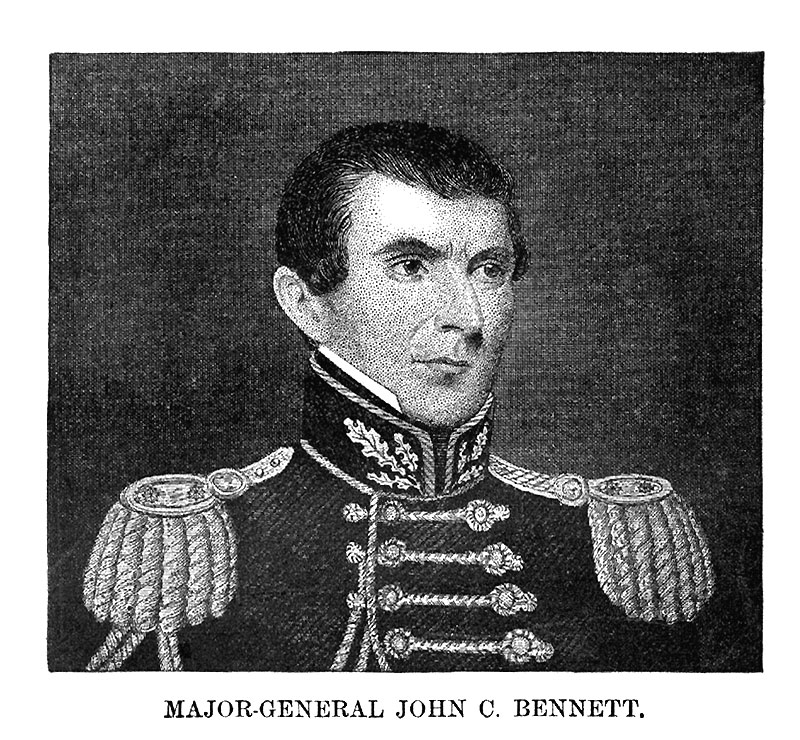
DURING the summer of 1842, an ugly storm-cloud burst upon the horizon of Nauvoo, which threatened serious disaster. A quarrel sprung up hetween the two greet leaders, Generals Smith and Bennett. The true inwardness of this quarrel was never fully known; but there is good reason for the opinion that if originated in jealousy. The city at that time contained some five or six thousand people, and was rapidly growing; yet it was not large enough for them both. Bennett had fast risen into power and greatness through the ill-advised generosity of the state government and the favoritism of the Mormon people. He was excessively vain and ambitious, and desired a greater share of the honors and emoluments than the prophet was willing to grant him. Immediately upon organizing under the charters, he had been given the two best offices, next to the supreme one held by the prophet himself. It is believed, further, that the 224 THE PROPHET OF PALMYRA. of the quarrel was not alone a jealousy of each other's power and influence; but that a jealousy resulting from quite another cause had much to do with it. In fact, it is very evident from the published statements by both parties, that there was a woman or two concerned. As they had been in confidential and close intimacy before, they now became vindictive and bitter enemies. But with his usual luck, Smith held the reins of power. The Lieutenant-General out-generaled the Major-General with the masses, and the latter went down, and was compelled to leave the city. He who had so lately been basking in the sunshine of prosperity, was expelled from the church -- "seceded." he called it -- and deposed from high places which he had for so brief a period occupied. He left the city, vowing a determination to expose the wrongs and wickedness of Mormonism, and his intention to bring the prophet to condign punishment; declaring, further, that he had never been a believer, but had only joined them to acquaint himself with their nefarious designs. On the other hand, Smith and the church organs were not slow in denouncing the apostate general. If the half were true that these belligerent chiefs told of each other, they both deserved the contempt of mankind. As a general rule, and not to show partiality, the great mass of the Gentile people believed them both. [ facing 224 ] 
MAJOR-GENERAL JOHN. C. BENNETT. View high-resolution graphic. A STORM CLOUD ARISES. 225 At the time of Bennett's defection, several others of the principal men manifested a rebellious spirit; and it looked for a season as if there would be a serious disruption. Of these, Sidney Rigdon, so long the confidential counsellor of Smith, and Orson Pratt, were the most prominent. And if Bennett's stories were true, each of these, with several others, had strong private reasons for entering into the rebellion. But the power of the prophet restrained them all, and Bennett alone was turned over to the "buffetings of Satan." The fallen chief at once left the city, and proceeded to Carthage, the county seat, claiming that his life was in danger -- how truly we can only judge in the light of subsequent events. He began a series of letters to the Sangamo Journal at Springfield, carrying out his porpose of exposure. These letters were widely read and commented on. They were interesting for many purposes. First: They exhibited in strong light the character of Bennett himself. Second: Whether he was worthy of full credence or not, they portrayed the workings of that theocratic despotism which prevailed at Nauvoo. And third: They give us an idea of the sort of people he had been associating with and upholding and defending; and of the motives which actuated him and them. As literary productions they were weak, bombastic, and in bad taste. 226 THE PROPHET OF PALMYRA. Bennett, through his letters to the Journal, and the Mormons, through their organs, kept up for several weeks a terrible tirade of abuse and so-claimed exposure of villainies, ad nauseum. The Times and Seasons of July 1, 1842, contains a long article relating to the difficulty. It denounces Bennett in severe terms, charging him with falsehood, debauchery, and many other crimes; and publishes letters from abroad showing that his disreputable character was known to them more than a year before. The Master of Nauvoo Lodge of "Free and Accepted York Masons," publicly announced that Bennett had "palmed himself upon the fraternity as a regular Mason in good standing," when he was an expelled Mason, and cautioned the fraternity against him. In the organ of August 1st, may also be found a report of a meeting called to give an expression of the public mind in the matter of this grave quarrel. At this meeting, General Wilson Law offered the following resolution: "Resolved, That having heard that John C. Bennett was circulating many base falsehoods respecting a number of citizens of Nauvoo, and especially against our worthy and respected Mayor, Joseph Smith, we do hereby manifest to the world that so far as we are acquainted with Joseph Smith, we know him to be a good, moral, virtuous, peaceable and patriotic man, and a firm supporter of law, justice and equal rights ; that he at all times upholds A STORM CLOUD ARISES. 227 and keeps inviolate the constitution of this State and of the United States." Being put to vote, about a thousand, the report says, voted in the affirmative; but Orson Pratt and two or three others, voted in the negative. This temerity occasioned great surprise, and Mr. Pratt was at once subjected to a categorical examination by the prophet. His reasons for the vote are withheld in the report, but he was pressed with the following question: "Have you, personally, a knowledge of any immoral act in me toward the female sex, or in any other way?" And Mr. Pratt answered: "PERSONALLY, toward the female sex, I have not." Dr. Bennett's charge against Smith of making improper advances toward Mrs. Pratt, was that they occurred in her husband's absence from the city. The resolution offered at the meeting and which was passed so overwhelmingly, it will be observed, was presented by one of the Laws, who soon afterwards engaged in another insurrection, and reaffirmed all the charges and more, that are therein denied. The "Ladies' Relief Society" also joined with a paper, signed by one thousand ladies, attesting to the "virtue, philanthropy and benevolence of Joseph Smith." Thirteen members of the city council made affidavit denying Bennett's charges, and further 228 THE PROPHET OF PALMYRA. declaring that there was no such a thing as a Danite Society in the city, within their knowledge. The Times and Seasons for August 1st, also is largely filled with the story of Bennett's character; and to these issues of that organ and to the Sangamo Journal at Springfield, during that interesting period, we refer the reader for the whole history of the war between the two doughty generals of the Nauvoo Legion. Bennett, in his letters, made free use of the names of men high in authority in the city, to corroborate his statements, evidently expecting to draw them off. But he failed; most of them controverted his stories through the organ. Some of these denials are carefully worded, and when closely examined are found to be partly denial and partly evasion. Others are more direct, and embrace points which a year or so afterwards were as vehemently charged by themselves. Among charges brought by Bennett against the prophet, was one of the attempted seduction of a buxom young English girl, who with her parents had not long before embraced the faith and emi- grated to the city. This girl (Miss Martha Brotherton) corroborated Bennett's charges in a pub- lished letter, giving circumstances in detail. Whether their story was true or not, it is known that the girl and her parents people of standing A STORM CLOUD ARISES. 229 and means -- left the city, and, it is believed, returned to England. An apology may seem to be necessary for occupying so much space with the quarrel between these two men. But let it be remembered that Dr. Bennett was for more than a year the second in an in position in the city, and a bright light in the church, and that he had during that time the seeming confidence of Smith and his followers; and more, that he was an appointee of the Governor of the State and of a Judge of the Supreme Court, to responsible offices. That he was a weak man and a knave, his own conduct and expose abundantly prove. How far the charges and criminations against each other are to be accepted by an honest public, we prefer to leave for the discerning reader to decide. Dr. Bennett's book, entitled The History of the Saints; an Expose of Joe Smith and Mormonism, issued soon after his defection and fall, contains this in its opening chapter: "I find that it is almost universally the opinion of those who have heard of me in the eastern part of the United States, that I united myself to the Mormons from a conviction of the truth of their doctrines, and that I was, at least for some time, a convert to their pretended religion. This, however, is a very great error. I never believed in them or their doctrines." But he claimed that he joined them in order to 230 THE PROPHET OF PALMYRA. ascertain the truth A STORM CLOUD ARISES. 231 He evidently failed |
|
320 THE PROPHET OF PALMYRA.
THE year 1844 was one of disorder and blood in Hancock County: but that of 1845 was more bloody still. At the August election of 1844, three very obnoxious men had been elected to office: Almon W. Babbitt, a Mormon attorney, and Jacob B. Backenstos, one of those much-hated men known as Jack-Mormons, to the Legislature and General Minor R. Deming to the office of Sheriff. As before, stated, the agreement entered into that no arrests should be made of the parties under indictment for the murder of the Smiths, was violated by the prosecution, and frequent attempts were made to arrest some of them during the winter by the Sheriff and his deputies. Jacob C. Davis, MORE VIOLENCE AND BLOODSHED. 321 one of them, was a Senator in the State Legislature, and at the opening of the session he took his seat in that body. During the winter he was arrested at the Capital by an officer from Hancock County; but was ordered released by a resolution of the Senate. During the session a move was made to repeal the charter of the city of Nauvoo, and on January 21, 1845, the measure passed the House of Representatives by a vote of 76 yeas to 36 nays. It subsequently passed the Senate by a large majority. The repeal was strenuously opposed by both Babbitt and Backenstos -- by the latter in a violent speech, which greatly incensed the Anti-Mormon community against him. During the winter and spring -- as a result of the unsettled condition of affairs at Nauvoo, and the consequent hard times -- there was an unusual amount of stealing done, not only in the city but in other parts of the county. It extended also to Adams, Henderson, and other adjoining counties. In Adams, where arrests could be made, there were as many as eight Mormons in jail at one time for these petty offences. In the city the two parties, :"Twelveites"and "Rigdonites," charged the offencea to each other. The nuisance became so insupportable, that public meetings were held at various points to devise means of protection and redress, 322 THE PROPHET OF PALMYRA. Township committees were appointed to collect statistics of these thefts for publication, which was done, footing up hundreds of dollars in some townships. Some of these reports, there is reason to believe, were exaggerated; but as many must have been omitted, it is safe to say the totals do not exceed the truth. Of course, it was not proven, or even known, that these depredations were all committed by Mormons, and they probably were not. The suggestion has been often made that much of this thieving may have been done on Mormon credit; which, in itself, is an admission against them; but that a large per cent. of it was perpetrated by members of that fraternity, all circumstances go to show. And events that transpired this year, show that they harbored among them men who did not hesitate at robery and assassination. On Saturday night, May 10, 1845, a horrible robbery and murder was committed near the town of Franklin, Lee County, Iowa, on the persons of John Miller, a Mennonite German minister from Pennsylvania, and Mr. Leiza, his son-in-law. The latter was not killed, but died of his wounds soon afterwards. The locality is about ten or twelve miles from Nauvoo, across the Mississippi, and the murders, three in number, were traced to that city. There names were William Hodge, Stephen MORE VIOLENCE AND BLOODSHED. 323 Hodge (brothers), and Thomas Brown. The Hodges were arrested on the 13th, and conveyed to the Iowa penitentiary at Fort Madison for safe-keeping. On the 15th, they were indicted by the grand jury in the Lee district court, then in session at West Point, and on the 21st were arraigned for trial. They asked for a change of venue, and the cause was certified to Des Moines County. On the 21st of June they were put upon trial at Burlington. They were defended by J. C. Hall and F. D. Mills, two eminent attorneys of the Burlington bar, and by Geo. Edmunds, Esq., of Nauvoo. The trial lasted about a week and ended in a verdict of Guilty. Judge Mason sentenced them to the gallows, and on the 15th of July they were duly executed. On the night of the 23d of June, Irvine Hodge, brother to the accused, was assassinated in Nauvoo, while on his way home from a visit to his doomed brothers in the Burlington jail. He had, it was said, endeavored in induce Brigham Young to send and have his brothers rescued from jail; and failing, had been free in denouncing his chief for refusing to authorize the raid. But little notice was taken in Nauvoo of this murder; no arrests were made, and no one was ever brought to trial for the crime. The perpetrator or the purpose of this murder may never be known. The "Patriarch" William 324 THE PROPHET OF PALMYRA. Smith's letter to the Sangamo Journal, dated September 24, 1846, may throw some light on the subject: "Irvine Hodge was murdered within twelve feet of Brigham Young's door. Amos Hodge, it is said, was murdered between Montrose and Nashville, Iowa (two towns across the river from Nauvoo), by Brigham Young's guard, who pretended to escort him out of Nauvoo for his safety, under cover of woman's clothes -- who then pretended that he had run away.... If Mr. Amos Hodge, the father of these young Hidges, will call and see me, I can tell him the names of persons that will put him on the track of the men who murdered his sons." But why did not Mr. Smith communicate those names to the grand jury, in order that the perpetrators of those secret crimes might be brought to justice? And why has he these long years since withheld from the public and the authorities his knowledge of the matter? Whatever he may have been then, he claims to be now a law-abiding man and good citizen, yet we never heard that he has ever given any other information concerning it, than is contained by innuendo in that letter. * On the trial of the Hodge brothers at Burlington, the accused made an affidavit for witnesses to prove an alibi, claiming to rely upon the testimony of five __________ * At the present writing, we believe Mr. Smith is still living and occupying a position of distinction in the Reorganized Church. MORE VIOLENCE AND BLOODSHED. 325 or six named residents of Nauvoo, 326 THE PROPHET OF PALMYRA. he was revived sufficiently to describe MORE VIOLENCE AND BLOODSHED. 327 and he desired others to be equally so; 328 THE PROPHET OF PALMYRA. In the autumn of this year (1845), MORE VIOLENCE AND BLOODSHED. 329 Plains region. 330 THE PROPHET OF PALMYRA. woman belonging to the family, MORE VIOLENCE AND BLOODSHED. 331 Sheriff Backenstos, at the head of his large force, 332 THE PROPHET OF PALMYRA. Wilcox, a young man from St. Mary's township, MORE VIOLENCE AND BLOODSHED. 333 is hardly to be supposed that the Mormons in that remote settlement from the city, and at a time of so much excitement against them, could be so aggressive as to commit such an act, continue reading on: p. 334 |
return to top of page
Special Collections Index | New Spalding Library | Old Spalding Library
"Home" | Bookshelf | Mormon Classics | Newspapers | History Vault
last revised: May 20, 2012